

Sound media history
This lesson introduce the history of sound media
Lecture: sound history, technology and culture
The Norwegian researcher Lars Nyre has presented these timelines of live sound media and of recorded sound media in his book Sound Media. From live journalism to music recording. Notice how Nyre makes an effort to mark mid 1870’s as a beginning in both cases. In the case of live sound media this is based on Alexander Graham Bell’s discovery of live transmission in 1875, and for recording media it marks Thomas Edison's invention of the phonograph in 1877. Before that, sound could not be mechanically reproduced and transmitted. Of course certain instruments, among them the human mouth, would be able to mimic and repeat sounds, but mechanical reproduction of sound arose in the late 19th century.
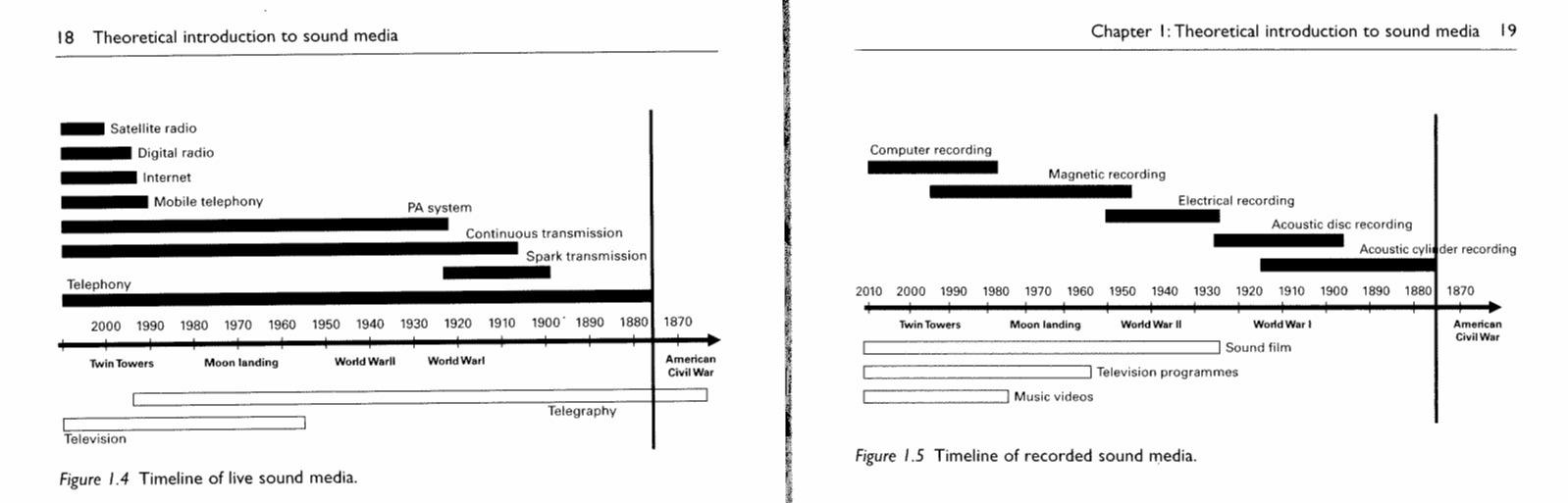 |
No doubt, the shaping of media is a process of customization, technological refinement, chance and wild ideas, which is not easily displayed in an overview like Nyre's. The sharp edges of each black box in the illustration somehow suggest that there is a clear and uncontested beginning of a medium, and that is remains stable from that point. Jonathan Sterne has investigated the cultural origins of sound reproduction in his book The Audible Past, and Friedrich Kittler analyses in Gramophone, Film, Typewriter (see the excerpt in the Sound Studies Reader) the cultural function of mechanical reproduction of sound, image and writing. Both accounts clearly show how cultural ideas for instance of memory, writing, death and entertainment interfered with the ways in which the new technologies were formed.
For a more technological timeline also check out The Audio Timeline at The Audio Engineering Society
Nyre’s illustration above is based on his “backwards history”, tracing present media back in time. It allow us to see how sound media since their emergence roughly 140 years ago have developed through several – and sometimes parallel – technologies. Not only is mechanical sound reproduction a modern thing, it is also based on a constantly developing technology and in constantly developing ideas of what a ‘sound recording’ is. Natural as it may seem to us today, sound reproduction is a highly unstable notion combining different technologies and practices. And keep in mind, that Nyre's approach starts from today and traces backwards. Other historical approaches could trace the history of almost forgotten sound technologies like the steel tape machine see fx this account of the Marconi Stille Recorder.