

Voice quality
Lecture: Different approaches to assessment of voice quality
Streaming of voice recordings: How to make categories for voice assessment in cultural studies and how to verify the consistency of them.
Since a lot of the archival voice recordings are only available for streaming or for listening on location in the archives, methods for assessment of voice quality may be useful when analysing the speaking voice. The auditory memory is very short. This makes it difficult to compare more than a couple of voices. But if the perception of the voice is placed into categories in a semantic schema and the categories are described and tested by different persons, it becomes possible to compare a large range of voices.
A snapshot from a listening situation in the DR Archive anno 2014. Some voice recordings are not allowed to leave the archive and are not digitized. Photo: A. Lawaetz
Both the field of audiologopedia and sound engineers/technicians have a method for describing the voice. The first group are diagnosing dysfunctional voices and not only do they have a vocabulary for the vocal disorder, in some countries consensus training is a part of the education as is the case at e.g. University of Copenhagen. The second group can locate the voice in a specific frequency range and manipulate it. In the archives, we are not dealing with diagnosing dysfunctional voices and a consensus-training material for voice assessment has, as far as I know, not been created. Nor is it important to manipulate the voice to achieve a certain effect when analysing the recorded voice (although in the podcast production unit this ability may be of use). What we are trying to deal with here is the ability to describe the voice qualities.
Since a lot of the archival voice recordings are only available for streaming or for listening on location in the archives, methods for assessment of voice quality may be useful when analysing the speaking voice. The auditory memory is very short. This makes it difficult to compare more than a couple of voices. But if the perception of the voice is placed into categories in a semantic schema and the categories are described and tested by different persons, it becomes possible to compare a large range of voices.
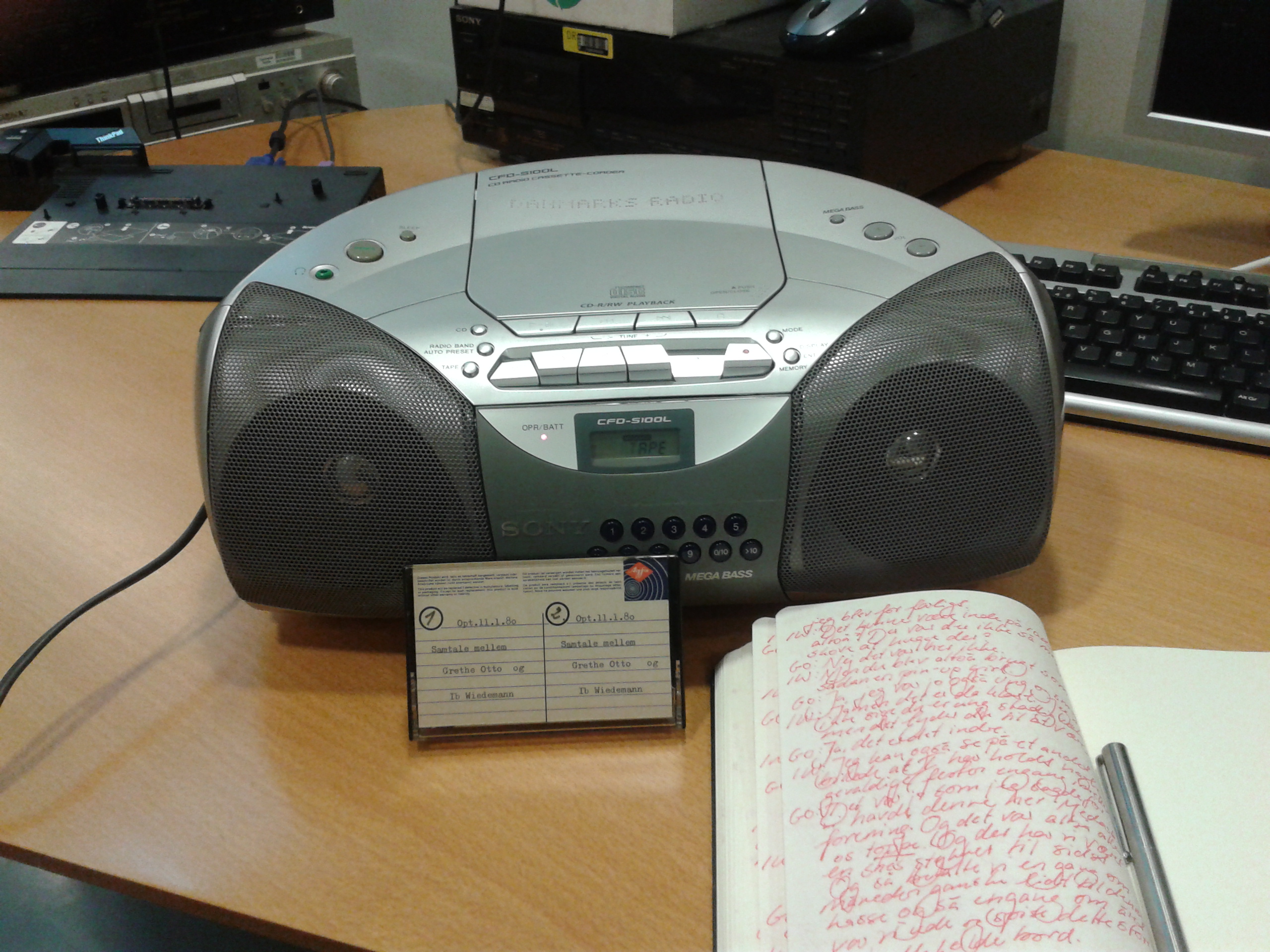 |
A snapshot from a listening situation in the DR Archive anno 2014. Some voice recordings are not allowed to leave the archive and are not digitized. Photo: A. Lawaetz
Both the field of audiologopedia and sound engineers/technicians have a method for describing the voice. The first group are diagnosing dysfunctional voices and not only do they have a vocabulary for the vocal disorder, in some countries consensus training is a part of the education as is the case at e.g. University of Copenhagen. The second group can locate the voice in a specific frequency range and manipulate it. In the archives, we are not dealing with diagnosing dysfunctional voices and a consensus-training material for voice assessment has, as far as I know, not been created. Nor is it important to manipulate the voice to achieve a certain effect when analysing the recorded voice (although in the podcast production unit this ability may be of use). What we are trying to deal with here is the ability to describe the voice qualities.