

2.3 Graphs
2.3.1 Graphs from Data
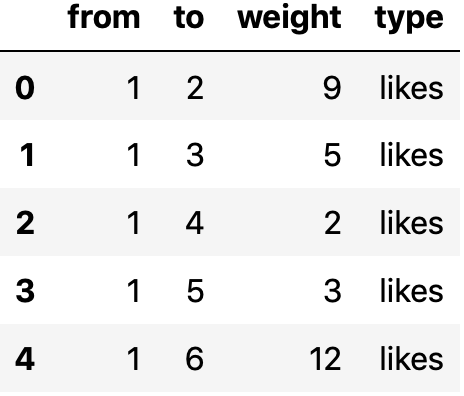
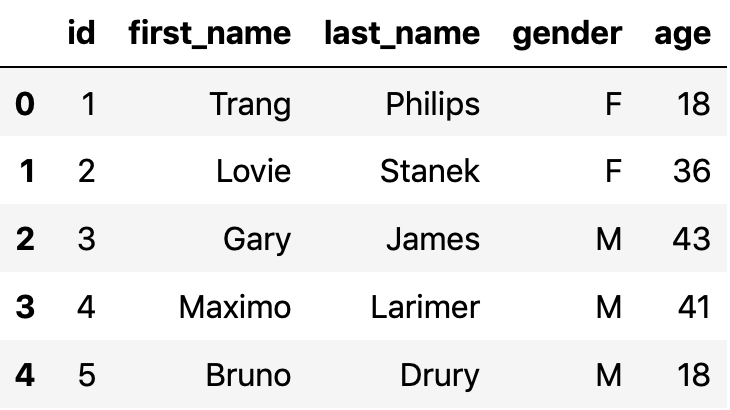
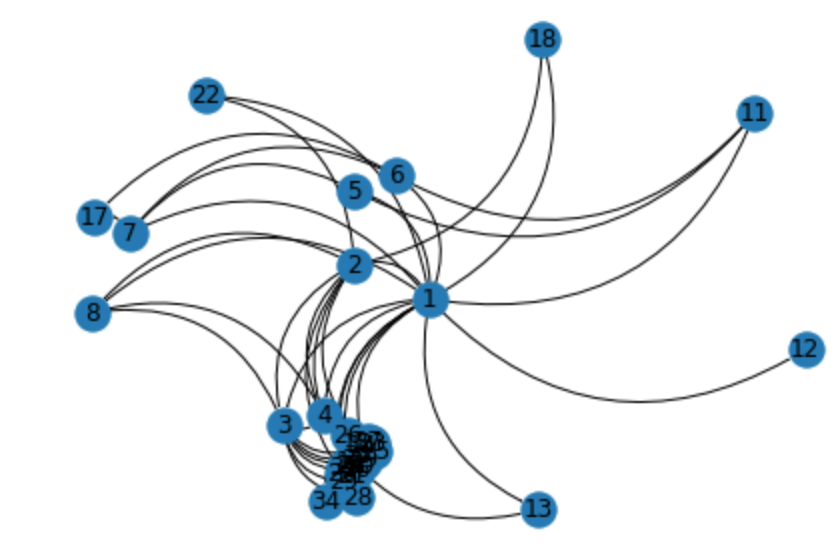
In this session, we would like to start digging into the details of (social) network analysis. Let's use a famous example from the past. Zachary's karate club is a social network of friendships of 34 karate club members at a US university in the 1970s. It is described in W. W. Zachary, An information flow model for conflict and fission in small groups, Journal of Anthropological Research 33, 452-473 (1977). It is a famous early example of successful social network analysis. Throughout the study, there was a conflict that arose between the administrator and instructor. As a result, the club ended up splitting into two groups. One group formed a new club with the instructor, while the other members either found a new instructor or stopped practising karate altogether. Based on the data collected, Zachary could accurately assign all members, except for one, to the respective groups they joined after the split (see: https://en.wikipedia.org/wiki/Zachary' s_karate_club). Let's see whether we can recreate this analysis in the notebook in Google Colab.
If you'd like to learn more about another way of analysing social networks and Netnography in particular, OER 4 has more on this.
REFERENCES
- Zachary, W. W. (1977). An Information Flow Model for Conflict and Fission in Small Groups. Journal of Anthropological Research, 33(4), 452–473.
- Zachary's karate club. (2023). In Wikipedia. https://en.wikipedia.org/w/index.php?title=Zachary%27s_karate_club&oldid=1136402443
- . Zachary's karate club. . . 30-01-2023.