

Case Studies
The Digital Grimm
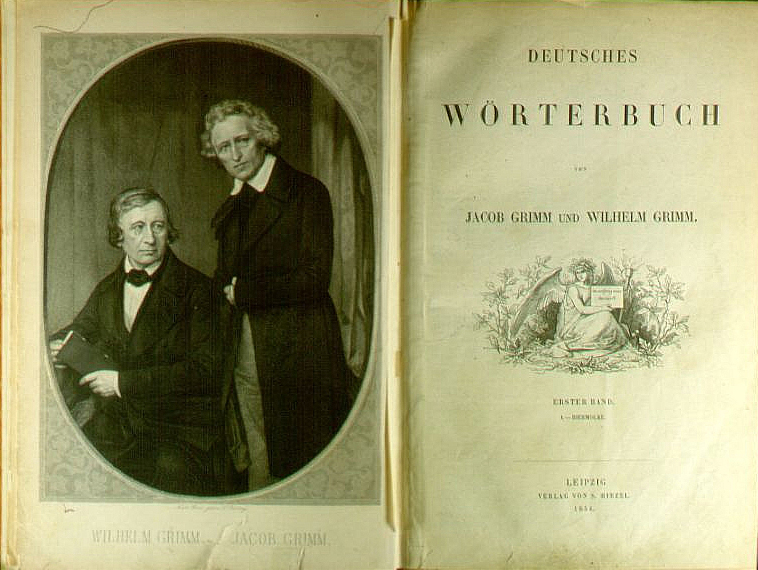
When working on the Deutsches Wörterbuch, Jacob Grimm felt depressed by his life as a lexicographer. In the preface to the first volume, published in 1854, Jacob wrote:
As if for days fine and tight flakes were falling down from the sky and soon the whole area is covered with vast snow I am quasi snowed in under the mass of words pressing towards me from all corners and crevices. Sometimes I want to get up and get rid of everything.
Dorothea Grimm, his brother’s wife, observed Jacob and Wilhelm anxiously. They have to be liberated, otherwise they will get mouldy, she thought, watching them work on the dictionary from the early morning until late at night.
The Grimm brothers did not finish their dictionary. Between 1852 and 1961, generations of lexicographers contributed to the still largest dictionary of the German language, describing more than 300.000 headwords in 16 volumes in 32 parts, which weigh about 30 kilogrammes in total. The history of the so-called Grimm is not unique in the history of historical, legacy dictionaries. Many lexicographers produced them over a long period of time. Thus, they not only collect a great deal of knowledge about languages and the world inhabited by these languages, but they also reflect the lexicographic theories of their respective time of origin. They are – like all dictionaries – related to one another in various ways, and thus implicitly form networks of information, which are not easy to explore because of the heterogeneous dictionary structures.
When the internet era began in the early 1990s, it seemed that the new medium with its hypertextual structure would fit the needs of dictionaries like the Grimm much more so than print ever could. The question was, however, how to transfer the Grimm into digital format?
From books to bytes
When a small team of digital humanists at Trier University started digitizing the Grimm in 1998, they felt like Jacob Grimm must have felt about 150 years ago. 300 million printed characters with the weight of centuries seemed to weigh down on their shoulders. A mere image digitization appeared to be the easiest way of publishing the dictionary online. That, however, would have made the dictionary only visible and browsable online. But what about making the content accessible and searchable, what about making the existing information networks alive? Should the team try to convert images into machine-encoded text via optical character recognition (OCR)?
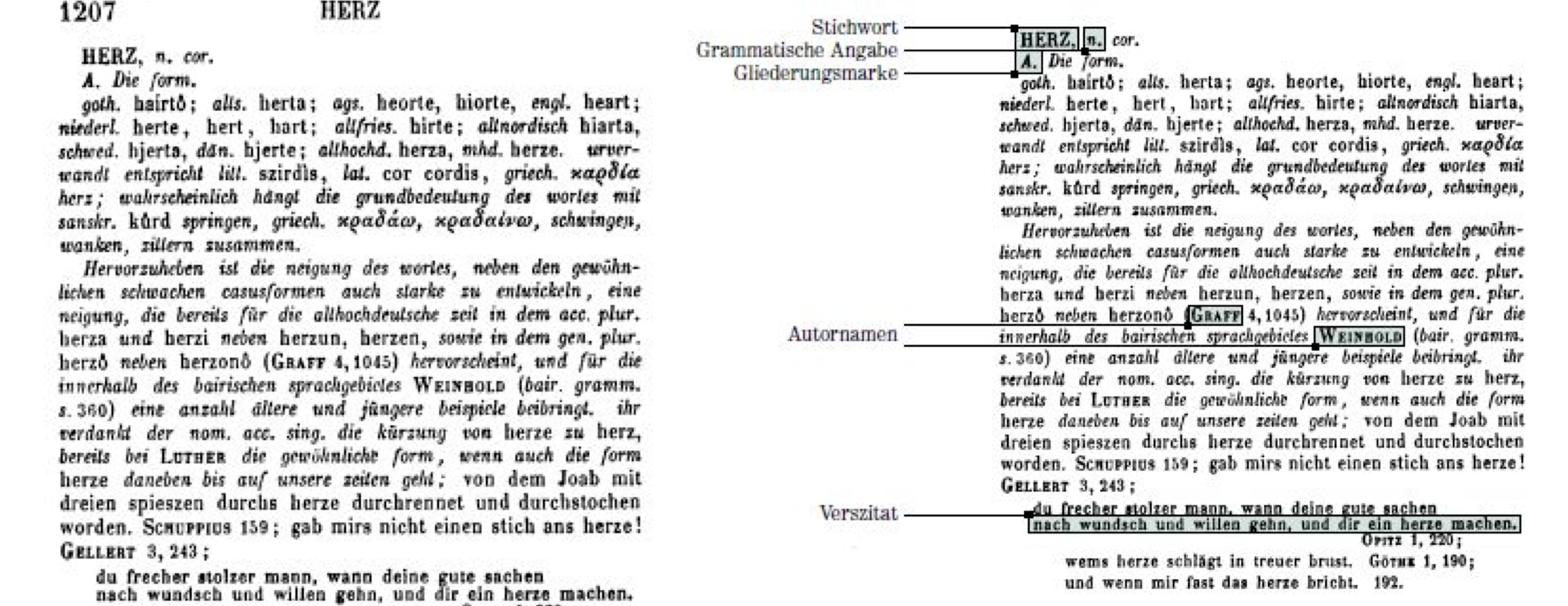
The results of several trials were utterly disappointing. The quality of the print was not good enough. Faced with more than 67.000 columns that are densely populated with about 300.000.000 poorly printed characters, partly with diacritics, partly coming from different alphabets, the OCR software at the end of the 1990s was not up to the task. It produced so many mistakes that proofreading would have been extremely time consuming and expensive.
Thus, the team decided to produce a digital version of the dictionary via double keying: the process of having each dictionary segment manually and independently retyped by two different operators, then mutually compared for mistakes. The result satisfied the academic demand and made the encoding of the dictionary in XML much easier. Two years after the beginning of the digitization process, the first volume of the “Grimm” was online and the dictionary gained new fans. The effort had been worthwhile.
Since 2003, users can explore this treasure house of the German language online.
Conversion to TEI XML
Because of the limited budget for the retro-digitization and the limited timeframe, the mark-up in TEI XML could only be done semi-automatically, following the typographical features of the print edition.
In Trier, we used a special system to do this conversion called TUSTEP:
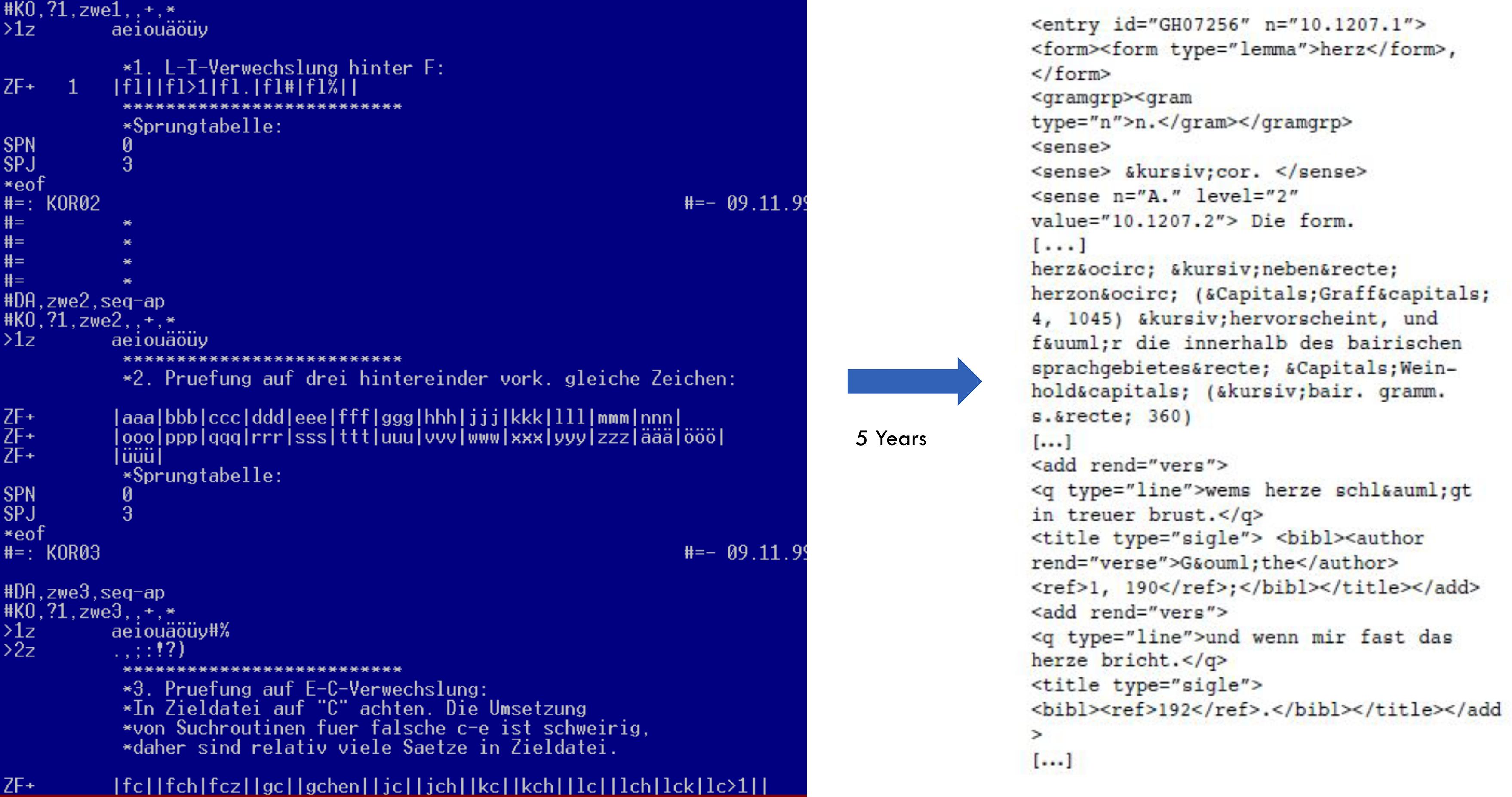
The conversion to TEI XML started a few months after the beginning of the project and lasted until the very end of the project. During the conversion process, the following structural elements were marked up:
- entries
- subentries
- headwords
- grammatical information
- sense unit as a whole
- the hierarchy of the senses,
- the names of authors quoted in the dictionary, and
- quotes taken from texts in verse.
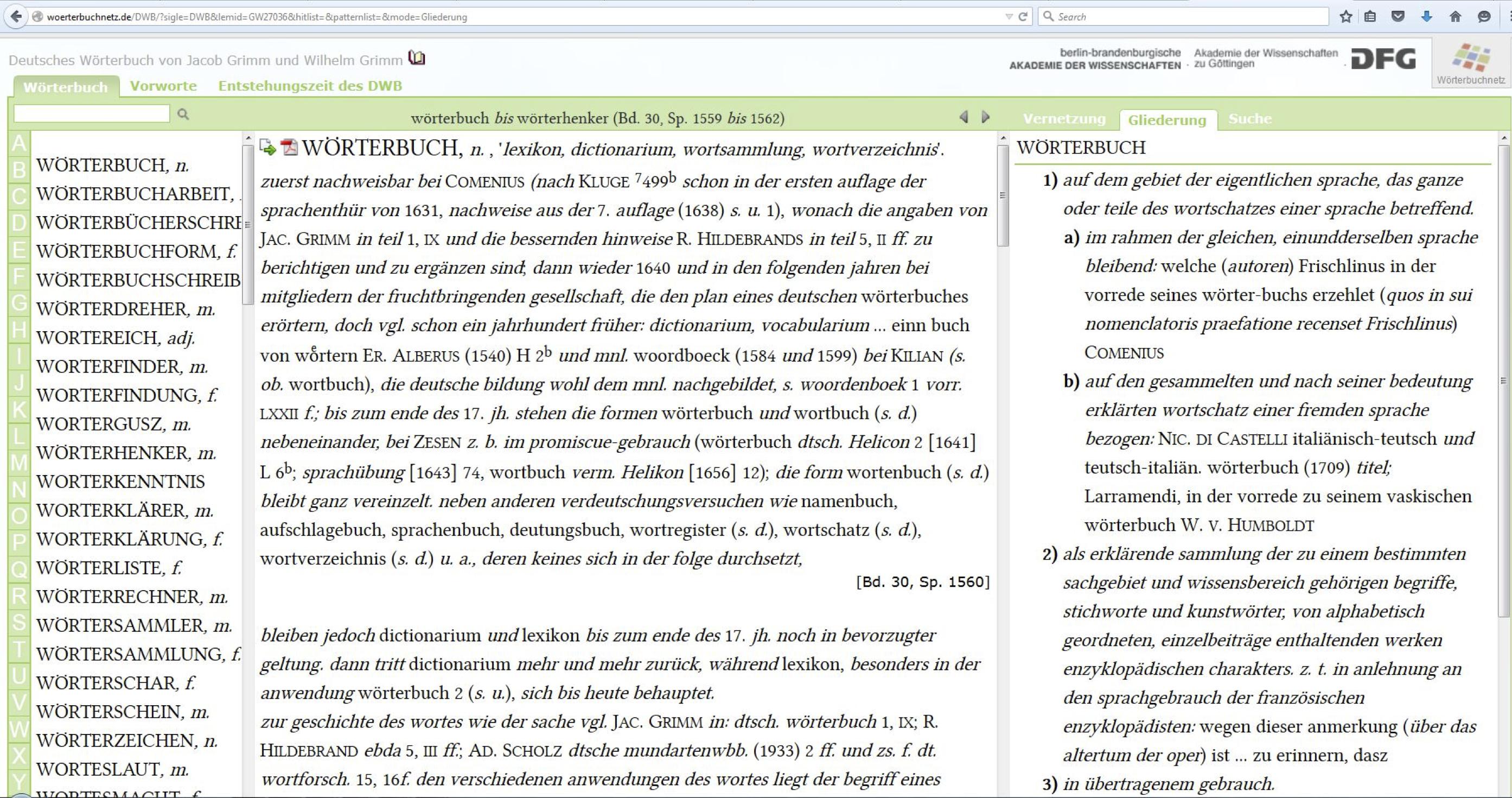
The Grimm in numbers
- written and published over more than 100 years (1852‒1961; 1971)
- 16 volumes in 32 issues + Index volume
- 67,744 columns
- more than 300.000 entries
- weighing 30 kilograms
- taking up 1.10 meters on a shelf
- digitization funded for five years