

1.1 KO and KOS
1.1.4 Types of Knowledge Organisation Systems II
On the last page, you were introduced to classification schemes and ontologies. Let's look at other types of KOS.
Taxonomies
Taxonomies have evolved significantly in the context of information architecture, in companies, or on the Web. Initially, taxonomy was seen as the study of natural classifications. (Satija, 2004; Broughton, 2015) and is now being applied in a broader sense.
Taxonomies have simple structures arranged alphabetically, usually in genus/species hierarchies. They consist of preferred terms, all linked together in a hierarchy or polyhierarchy (Zeng, 2008).
The following image shows an example of The Nomenclature for Museum Cataloging:
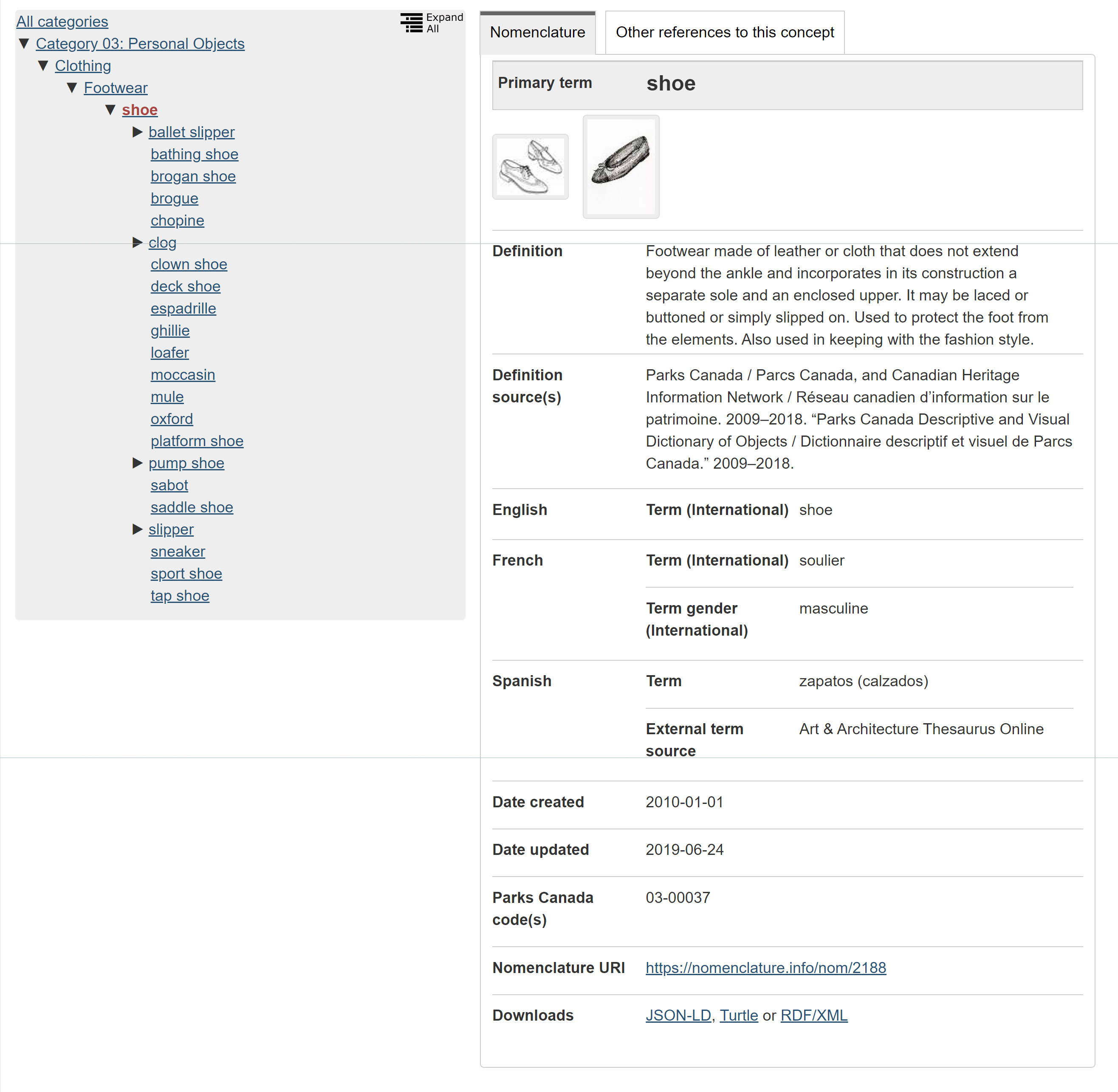
(Source: The Nomenclature for Museum Cataloging. Available at: https://www.nomenclature.info/)
Thesauri
A thesaurus is a controlled vocabulary designed to help the indexer and the searcher find the same term to represent or search for a given concept. Its origins go back to Roget's Thesaurus, a literary thesaurus designed to select words and phrases in natural discourse (see the Timeline). However, the thesauri in this course are the vocabularies designed for information retrieval.
A thesaurus is a "controlled and structured vocabulary in which concepts are represented by terms, organized so that relationships between concepts are made explicit, and preferred terms are accompanied by lead-in entries for synonyms or quasi-synonyms" (International Standard Organization, 2011, p. 12). This KOS, usually covering specialised domains, represents the relationships between terms as equivalence, hierarchical (narrower and broader), and associative (related terms) relationships.
The image below shows a screenshot of the Art & Architecture Thesaurus:
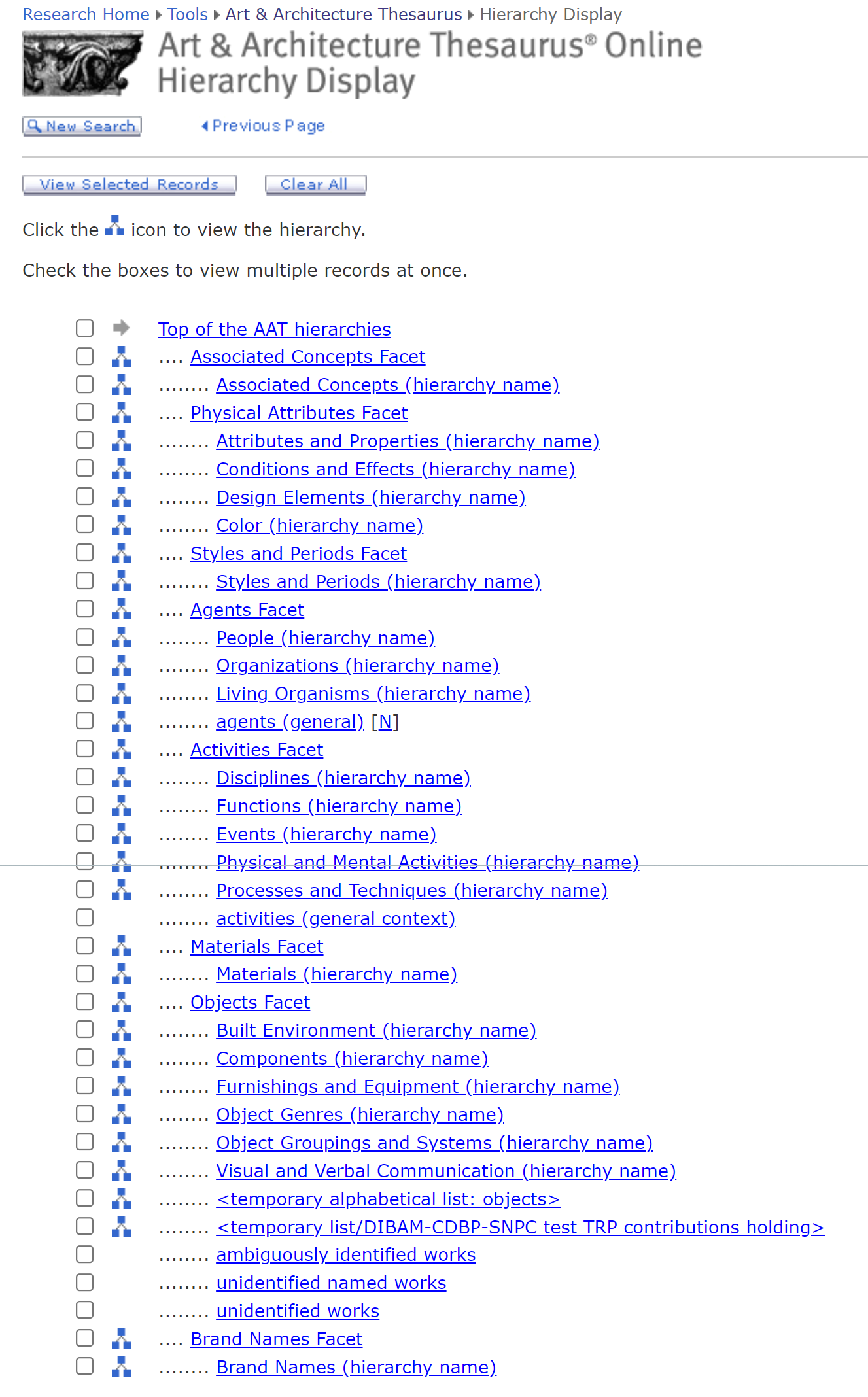
(Source: The Getty Research Institute, Art & Architecture Thesaurus Online. Digital image courtesy of Getty's Open Content Program. Available at: https://www.getty.edu/research/tools/vocabularies/aat/)
Subject Headings Lists
A subject headings list is a controlled vocabulary that expresses single and combined terms and may also list equivalent or related terms. One of the most widely used lists is the Library of Congress Subject Headings (LCSH). The first edition was published in 1914 and is continually updated. LCSH categorises topics into logical arrangements, controlling synonyms, variant spellings, and homographs. Subject headings are listed in boldface type and may consist of one or more words.
This vocabulary contains terms available for subject indexing and rules for combining them into pre-coordinated strings, and The result in practice is as shown in the following example:
Spain--History--Civil War, 1936-1939
This subject heading corresponds to the following Library of Congress Catalog record:
https://lccn.loc.gov/73175088
Gibbs, Jack. The Spanish Civil War. London, E. Benn, 1973.
128 p. illus., maps, plans, ports. 26 cm.
DP269 .G44
ISBN: 051017809X
The following image shows an example of the Library of Congress Subject Headings list:
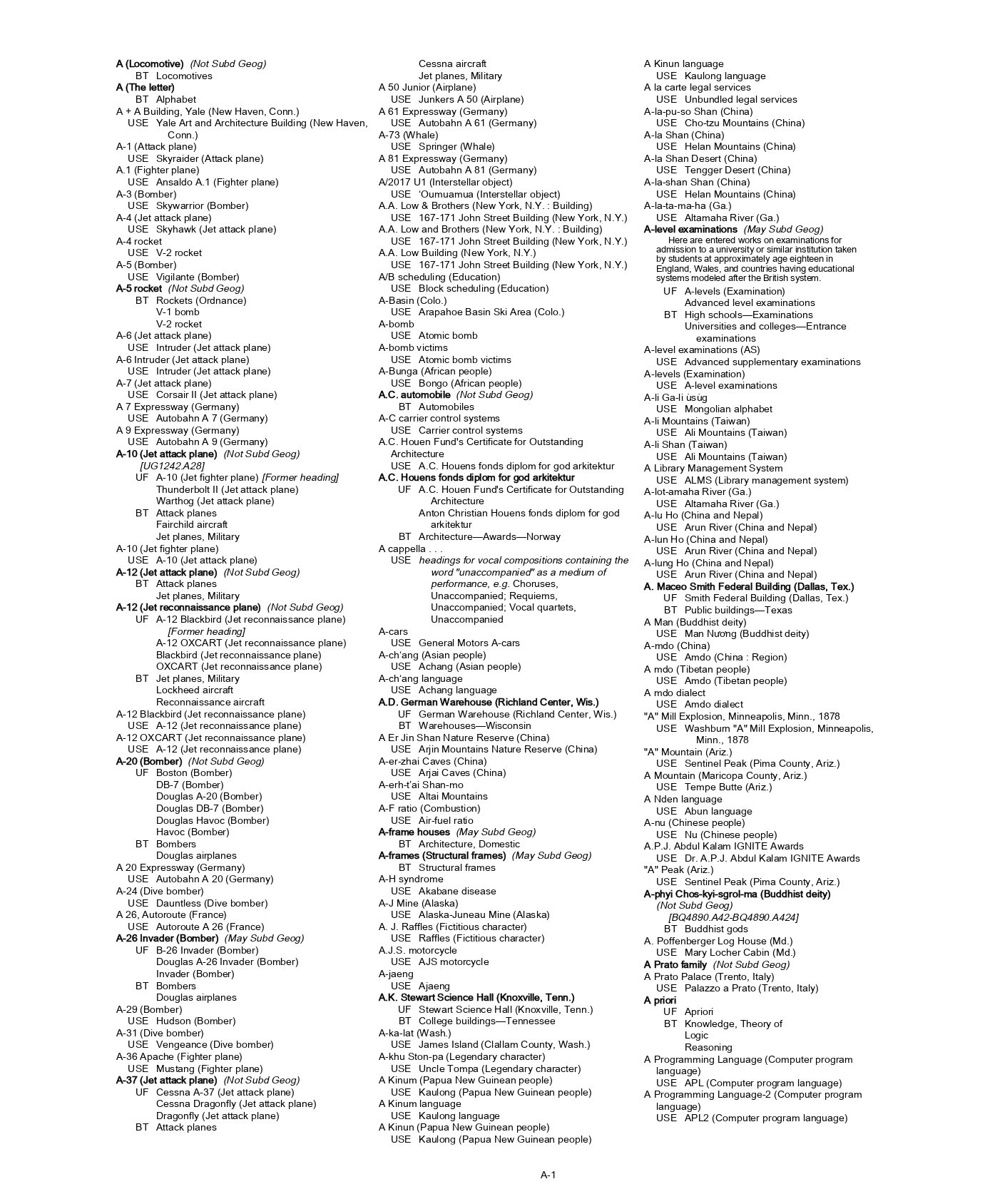
(Source: The Library of Congress, Library of Congress Subject Headings. Available at: https://www.loc.gov/aba/publications/FreeLCSH/A.pdf)
REFERENCES
- Broughton, V. (2015). Essential classification (2nd ed). Facet Publishing.
- International Organization for Standardization. (2011). Thesauri and interoperability with other vocabularies — Part 1: Thesauri for information retrieval (ISO Standard No. 25964-1:2011). https://www.iso.org/standard/53657.html
- Satija, M. P. (2004). A dictionary of knowledge organization. Guru Nanak Dev University.
- Zeng, M. L. (2008). Knowledge Organization Systems (KOS). Knowledge Organization, 35(2/3), 160–182. https://doi.org/10.5771/0943-7444-2008-2-3-160