

Unit II: Ethics, Legal and Moral Frameworks
2.5 Investigating Indentured Servitude
 |
This case study is written by Cynthia Heider, Dr. Nicôle Meehan, and Bayard Miller. The page is designed by Felix Bui.
Introduction
 Digitization has facilitated access to the historic record in unprecedented ways. Yet many records, even in their digital form, remain difficult to use. What if users had access not only to the image but also to the text within the image? It was with this in mind that the Center for Digital Scholarship at the American Philosophical Society launched its Open Data Initiative (ODI). Under this initiative, CDS staff create datasets from APS collections focusing primarily on historic documents that are rendered more useful when computer readable. Opening up these documents to computational analysis permits unprecedented access and can help us gain a better understanding of the past. However, some datasets present complex challenges that practitioners of open data must consider before releasing data to the world.
Take for example the Record of Indenture–an amazing resource of over 5,000 indenture records. Each record consists of a name, country of origin, length of contract, debt owed, and details on the terms of the indenture. This is extremely rich and valuable data. But users should be aware that each data point actually represents real human beings, who lived real lives, often under great duress. In most cases, the only information we have about them was captured, without consent, by someone who held a significant amount of power over them.
| Click on the hotspots to explore these indentures from the “Record of indentures of individuals bound out as apprentices, servants, etc., and of German and other redemptioners”. (Source: The digital collection Investigating Indentured Servitude: Visualizing Experiences of Colonial America) |
Data is great for producing new scholarship and facilitating conversation. It can also reinforce structural harms, biases, and inequalities. Approaching data with empathy has become the guiding principle of the ODI. This case study highlights Investigating Indentured Servitude: Visualizing Experiences of Colonial America, a digital project that takes a humanistic approach to open data and explores what it means to represent the human experience quantitatively.
| Learn more about what Indentured Servitude is and how it is different from slavery. (Source: The digital collection Investigating Indentured Servitude: Visualizing Experiences of Colonial America) |
Legacy Data and Data Legacies
CDS had previously produced structured data versions of historical documents to increase their accessibility, including records from Eastern State Penitentiary and the postal records of Benjamin Franklin during his tenure as Postmaster of Philadelphia. These data projects had complexities, but the data behind the ODI project that became Investigating Indentured Servitude: Visualizing Experiences of Colonial America was much more challenging and required more nuance in approach. Sourced from a historical document entitled “Record of indentures of individuals bound out as apprentices, servants, etc., and of German and other redemptioners, 1771 October 3 - 1773 October 5,” some of the hurdles we faced turning this document into structured data involved missing, incomplete, and/or inaccurate entries as well as contemporary power differentials which influenced the data’s original collection. Therefore, a careful approach was necessary not only to ensure the integrity of the data produced and the knowledge derived from it but also to facilitate a humanistic process that we hoped would minimize any perpetuation of harm embedded in the original records.We had to confront these hurdles early on. The transcription process of the Record of Indentures ledger revealed something that often doesn’t become visible until the analysis/knowledge production stage of dealing with data: the subjectivity of the information at hand. Firstly, a number of pages missing from the ledger as well as some hard-to-decipher handwriting necessitated the supplemental use of a previously published version of the ledger, put out by the German Society of Pennsylvania (GSP) in 1907. Created primarily for use by genealogists, this volume was differently structured and did not include all information fields present in the original ledger. A close comparison also revealed alteration of the ledger’s contents in the GSP volume - one example being the omission of the names of women, sometimes recorded simply as “wife.” The context of the GSP rendering of the ledger’s data is now apparent, it was easier to see the biases, limitations, and embedded power relationships therein.
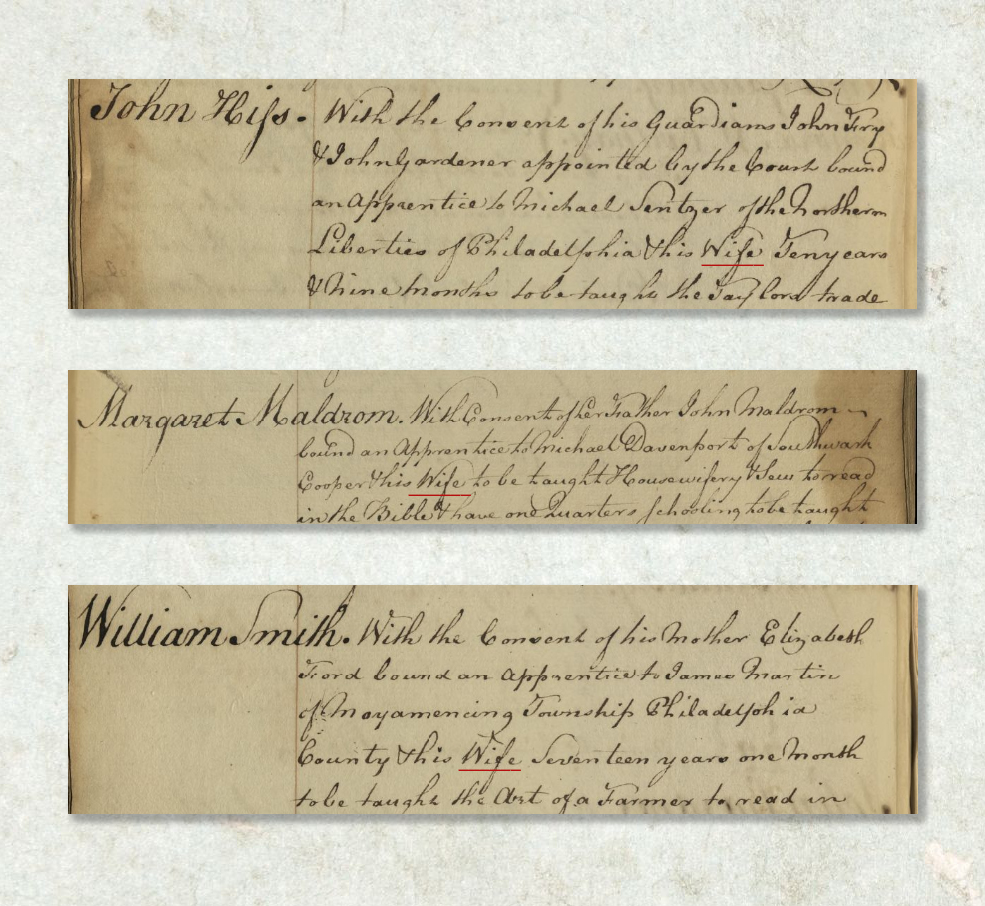 |
| The women’s names in the ledger were often neglected and recorded simply as “wife”. Indentures from the “Record of indentures of individuals bound out as apprentices, servants, etc., and of German and other redemptioners”. |
| Listen to Dr. Loukissas talk about the difference between data sets and data settings, and why it matters. |
Humanistic Approaches to Data
Each visualization thus acts as a window into the dataset, serving as a source of historical context, and each personal story serves as a mechanism to counteract a perceived absence of emotion that visualizations can facilitate. The Record Book of Indentures is filled with feeling; the pages capture the experience of five thousand individuals during a time in their life that would likely have involved a complex mix of emotions; hope, anxiety, sorrow, adventure, and hardship; their journey being far more than a line or dot in a visualization. To elide this fact would be to present only partial truth.
 |
| These charts demonstrate the number of years each person had to serve under the contract of indenture. (Source: The digital collection Investigating Indentured Servitude: Visualizing Experiences of Colonial America) |
To best illustrate our approach to humanizing this dataset, we can turn to the case of Catherine Biesman whose contract of indenture was unusually long at 26 years, a fact that became clear in the production of the visualization above. Catherine’s record below shows that on August 1, 1772, she was indentured as a servant to James Smith, a contract that turned out to be a continuation of an initial agreement signed on September 17, 1771, with George Michael Kraft.
| Click on the hotspots to learn about the case of Catherine Biesman whose contract of indenture was unusually long at 26 years. (Source: The digital collection Investigating Indentured Servitude: Visualizing Experiences of Colonial America) |
Conclusion
This case study has shown just one approach to open data. We were, and remain, excited about the potential uses of this data as it has the potential to tell thousands of stories and reveal new knowledge about migration, labor, and exploitation. However, the data can be extremely sensitive and we are both aware and concerned about the risks of excavating it from historic documents. While we offer a humanistic and empathetic approach to this data, on the other hand, it has the potential to be used for the wrong reasons. Such is the nature of data and of archives.Author Bio*:
Cynthia Heider is the Public Digital Scholarship Librarian at the University of Pennsylvania, where she works to initiate and support digital projects, scholarship, and programming that center community partnerships and public engagement. She previously worked as a Digital Projects Specialist at the American Philosophical Society Library & Museum. Cynthia holds a Master's degree in public history from Temple University and a BA in history from Goucher College.
Dr. Nicôle Meehan is a Lecturer in Museum and Heritage Studies at the University of St Andrews. She teaches and conducts research in digital museology, focusing on digital access and digital exclusion, and paying particular attention to digital colonialism. Current research examines the value-based judgments enacted by museums in the use of digital technologies in relation to the climate crisis.
Bayard L. Miller is the Associate Director of Research, Engagement, & Technology at the American Philosophical Society. He oversees the Center for Digital Scholarship and has managed major digitization and digital humanities projects for over ten years. He holds an M.A. in Public history and archives from Temple University’s Center for Public History.
Designer Bio*:
Felix Bui is currently a junior lecturer at the Faculty of Arts & Social Sciences at Maastricht University. She teaches courses about the history and development of AI, the philosophy of technology, and research skills. She holds a master’s degree in Media Studies: Digital Cultures and a background in Marketing & Communication. Her research interest involves AI and creativity, mediatization and media representation of queer communities, data and media ethics with a focus on diversity and inclusivity.
References
- Boyd Davis, Stephen, Olivia Vane, and Florian Kräutli. ‘Can I Believe What I See? Data Visualization and Trust in the Humanities’. Interdisciplinary Science Reviews 46, no. 4 (2 October 2021): 522–46. https://doi.org/10.1080/03080188.2021.1872874.
- D’Ignazio, Catherine and Lauren Klein. Data Feminism. Cambridge, MA: The MIT Press, 2020.
- Loukissas, Yanni. All Data Are Local: Thinking Critically in a Data-Driven Society. Cambridge, MA: The MIT Press, 2019.
- Otty, Lisa, and Tara Thomson. ‘Data Visualisation and the Humanities’. In Research Methods for Digitising and Curating Data in the Digital Humanities, edited by Matt Hayler and Gabriele Griffin, 113–39. Edinburgh: Edinburgh University Press, 2016.