

Unit II: Ethics, Legal and Moral Frameworks
2.9 Global Digital Humanities Symposium
 |
This case study is written by the following authors (in alphabetical order): Taylor Hughes-Barrow, Arun Jacob, Viola Lasmana, Kristen Mapes, and Kate Topham. This case study is designed by Emma Prebreza and Claudio Lo Sciuto.
Introduction
 |
 |
Founded in 2016 at Michigan State University (MSU) in East Lansing, Michigan, the Global Digital Humanities (DH) Symposium began as a forum showcasing DH projects at MSU in conversation with external keynote speakers working in the intersections of the digital humanities and global issues. Since then, the Symposium has grown to include keynote speakers and presenters from around the world, as well as a dynamic Planning Committee that comprises MSU and non-MSU affiliated individuals. Through its values and actions, the event has cultivated a community which continues to simultaneously deepen and expand.
We are a DH community grounded in social justice ethos and praxis, reflected not only in the content of our symposia (with topics ranging from digital activism, climate justice, digital storytelling, anticolonial frameworks, feminist pedagogies, Indigenous rights, to archives and preservation), but also in the administration, planning, and execution of the Symposium itself. The ongoing and behind-the-scenes work to create the Symposium is as deeply important as the presentations and discussions featured during the event. The making of our Global DH Symposium is, in fact, a digital humanities project, an activation of social justice work, and a manifestation of digital humanities infrastructure and ecosystem.
 |
In this case study, we will share several areas of Symposium planning and management that exemplify the ways that we create this event and how our values are infused into the decisions and priorities that we make.
Conference-Making as Digital Humanities Work
Conferences are critical infrastructure for the facilitation, curation and creation of knowledge through which scholarly communities coalesce to inspire and empower each other to enact positive change. Considering the centrality of conference attendance, presentation, and post-event publications to the development of the scholarly record and in determining scholarly reward, critiques of the power and structures of conferences (Eichmann-Kalwara et al. 2019; Estill et al. 2022; Nebiolo and Palermo 2019) are crucial to advancing an ethical field and holding infrastructure accountable to the community.
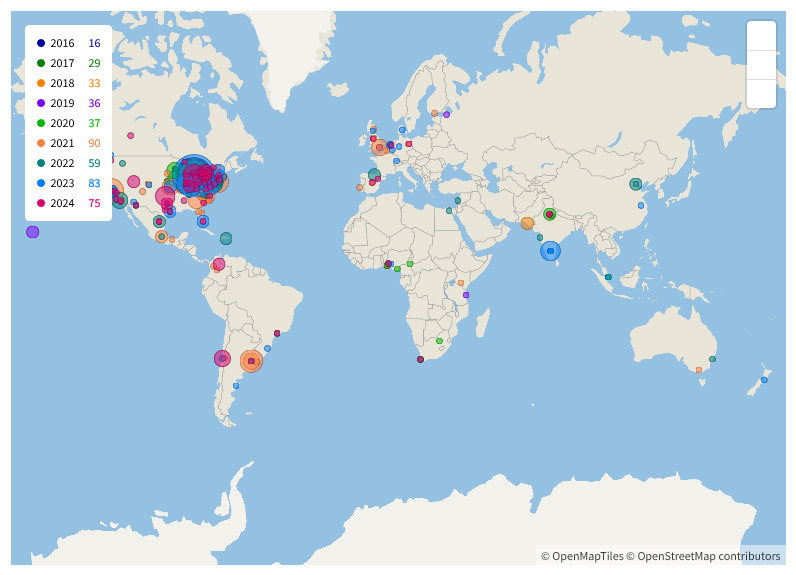 |
| Figure 1: Presenters are located across the world (location determined by institutional affiliation at the time of presentation |
The labor involved in the planning, organizing and executing conferences is rarely discussed as a form of digital humanities praxis. The growing episteme of critique and reflection on how DH conferences are operationalized makes clear how “inclusive representation and community diversity” are enacted and need to be thought through and overhauled (Gao et al., 2023). In 2015, digital humanists Domenico Fiormonte, Teresa Numerico, and Francesca Tomasi envisioned that within the next ten years, the field of digital humanities would see geographic expansion and the inclusion of non-Western perspectives. That decade is nearly complete, yet their vision is yet to be achieved. DH conferences, in particular, still favor white male presenters and European-focused perspectives (Eichmann-Kalwara et al., 2019).
Social Justice as an Imperative for Digital Humanities Conference Work
The Global DH Symposium seeks to showcase social justice-oriented and globally engaged DH works through its program while also making ethically grounded decisions in cultivating community and planning the event. With social justice as a foundation to our digital humanities conference work, we strive to make the event as global as possible. This means seriously considering what the global means in both its limitations and possibilities: understanding the problems, frictions, inequalities, and injustices that globalization brings while at the same time acknowledging the potential of a networked world made possible by digital technologies.
While many conferences in North America, historically and traditionally speaking, reinforce the marginalization of diverse voices by centering specific kinds of perspectives (often, these tend to be male and white-centric), we intentionally set out with the commitment to creating a conference that pays attention to digital humanities works with social, cultural, and political concerns indispensable to their core. We also make it a point to highlight works that may not have received much visibility in the digital humanities field or that may not be labeled as such given the field’s uneven developments in different places, especially the “Global South.”
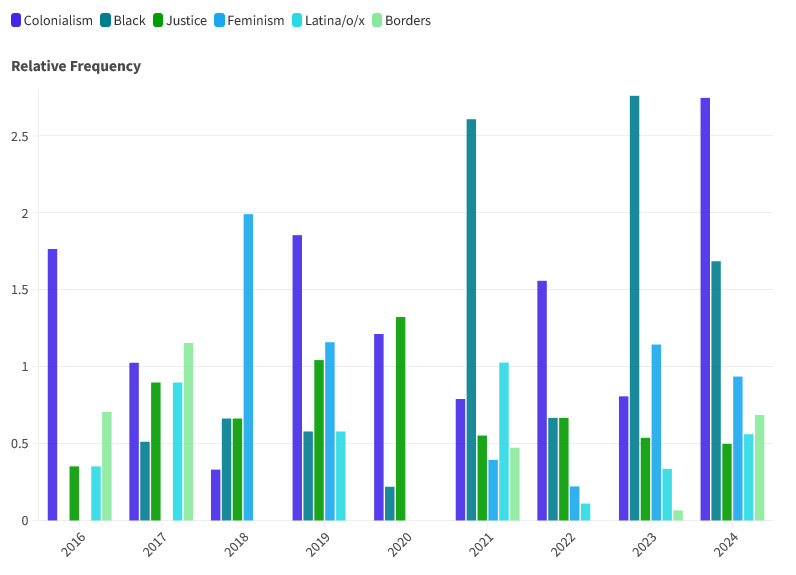 |
| Figure 2: Social justice word frequencies in Symposium abstracts, 2016-2024 |
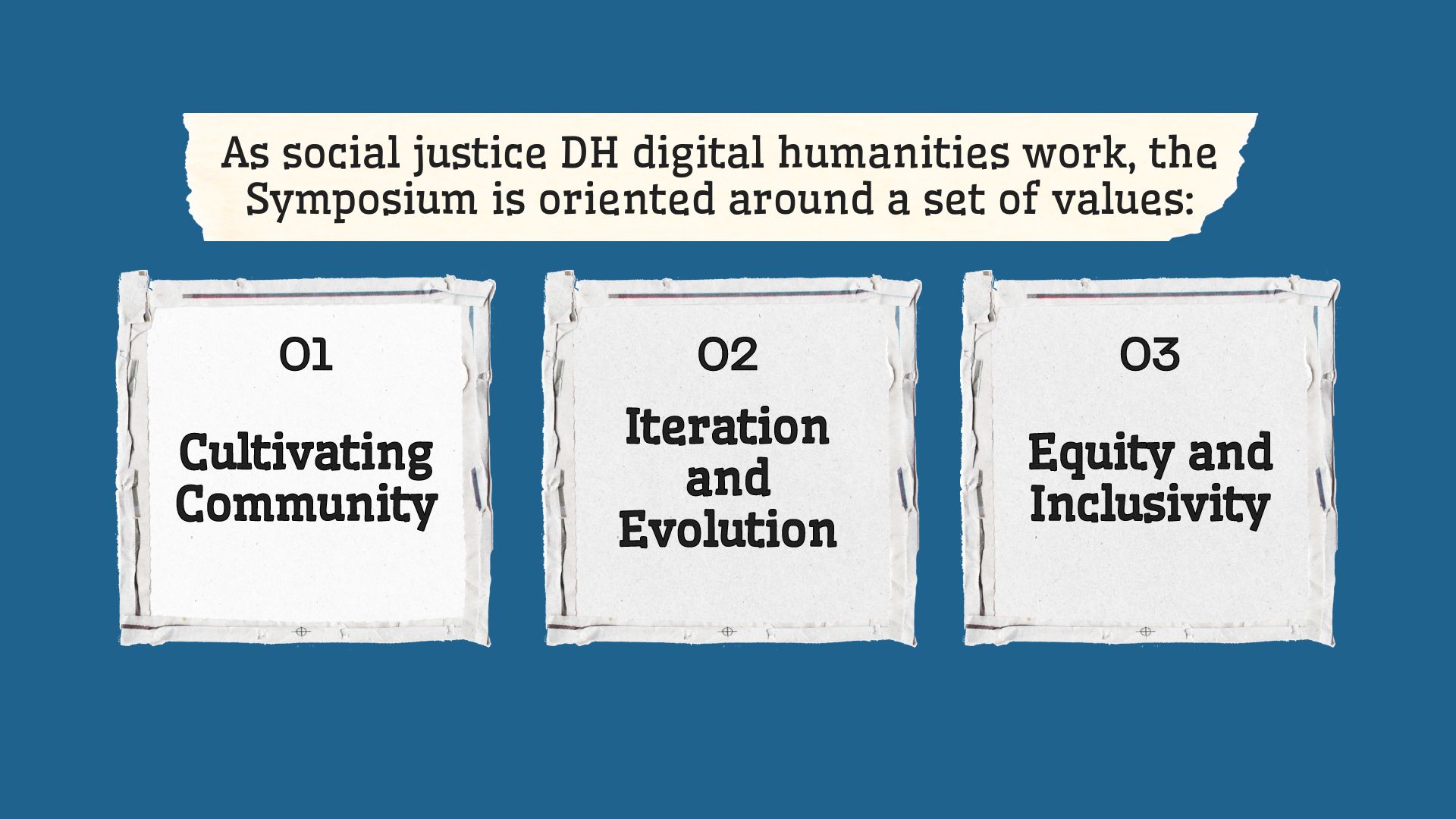
As a conference community that continues to grow and learn together, we understand that social justice-oriented work is not without its challenges and is always ongoing. In an effort to adhere to our imperative of social justice, these are the key values that guide our practices.
This is about some of the ways we are attempting to dream ways to access care deeply, in a way where we are in control, joyful, building community, loved, giving, and receiving, that doesn’t burn anyone out or abuse or underpay anyone in the process.
- Leah Lakshmi Piepzna-Samarasinha, Care Work (2018)
| Figure 3: A selection of presentations from 2021-2023 |
Cultivating Community
The Global DH Symposium community is at the heart of everything we do. To enact and sustain social justice work, one first needs community. Building community is iterative and takes time: over the nine years since the Global DH Symposium was founded, we have cultivated a strong and vibrant network of Global DH scholars and practitioners of all levels through our annual meetings. Our consistent efforts at creating community is reflected in the number of people who return to propose, present, review, and attend year after year, in addition to the influx of new participants that every annual meeting brings.
Iteration and Evolution
Each year, we recruit new voices (reviewers and committee members) and retain existing ones in order to have longevity, as well as always to gain fresh perspectives. Our Planning Committee reflects this continuity and diversity, with some committee members being long-time participants of the Symposium and some being newer ones. For us, iteration and evolution means that we are always learning and trying to improve -- reinvention does not always have to be invention. We are not trying to dominate the field and not looking to be the largest conference in digital humanities; in fact, we have kept our conference intentionally small, allowing for experimentation and enabling deeper relations.
Equity and Inclusivity
Over the years, we have foregrounded an ethos and praxis of care at every level of running the Symposium, from pre-Symposium planning to post-Symposium reviewing: this is a vital part of equity and inclusivity being the foundations of our programming. Practicing equity and inclusivity with care takes various forms, ranging from having a set of external reviewers to help in ethical decision-making, to implementing a non-hierarchical conference, to increasing accessibility through linguistic and time zone multiplicities, and finding creative ways of fostering community beyond presentations through activities like trivia games, especially when the COVID-19 pandemic challenged how we facilitated social interactions in our virtual conferences.
Part of our work in equity and inclusivity is activating a feminist approach to making labor visible and known. In staying true to the roots of the meaning of collaboration, as both a working together and a word that has embedded within it the word labor, we strive to always accomplish best practices in appreciating and rewarding the contributions of everyone who makes this community and conference possible: the committee members, the reviewers, the translators, and the participants.
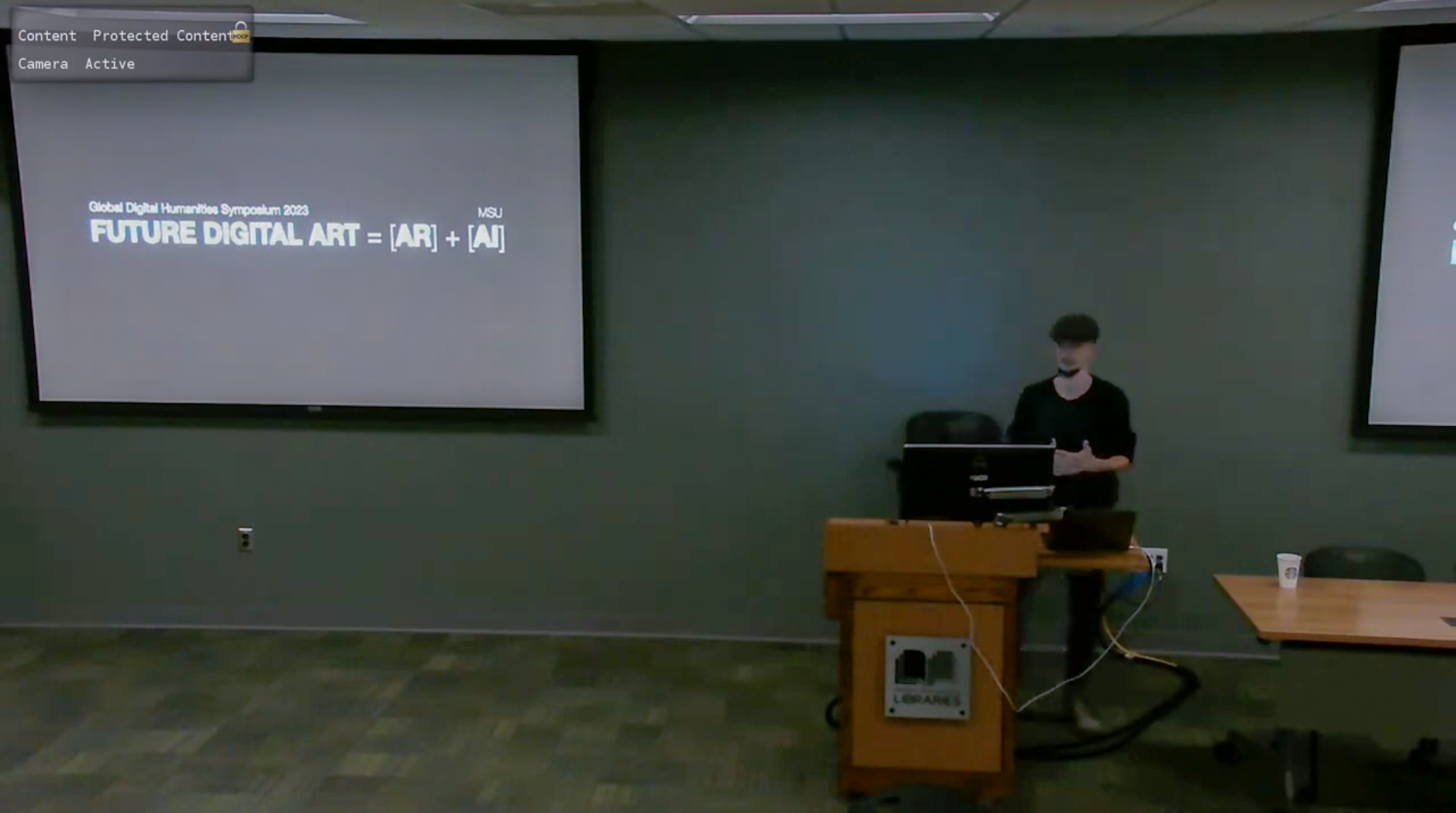 |
| Figure 4: João Beira at the Symposium 2023 during his presentation “Merging the physical with the digital: A case study for the future of digital Art”. You can watch the live recording here |
Values in Action
Planning Committee
Our Planning Committee is made up of a non-hierarchical group of scholars, librarians, archivists, postdocs, faculty, and undergraduate, high school, and graduate students from across and outside the United States, regardless of affiliation and position. The variety of backgrounds within the committee -- including new and rotating members -- allows for the Symposium to uphold its key values and ensures heterogeneous perspectives. As a committee with diverse sets of expertise, we work together in coming up with potential keynote presenters, brainstorming conference activities and engagement, and crafting the program. At the core, we are always aiming to improve how we enact our three key values.
In 2021, we launched the formation of four subcommittees within the Planning Committee, with members working collaboratively through monthly virtual meetings: Content and Publications, Technology and Volunteers, Communications and Community Building, and Local Planning. Part of our evolution as planners of the Symposium has also included experimenting with different platforms (e.g., Trello, Slack, etc.) to better manage our organization and communication.
As a global committee, we have been confronted with the following challenges: time commitment, working across time zones (US, Europe, Asia, Africa, etc.), and how to overcome practical barriers such as tax issues when sending honoraria to committee members who are not based in the United States or who have visa restrictions that restrict receiving an honorarium. The committee is a crucial component to the success of the event and serves as a nexus of community building, but supporting deep engagement is difficult amidst everyone’s limited time. Combined with the aforementioned logistical challenges, these challenges mean that we must continue to iterate to find the balance between facilitating enticing, enriching work and making the conference happen.
Making the Program
We welcome reviewers from around the globe (in 2024, we had a total of 50 reviewers). Each year, we invite all presenters and reviewers from the previous Symposium to become involved in the community by reviewing submissions, and we open the review opportunity to members of the Global Outlook (GO:DH) community. Additionally, we invite reviewers into the program decision-making process. This opportunity gives people an on-ramp for getting more involved in the formal planning process, and it opens up the ways of conference/academic thinking to newcomers. Finally, it brings in new voices to keep our program-planning informed by expertise from around the world.
The Symposium ran using a double-anonymous review process from 2017-2023, during which time we relied on the invisible volunteer work of several dozen reviewers as well as a laborious by-hand matching system. For the 2024 Symposium, we adopted Oxford Abstracts as a system for handling submission, reviews, registration, and communication. This system allowed us to shift to an open review process and to provide reviewer feedback to submitters. The transparency afforded by the review process improved the experience for reviewers and provided valuable insight to submitters. In the words of one of our reviewers (shared anonymously through a feedback survey): “The review process was clear and transparent; the review portal was accessible and easy to follow along; and the nesting of each of these components within the overall symposium organizing was an excellent way to model an inclusive and generative space for discourse-and community-building across both geographical and disciplinary difference.”
We engage reviewers in the program-creation process further by inviting them to the “decision-making days,” when all planning committee members and reviewers are welcome to join the virtual sessions in crafting the program and determining acceptances and rejections of submissions. Over two days, we use Zoom and an export of submissions and reviews on a Trello board, and we work through each submission together -- a human-driven and engaging (and exhausting) process of paring down the list of submissions and creating the program. Reviewers get a window into how the Planning Committee works and gain a sense of transparency and agency in their relationship with the Symposium through this opportunity. For the Planning Committee, we benefit from these additional perspectives and voices as we make decisions toward final implementation of the program.
Multilingualism
The pandemic prompted a major shift for the Symposium in many ways. After recovering from our lightspeed pivot to Zoom in March 2020, the planning committee investigated what opportunities an all-virtual conference could provide. Up to that point, the conference had always been exclusively in English. Given the value we place on building a global community, this was a significant limitation. However, with a conference entirely on Zoom, we could leverage the platform’s interpretation features and put funds freed up from travel and catering expenses towards hiring interpreters.
At the time, there were few conferences that were conducted in multiple languages. DH2020 in Ottawa was intended to be multilingual but had been canceled due to the pandemic. We reached out to our DH community and our local community at MSU with the goal of finding collaborators. We strove to find people we could learn from so that we could support our interpreters in their work while staying within our budget. We connected with Melissa Jameson, a professional Spanish-English interpreter who was instrumental in guiding us through the process of building multilingual infrastructure. She helped us understand the norms and best practices of the field and gave us a roadmap for how to support our other interpreters.
| Figure 5: The proceedings website showcases presentation materials across presentation languages and types |
Since then, each year the planning committee has reflected and iterated the (often imperfect) ways we support multilingualism at the Symposium. Since the first year, we have supported interpretation between Spanish and English. For the first two years of our multilingual endeavor, we also supported French-English interpretation with an eye towards supporting scholars on the African continent. However, over the course of those two years, we received very few proposals in French and little indication that participants were tuning into the French language channel in Zoom. It became clear that French wasn’t expanding our reach in the ways we had hoped. In 2022, we decided to experiment with supporting Mandarin Chinese after hearing that the Symposium was promoted on WeChat in Chinese-speaking DH circles. However, Chinese proved to be a more challenging language to build infrastructure for. We had fewer connections to speakers in that community and relied on relative newcomers to the field. While we were happy to provide opportunities for new interpreters to gain valuable experience, our small team needed to put in too much labor for the quality of translation, especially considering the low demand for it that we were seeing. We made the difficult decision to make the 2024 Symposium bilingual in Spanish and English only, with the plan of deepening our engagement with Spanish-language DH communities.
Running the Event
As a one-of-its-kind DH symposium, we are committed to planting and growing the seeds of transformative, emerging, and nascent Global DH work in the world. To that end, our presentations are all plenary -- not only does this allow for greater visibility and equity, making the sessions plenary also means increased engagement and collegiality. When the COVID-19 pandemic prompted a shift to a virtual event, we also provided human-created captioning.
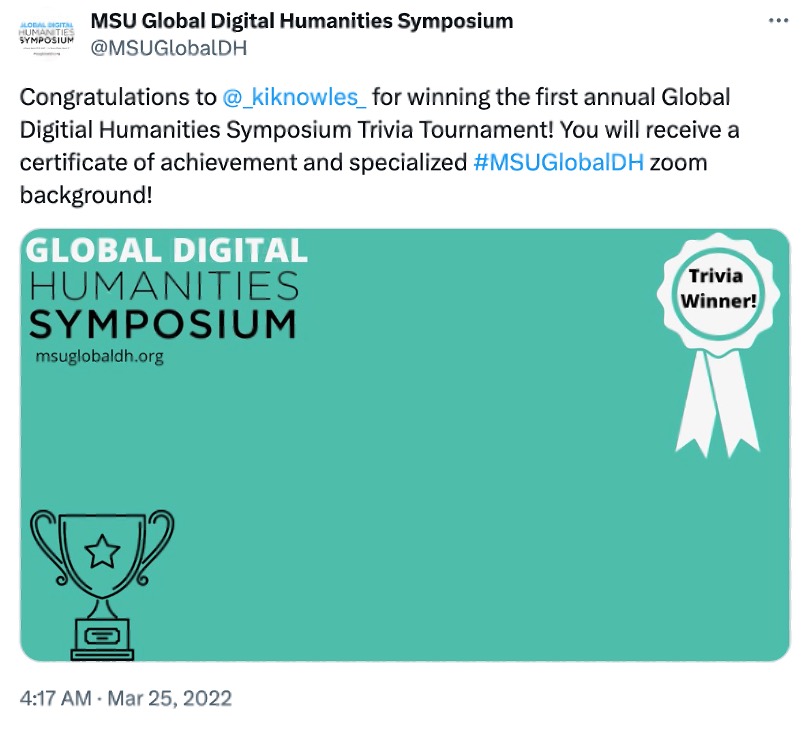 |
| Figure 6: Screenshot of Tweet acknowledging Trivia winner from 2022 Virtual Symposium |
The Symposium has always – and will always – offer free registration. For in-person days (the Symposium was entirely in-person from 2016-2019 and has returned to offering an in-person day since 2023), we take seriously the role that hospitality, space, and tone play in building community during a conference, so we work to offer low-cost to no-cost accommodation, provide delicious food to suit all dietary needs, and build comfortable spaces for conference discussion. The in-person event has also always been live-streamed, so that the work of presenters can be shared more widely. The Global DH Symposium, therefore, functions as a global and local event, with a priority on an ethics of welcome and openness as our guiding principle.
| Figure 7: Slide to reveal the physical location of the Global DH Symposium and souvenirs for face-to-face attendees. |
Cultivating Artifacts of Global DH Work
Conference presentation is a valuable component of scholarly activity, but it can be ephemeral. For this reason, the Symposium provides infrastructure for presenters to contribute their work to a more persistent scholarly record. Since the first Symposium in 2016, we have shared recordings of presentations that were live-streamed with the aim that those artifacts serve to amplify the work of the scholars and support their continued life in the field. In 2021, we launched proceedings on Humanities Commons, using its features as a public website and a subject repository to encourage discovery. In November and December 2023, we released a double special issue of Reviews in Digital Humanities to showcase 8 projects that were part of the 2023 Symposium, and we anticipate future collaborations with the Reviews in DH journal.
| Figure 8: The eight projects presented in the special issues of Reviews of Digital Humanities |
In celebration of the 10th Symposium in 2025, we will launch a Global Digital Humanities journal as a publication venue for global DH work writ large. This journal will be an open and inclusive space, offering translation across languages and across cultural contexts (Ortega 2019), and opening possibilities for scholarly visibility and reward.
Conclusion
In keeping with the meaning of symposium (a lively gathering for conversation, drinking, and intellectual discussion), we are deliberate about creating a joyful, affirmative, and generative space for sharing ideas, projects, and knowledge, for this is also what our ongoing work as a global DH team committed to social justice means. A community, a digital humanities project, a pedagogical resource, and a global event -- this is the ever-growing, ever-evolving Global Digital Humanities Symposium.
Author Bio Notes*:
Taylor Hughes-Barrow (she/her/hers) is a Digital Humanities undergraduate student at Michigan State University. Majoring in Human Development and Family Studies with an additional minor in Law, Justice, & Public Policy. She plans to integrate human development, design justice, technology and education utilizing digital methods to design immersive learning environments in graduate school. Taylor has worked with the Global DH Symposium and Digital Humanities at Michigan State University program since Spring 2022 and has served on the Planning Committee and moderated sessions. Her review of the Affirmations 2.0 project was published in Reviews in Digital Humanities in November 2023.
Arun Jacob (he/him) is a doctoral candidate at the Faculty of Information, University of Toronto. He completed his Master of Arts in Cultural Studies and Critical Theory and Master of Arts in Work and Society at McMaster University, Hamilton, Ontario, and his Master of Professional Communication from Toronto Metropolitan University. Arun's doctoral work unites media genealogy, intersectional feminist media studies, and critical university studies to explore how contemporary university data management techniques and information management systems shape our socio-cultural relations, experiences, and knowledge. Arun’s publications have appeared in Debates in Digital Humanities 2023, Interdisciplinary Digital Engagement in Arts & Humanities (IDEAH), Digital Studies/Le Champ Numérique, The College Quarterly, Digital Humanities Workshops: Lessons Learned, Alternative Historiographies of the Digital Humanities and Real Life in Real Time: Live Streaming Culture.
Viola Lasmana is an American Council of Learned Societies Emerging Voices Fellow and a South & Southeast Asian American Studies Postdoctoral Fellow at Rutgers University-New Brunswick, working at the intersections of transpacific Asian American studies, gender and sexuality studies, and global digital humanities, with an emphasis on literature, film, and media arts. She is currently completing a book, Shadow Imaginations: Transpacific Indonesian Feminist Archives in the Wake of Political Violence. Her work has appeared in Alternative Historiographies of the Digital Humanities, Film Quarterly, make/shift: feminisms in motion, The Cine-Files, Digital Pedagogy in the Humanities, Visual Anthropology, Computers and Composition, and Interdisciplinary Humanities. Viola has previously taught at Columbia University, University of Southern California, and Occidental College. She received her PhD in English from USC, with a certificate in Digital Media and Culture from the School of Cinematic Arts, and the Andrew W. Mellon PhD Fellowship in Digital Humanities.
Kristen Mapes is the Assistant Director of Digital Humanities at Michigan State University. With Masters degrees in Medieval Studies from Fordham University and in Library and Information Science from Rutgers University, Kristen is interested in the ways that historical cultural materials are preserved, shared, and reused. Aside from exploring digital humanities community building as infrastructure, her research uses computational image analysis to discover new ways of engaging with legacy digital humanities projects and digital collections. Her teaching focuses on introductory digital humanities, graduate digital humanities pedagogy, and digital humanities oriented study abroad courses.
Kate Topham is the Digital Humanities Archivist at Michigan State University. She received her Master’s in Information Science from the University of Michigan School of Information. Her work sits at the intersection of digital scholarship and digital curation: she consults on digital preservation within digital scholarship projects as well as leverages library and museum collections for computational analysis. She teaches computational text analysis, python programming, and data ethics. Her work has appeared in KULA: Knowledge Creation, Dissemination, and Preservation Studies, Genealogy, and TCB: Technical Services in Religion & Theology.
Designer Bio Notes*:
Emma Prebreza is currently a 3rd-year student of the BA Digital Society at Maastricht University. She participates in the university’s Honours Programme, through which she is contributing to the #dariahTeach project as an editor. For her bachelor’s thesis titled Capturing Motherhood: Exploring Sharenting among Slovak Millennial Mothers, she explored the contemporary practice of sharing multimedia content about children in the context of normative expectations of motherhood. Next to her studies, she works as a project coordinator at Bratislava Policy Institute, one of Slovakia’s leading democratic think tanks. Starting in the academic year of 24/25, she will start her master’s degree in International Public Policy and Public Management at Erasmus University in Rotterdam and is interested in pursuing a career in the field of digitalisation and public policymaking.
Claudio Lo Sciuto (He/Him)is currently a 3rd-year student of the BA Digital Society at Maastricht University. He participates in the university’s Honours Programme, through which he is contributing to the #dariahTeach project as an editor. Next to his studies, he works as an IT student assistant for the Faculty of Arts and Social Sciences. Additionally, he recently finished an internship at the Brightlands Institute of Smart Society (BISS), a research centre which focus is the development of ethical AI systems. He is tech-savvy and in the academic year of 24/25 will pursue an MSc in Techno-anthropology at Aalborg University.
*Author and designer bio(s) and affiliation(s) are accurate at the time of writing
References
-
Eichmann-Kalwara, Nickoal, Jeana Jorgensen, and Scott B. Weingart. "Representation at Digital Humanities Conferences." Bodies of Information: Intersectional Feminism and the Digital Humanities (2019), edited by Elizabeth Losh and Jacqueline Wernimont, University of Minnesota Press, 2018, pp. 72–92. https://doi.org/10.5749/j.ctv9hj9r9.9
-
Estill, Laura, Jennifer Guiliano, Élika Ortega, Melissa Terras, Deb Verhoeven, and Glen Layne-Worthey. "The circus we deserve? A front row look at the organization of the annual academic conference for the Digital Humanities." DHQ: Digital Humanities Quarterly 16.4 (2022). http://digitalhumanities.org:8081/dhq/vol/16/4/000643/000643.html
-
Gao, J., Nyhan, J., Duke-Williams, O. and Mahony, S. "Exploring international collaboration and language dynamics in Digital Humanities: insights from co-authorship networks in canonical journals," Journal of Documentation, Vol. 79 No. 7 (2023), pp. 240-260. https://doi.org/10.1108/JD-06-2023-0113
-
Piepzna-Samarasinha, Leah Lakshmi. Care work: Dreaming disability justice. Vancouver: arsenal pulp press (2018).
-
Nebiolo, Molly and Gregory J. Palermo. “DH2018: A space to build bridges.” DHQ: Digital Humanities Quarterly 13.1 (2019). http://digitalhumanities.org:8081/dhq/vol/13/1/000413/000413.html
-
Ortega, Élika. “Zonas de Contacto: A Digital Humanities Ecology of Knowledges.” Debates in the Digital Humanities 2019, edited by Matthew K. Gold and Lauren F. Klein, University of Minnesota Press, 2019, pp. 179–87. JSTOR, https://doi.org/10.5749/j.ctvg251hk.18.