

1.1 Introduction to Historical Newspaper Analysis and Digitisation
1.1.4 From data to information: overview
OCR
Optical Character Recognition (OCR), also called Automated Text Recognition (ATR), is the task of automatically transcribing the textual contents contained in images. This is a fundamental step in all digitalization processes, as it provides the textual data which is needed to further be processed in Natural Language Processing tasks.
As you can see in the following example, OCRed documents contain numerous errors due to the state of documents as a result of ageing, poor storage conditions and/or the low quality of initial printing materials. These errors reduce the performance of all downstream natural language processing tasks.
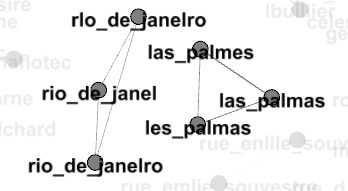
Here is another example of character recognition errors. In this case, the names of the cities have been grouped by an automatic method. This gives you an indication of the errors that can be produced and the great variability of the same term:
Article separation
Moreover, in the specific case of digitized historical newspapers, a step related to OCR is necessary to fully exploit the potential of the data.
Article Separation (AS) is defined as the task of identifying regions on a newspaper page that hold information to one article and is an important step for further natural language processing applications in the information retrieval pipeline. However, the AS task can be
divided into two parts: (text) block recognition and subsequent clustering.
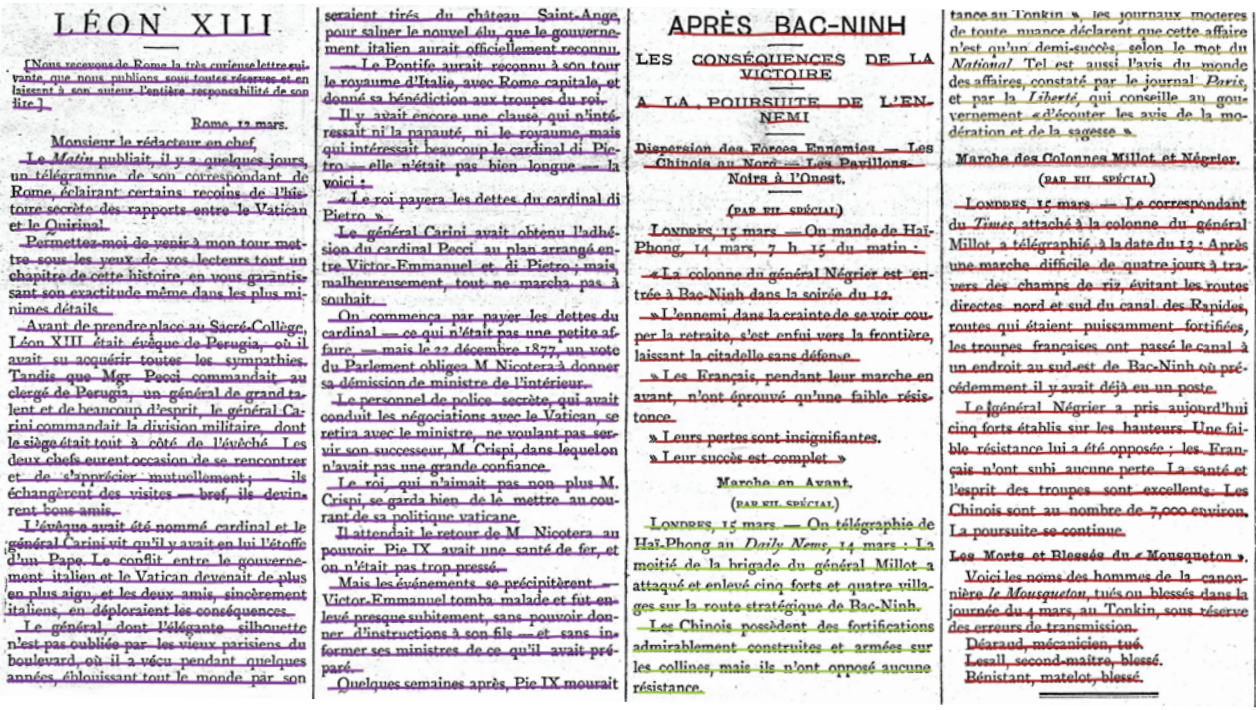
The proper working of this step determines our ability to query not only whole pages of newspapers but also articles. This makes it much easier to build a corpus on which to base further analysis.
Semantic Text Enrichment
Semantic text enrichment consists of analyzing documents and adding semantic metadata to their
contents. In the case of historical newspapers, among several semantic metadata, we concentrate on named entities. Named entities are generally proper nouns that refer to specific entities that can be a person, organization, location, date, etc. If we consider this sentence as an example: Mount Everest is the tallest mountain above sea level, NER should detect Mount Everest as a named entity of type location as it refers to a specific entity.
Some other examples of named entities are listed in the following table:
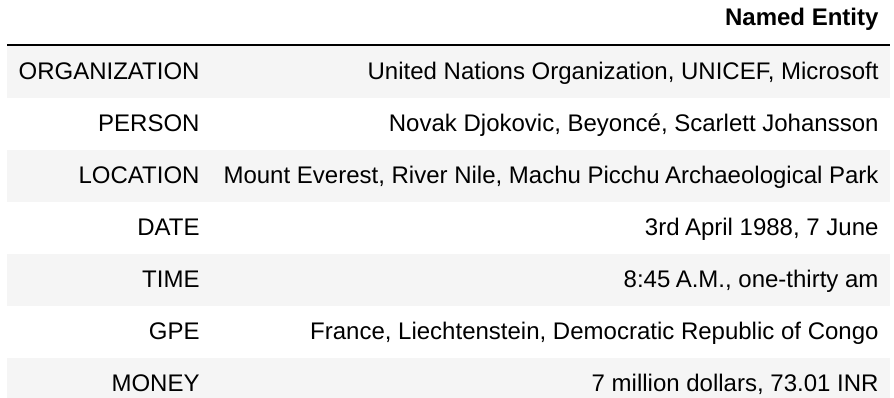
When we talk about Semantic Text Enrichment more precisely, we aim to recognize these entities in documents and disambiguate them to a knowledge base. In addition, these entities will be associated with the stance of the text in which they are mentioned.
Named Entity Recognition is one of the most important and most studied tasks in NLP. It has many industrial and scientific applications. It can clearly facilitate information retrieval in historical newspapers.