

3.1 Document Understanding and Information Extract : Overview and Programming Basics
3.1.2 Information Extraction History
Information extraction dates back to the late 1970s in the early days of NLP with the development of a system named JASPER (Journalist’s Assistant for Preparing Earnings Reports) Andersen et al. 1992 meant to analyze a live feed of company press releases, and then to identify which of those releases contain information on company earnings and dividends, and for those releases, to extract a predetermined set of information, so that, finally, to provide real-time financial news to financial traders (so the traders will have the edge in the very competitive real-time financial news market).
Most of the text values that JASPER extracted were numbers (net income, per-share income, revenues, sales, average number of shares outstanding, etc.). These values were declared as a template in which each slot should be filled with an extracted value. For each slot in the template, the system (JASPER) tried to match against each sentence an associated set of patterns of words; if any of the patterns matched, a procedure, or extraction method, also associated with the particular slot, was called to decide whether the patterns which matched can be used to assign a value to the slot.
This type of method was basically a rule-based method, which was particularly common to most systems first developed for extracting information from unstructured text.
Once with the appearance of the web of documents (Internet, the information explosion of the last decade has placed increasing demands on processing and analyzing large volumes of online data. In response, the Advanced Research Projects Agency (ARPA) has been supporting research to develop a new technology called IE, and, as follows, a series of conferences/campaigns started working towards the definition of the tasks of IE and its evaluation. These started in 1988 as follows:
-
MUC (Message Understanding Conference) began in 1988 to find a way to evaluate IE. The MUCs established IE as a major application of NLP (Sundheim 1996).
-
ACE (Automatic Content Extraction) replaced the filling of one complex and task-specific template with a few dozen more general relations and events. It produced lots of annotated training data, fostering the development of supervised methods (Doddington et al. 2004).
-
TAC-KBP (Text Analysis Conference - Knowledge Base Population) increased the scale of the data to be processed to create a unified database connecting tens of thousands of entities with about 40 relations and then answering questions about selected entities. These conferences provided minimal annotated training data, encouraging semi-supervised methods (Ji and Grishman 2011).
If you want to know more about the history of this field, please read the following section:
MUC (Message Understanding Conference) 1988 - 1996
The first campaign was the Message Understanding Conference (MUC-1) in 1988, and it was organized as more of a meeting to discuss how IE might be evaluated. As previously experimented (JASPER), there was agreement on the need for a shared template capturing the most important information in a document at this meeting. The first two campaigns, MUC-1 and MUC-2, invited participants to submit filled templates extracted from Navy exercise message traffic texts. MUC-3 finally agreed on scoring using recall, precision, and F measure (the harmonic mean of recall and precision was suggested as the primary metric for assigning a rank to the participating systems.)
MUC-3 used news about terrorism in Latin America, and they provided an annotated corpora with texts and filled templates for the evaluation:

The documents were all uppercase, as in the image above.
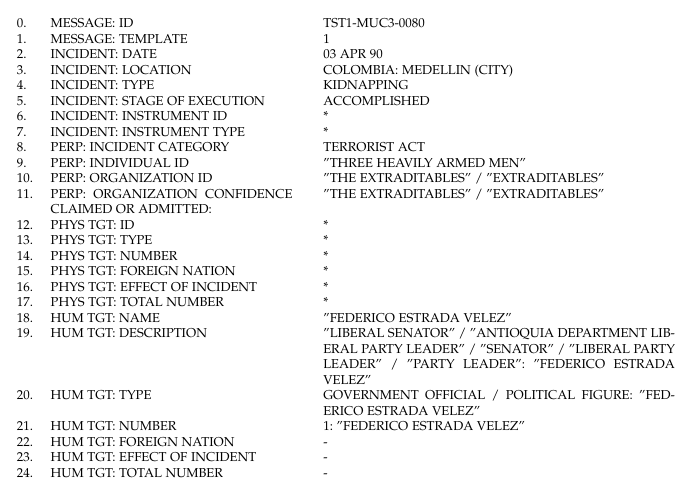
MUC-3 proposed the extraction of different text excerpts to fill several types of templates (bombings, arsons, kidnappings, killings, attacks, etc.). The “/” separates alternative correct slot fills. The templates were substantially more complex than in prior years. The participants were required to develop a complete system to fill these templates, which were further referred to as event templates. The template to fill consisted of the detection of the date of the event (03 APR 90), the location (COLOMBIA: MEDELLIN), the type of the event (kidnapping) … the perpetrator (THREE HEAVILY ARMED MEN), the human target (FEDERICO ESTRADA VELEZ), etc. The participating systems should have been able to fill all the slots.
Next, because the results were rather low, the other campaigns (.. MUC-5, MUC-6) started to require several component subsystems. For example, MUC-6 split off different tasks with separate evaluations:
-
Named Entity Recognition (NER)
-
Relation Extraction (RE)
-
Event Extraction (EE)
-
etc.
Further, these newly defined, more general independent tasks drew greater attention because they were more feasible to plug and play: a system can detect the perpetrators, the human targets, the location and the date; another system can detect the type of the event, etc.