

2.2 Dance and performativity: two cases in point
2.2.2 Analysis of Trisha Brown's "Set and Reset" (1983)
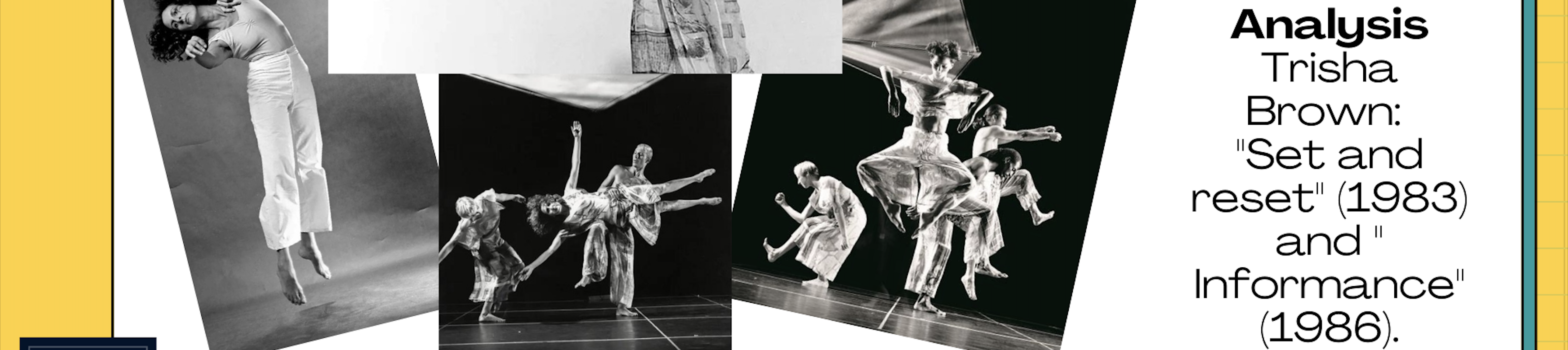
 Case study
Before going through the case study, here are a few instructions you can follow using the digital tool e-spect@tor or not:
A. Without using the e-spect@tor tool
1) Please watch the video first, without taking notes: in this way, you will grasp the different aspects of the performance (as if you were attending the live show).
2) Watch it again and take notes focusing on the performative aspects. Then, compare them with the analysis that is provided to you below.
B. Using the e-spect@tor tool
First, please read the guidelines to create your account on the e-spect@tor tool and connect to it following the instructions in Unit III.
1) Once connected to the e-spect@tor tool, please join the project Trisha Brown "Set and Reset" using the code: tor-e-1-ceYToX-TLN7FL
2) Please start watching Trisha Brown's "Set and Reset" first, using the "performance mode": in this way, you can't stop the run of the video as if you were attending the live show. Aflso, as if you were attending a live show for the first time, you can annotate free comments (like association of ideas) and use the set of emoticons to declare your emotions and basic opinions.
3) Please watch the video a second time using the "analysis mode":
This time, you can stop, forward and reward the video for paying attention to performative elements you consider relevant to analyse. In addition to the set of emoticons and free comments, you are now allowed to use the ontology to draw your interest in different categories of performative components such as "staging", "acting", "dramaturgy", and "reception". Start annotating the video of Trisha Brown's "Set and Reset", considering the performative components you detect along the video.
The following video from the Brooklyn Academy of Music Hamm Archives should be viewed and listened to in its entirety before reading the subsequent analysis :

The following breakdown is composed of our analysis. It relies on that of historical scholar Susan Rosenberg, whose voice-over constitutes a performative paratext contributing to the performative effect of the video. The latter is not fully part of this analysis and will be further discussed in the last part of this lesson.
Why is "Set and reset" performative?
- Onomastics leads us to analyse "Set and reset" as a hint to the non-improvised dimension of performance, made of "restored" and "twice-behaved" behaviours, to quote Schechner's words. As Rosenberg underlines, the performance is made of movements that have been "repeated" "over and over," as the 1983 (0' to 2'29) and 1996 (2'30) extracts show.
- "Set and reset" raises the issue of the essence of the gestural language of dance. Performativity lies in the mixture between the "vitality" of impulse ("impulses...alive in the moment", "vitality of movement") and the "repeated" gesture ("movements explicitly set", "repeated"), giving the feeling that the dance currently performed is utterly improvised. Nevertheless, there is no such thing as improvisation in Brown's work. In Rosenberg's words, "Set and reset" has emerged from Brown's original will to "rein in the Esprit of improvisation into a fixed choreographic form". In "Set and Reset", the movement performed is no improvisation: it comes from improvisation "remembered, repeated, recorded ", "perfected" and "elaborated upon". However, the "fixity" of the choreographed form has nothing to do with normativity, as repetition is conceived as an element of evolution and change, not as closure. What is sought out here is the "effect of improvisation".
- "Set and reset" conveys the partial rejection of the codes of classical ballet. From 0'55 to 1'47, two dancers with polarised techniques are on stage. While Eva Karczag performs rounded, fluid, "elegant", "more articulated balletic leaps" and "codified" gestures, Trisha Brown relies on postmodern dance and its "uncodified" gestures and "deliberate refusal of codification and categorisation," which is perceptible in her broken, more jerky movements. Interculturality and intercultural exchanges between dancers and techniques may add a performative element to the piece.
- "Set and reset" challenges the audiences and invites us to reflect upon the status of "improvisation" within a performance, conceived as a repeated combination of gestures that have been incorporated by the performers, as indicated in the prefix "re-" («reset»). The polysemy of the terms "set" and "reset", the latter possibly meaning setting + 1 or back to square one, enhances the performer's capacity for reinvention (setting +1) or for self-reflection, back to square one standing for the continuous reflection on movement and its essence, which may well correspond to the "impulse" and "vitality of movement", terms that Rosenberg accumulates throughout her speech.
- Performativity also stems from the hybridity between dance and other arts and art forms, namely visual arts, design (costumes, lights and setting by pop, postmodern and neo-dada artist Robert Rauschenberg) and experimental music (Laurie Anderson).
In a nutshell, "Set and reset" can be analysed in the light of the three performative criteria presented above, highlighting some of Schechner's categories, especially "showing doing" (that is, underlining the action being done through the repeated movements of the dancers) and "explaining showing doing" of Rosenberg's commentary that becomes performative and part of the dance performance.