

2.3 Is there such a thing as performative fashion?
2.3.3 Analysis of Jean-Paul Gaultier's "Le défilé"
 Case study
Before going through the case study, a few instructions :
1) Please watch the video first, without taking notes: in this way, you will better grasp the different aspects of the performance (as if you were attending the live show).
2) Watch it a second time and take notes about the fashion show, focusing on its performative elements. Compare your notes with the analysis that is provided to you below.

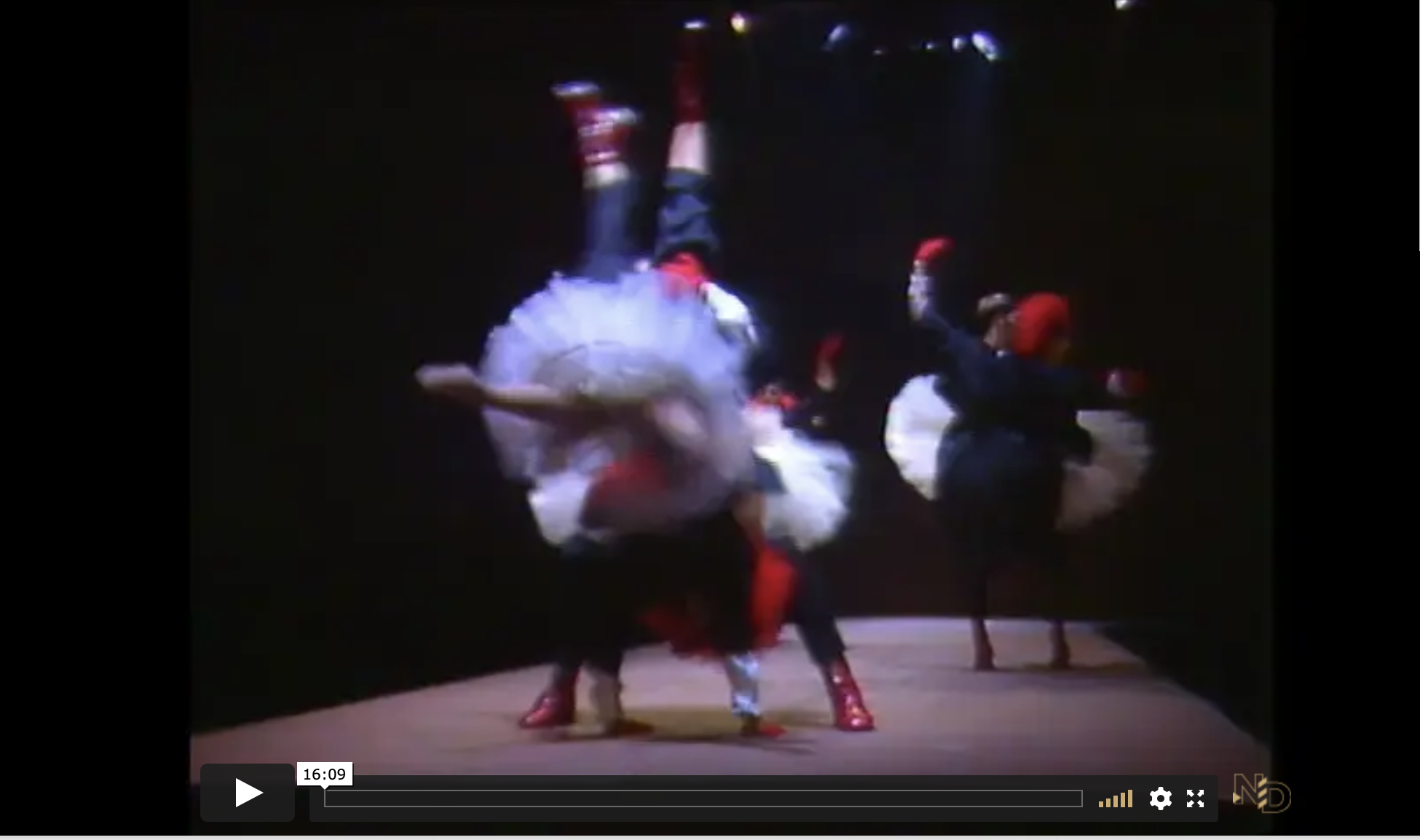
"Le défilé" is a great example of fashion's ability to hybridize with other arts and art forms. The show was presented in 1985 at the Pavillon Baltard in collaboration with choreographer Régine Chopinot, with whom Gaultier worked on several occasions (i.e. Delices, Les Rats, Rossignol, in the 1980s and Ana in 1990, for example).
Surprisingly enough, the 16-minute video, which is an extract from the overall performance, is archived at the Centre National de la Danse, proving that audiences may still be tricked into thinking they are watching a fashion show while watching a dance performance all along. Actually, "Le défilé" is both: it is a choreographic rendition of a catwalk.
Divided into no less than 14 tableaux, some of them with a name alluding to dance, fashion or the body though abundant use of puns and play-on-words ("La bosse de la danse", "Les derniers cri-nolines", "Les accessoires encombrants: les vacances de M'sieur Dame Cloche-pied Cloche-tête", "Fenêtres sur corps", "Les vieux slips",... ), the performance features 16 performers (dancers and models) clad in burlesque, absurd costumes and accessories, from huge knitted crinolines (tableau Les Puzzles, see below), tutus and suits with protruding fake / puppet legs accessorized with clownish shoes and massive wigs (tableau La bosse de la danse, see below), to giant men underwear and puffy, fluffy dresses.
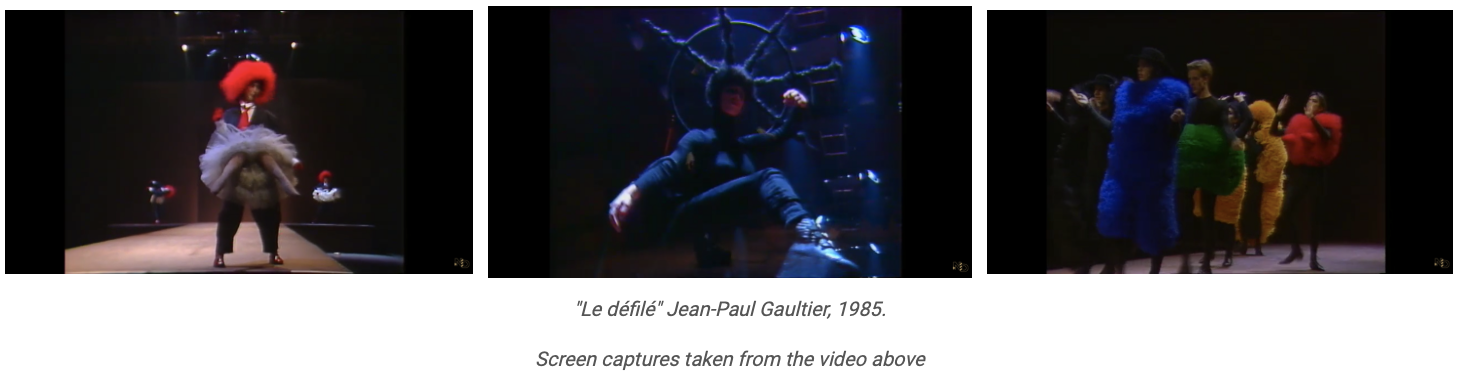
Le défilé" Jean-Paul Gaultier, 1985 Screen captures taken from the video above
What makes "Le défilé" performative ?
-
The word "défilé" is polysemic and refers to the catwalk and other forms of walks and parades (like the mock military parade, as can be seen in "Les Puzzles", from 13' on)
-
It is a hybrid form, a cross-breeding of a fashion show and a dance performance, making it almost impossible to choose between the two, which is accentuated by the awkward, fidgety, hampered movements and walk of the performers and the dissonant, discordant music
-
The tableaux mix humour and burlesque through carefully thought-out movements
-
The show features performative clothes and bodies: the human body struggles with the clothes, which also struggles to embrace the performers' movements. The latter depends on the costumes' cut and weight, and the result is an uncertain and fidgety choreography. As some of the dancers testified, the costumes forced them to adapt and adjust their movements accordingly constantly:
Michele Prélonge and Claire Servant, both dancers in 'Le défilé,' evoke, for instance, the slowing down effect induced by the huge, white-knitted crinolines they were wearing in the tableau 'Les derniers cri-nolines'. These pannier clothes were not only heavy when they jumped or fell down to their knees - however light and comfortable they seemed to be. But because of their softness and heaviness, the dresses were slow to move during turns. There was no evidence of the efforts and energy necessary to adjust the ensemble. The work behind the dance was, just like the dancers' bodies, hidden behind the costumes" (our translation from the original below).
« Michèle Prélonge et Claire Servant, toutes deux interprètes dans “Le Défilé”, évoquent, par exemple, le facteur de lenteur introduit dans leur danse par les volumineuses crinolines en tricot blanc qu'elles portaient dans la séquence des “Derniers cri-nolines”. Ces robes à panier étaient non seulement lourdes à entraîner dans les sauts répétés et les chutes à genoux – alors que l'impression donnée est celle d'une légèreté moelleuse –, mais, du fait de leur souplesse et de leur masse, elles réagissaient avec retard dans les tours. Rien ne laisse soupçonner l'effort d'ajustement rythmique qui s'ensuit, ni l'énergie requise. Le travail de la danse n'apparaît pas plus que les corps des danseuses » (A. Suquet, "Chopinot", Le Mans, ed. Cénomane, 2010, 31).
Performative bodies stand for the reciprocal action between the body and clothes, leading to a specific, unique, choreographed form. Clothes are performative because they have a life of their own while being part of a whole:
Fabrics seem animated by their own kinetic potential, and dance, which fuels it, must adapt to it, and integrate its reactions" (Suquet, translation ours from the original version below).
« Les matières semblent animées de leur propre potentiel cinétique, et la danse, qui le réveille, doit s'y adapter, intégrer ses réactions » (Suquet, ibid).