

2.4 Performance Art: liminal, strange and body experience
2.4.4 Performed strangeness
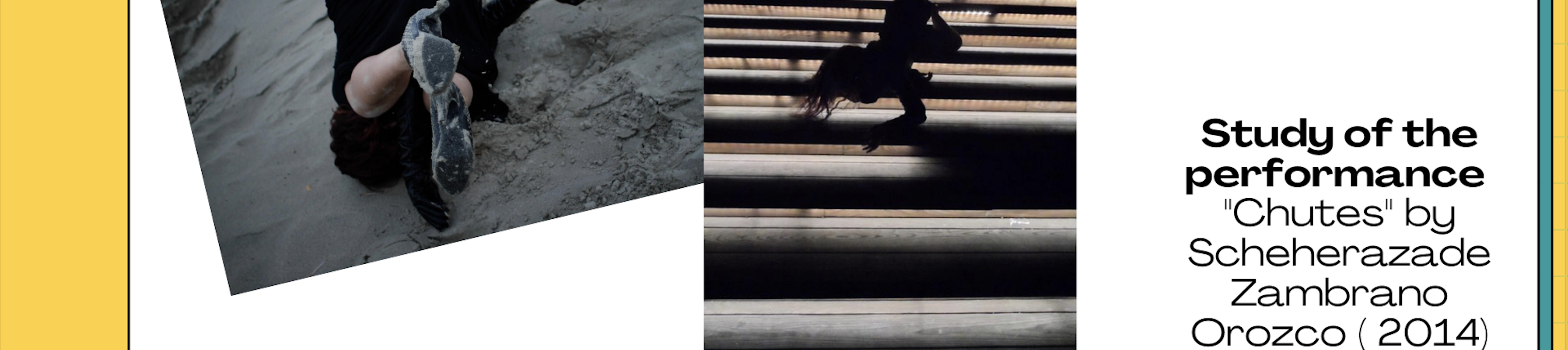
Instructions :
1) Before reading this page, please review the notes you've taken about the third point indicated in the introduction of the study ("The peculiar vision of the world that suggests the performance to the spectators.")
2) While reading this page, compare your notes with what is proposed here as an interpretation of these precise aspects.
Feel free to re-watch the video with the several bookmarks implemented according to the different time span mentioned in the analysis.
Insofar as Performance Art usually occurs in a place that is not dedicated to live performance (as is the case here in a university space), it is through the actions composed during the performance that it distinguishes itself from the real world and establishes itself as an artistic creation. These actions must necessarily seem "foreign" to the real world: they draw and unfold a sort of parallel world that reveals another dimension of reality. If the title "Chutes" makes it possible to grasp the main theme of the performance, it was not necessarily known to all the people who attended, as some discovered it on the spot, in an impromptu manner. What did they see and understand then? In concrete terms, the spectators witnessed, for about thirty minutes, the disarticulated, staggering and tumbling wandering of a dancer in a part of the space that is normally dedicated to them in its entirety. As mentioned earlier, the performance space was signified by a green tarpaulin on the floor in the shape of a square on which was glued a course of scotch tape that zigzagged in all directions, sometimes overflowed the plastic, made up hairpin angles and went back and forth on itself.
The tape thus traces a tortuous and illogical path that contrasts deliberately with the relatively rectilinear, rapid and coherent path that each student or professional at the University takes to get from one point to another in their activities. The space of the performance thus shows, in its very composition, that the place of the University can be apprehended and experienced in another way. In other words, the University can also be the place of creation, conviviality and encounter.
Moreover, the actions composed by the performer in Chutes embody this path drawn on the ground and give it life. In contrast to the determined and sustained step of the students who run from one room to another, from one building to another, to not be late for class, the dancer's tortuous path takes about thirty minutes to cover and crisscross a space of a few square meters. The time after which the university world seems to be constantly running seems to expand infinitely, as the performer also signifies by simulating slow motion on several occasions. The University suddenly appears as a different world, and its architecture, mainly conceived from a utilitarian perspective, is revealed differently. Staircases become bleachers where one can sit and watch the performance, and walkways become vantage points from which to observe the performance.
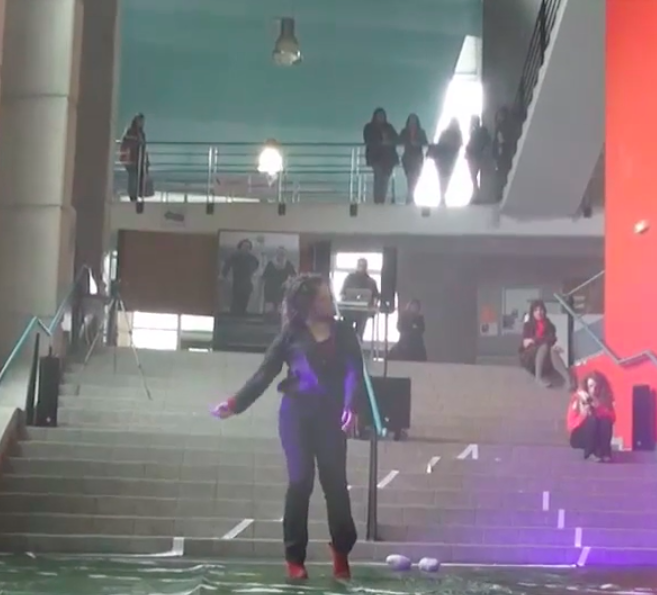
Audience on the stairways and the walkway
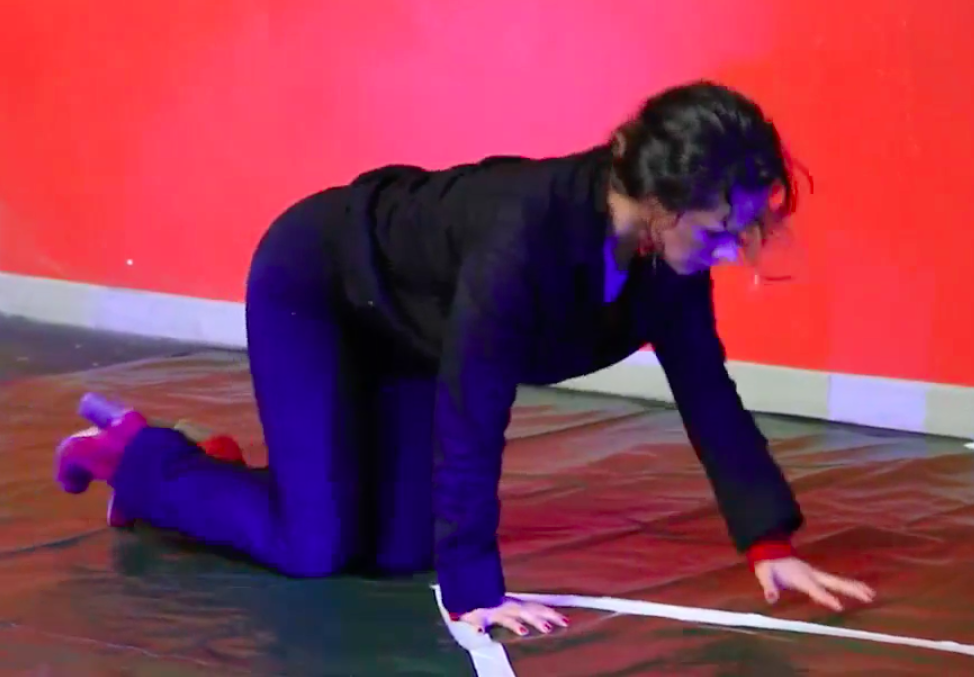
The dancer's disjointed movements, swaying and swaying in all directions, contrast with the students' upright posture and gait, as do her crawling on all fours (11min54s-12min16s) and her crawling on the floor, which even resembles swimming (13min43s-13min50s). If there is verticality in her postures, it is an inverted verticality where the dancer balances on her head, as we have seen before. It is as if gravity suddenly manifests itself forcefully on the dancer's body, and the earth reminds her of its existence under her feet: the presence of clay balls in the performance space may well signify this telluric power. The artist seems to try several times to resume a normal, straight and rectilinear walk, but similarly manipulated by an invisible force, she always ends up deviating from her trajectory, staggering and falling to the ground.
The music, which does not compose a harmonious melody but a disjointed alternation of various electronic sounds, accompanies the dancer's wanderings and multiple falls during the course of the performance and plunges the audience into an impression of absolute strangeness where reason seems to have lost all authority. Thus, the University, usually considered as the temple of thought, the reign of the mind over the body, is embodied differently by opening up, during the performance, a space where the masters are, on the contrary, nature, telluric forces and animal instinct, reminding the student and university public that reasoning detached from any real and organic experience can lead to completely erroneous elucubrations.
As conclusion, we can say that the performance Chutes by the dancer and choreographer Scheherazade Zambrano Orozco presents the main characteristics of Performance Art: its realisation in an unconventional space, the importance given to bodily presence and the transmission of a different vision of the world. In this particular case, the artist's disordered wanderings and unusual movements provide the students, who become spectators for the duration of the performance, a different view of the University: usually austere and associated with studies, this space is thus reinvested with a breath of both poetry and life.
Please help us improve this course.