

Unit I: Introduction to Social Justice in the Digital Humanities
1.7 The Intersections of Social Justice and Digital Humanities Pedagogy
 |
This introduction is written by Susan Schreibman and Anna Villarica. The page is designed by Anna Villarica.
Introduction
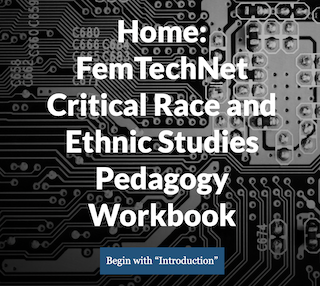
The pedagogic intersections between social justice and digital humanities is a relatively recent phenomenon, even within the relatively young field of digital humanities. The examples we found are less plentiful than, for example, courses that focus on an introduction to the field or on a specific methodology. Nevertheless, since c. 2015, there has been an increasing number of courses that specifically target the intersection of these two spaces, theoretically and methodologically, typically taking a praxis-based approach to learning and teaching. Some of these courses rethink how students are assessed and engaged, for example, through syllabi that encourage student-led projects focusing on social impact, exposing inequalities or societal injustices (a gathering of these can be found at the FemTechNet Critical Race and Ethnic Studies Pedagogy Workbook, pictured on the right). There are also several sites that amalgamate or create resources, including Teaching and the Digital Humanities (2015) and Digital Humanities for Social Justice (2023), as well as this course, for instructors who would like to incorporate exercises, assessments, and/or readings at the intersections of social justice and digital pedagogy.
This introductory page is divided into three sections. Section I provides examples of DH courses within a methodological and theoretical framework. In section II we highlight several digitally-inflected project-based assessments. Section III provides a list of resources for instructors wishing to incorporate social justice themes into their Digital Humanities teaching.
I. Methods and Theories
Digital Humanities is one of many fields in which instructors have begun to take an intentional approach in integrating social justice themes into their methodological practice. In his 2020 article ‘Between Social Justice and Decolonisation: Exploring South African MOOC Designers: Conceptualisations and Approaches to Addressing Injustices’ Taskeen Adam provides a framework for three lenses for what he terms Dimensions of Human Injustice. These lenses, e.g., material, cultural-epistemic, and political/geopolitical, provide a framing that instructors adopt, depending on their own positionality, educational goals, and methodologies chosen. These lenses also play a part in the instructor’s own views on how society shapes the ‘ways in which they understand and approach student difference and disadvantage’ (Keddie 2012: 264). Central to course design is about choosing the best methodology(ies) to address specific injustice(s):
...some placing greater emphasis on cultural-epistemic injustices embedded in geopolitical inequalities, and others on material injustices that need addressing at societal and national levels. This approach assists in putting aside narrow interpretations of particular discourses, for example, social justice being equated to economic justice, or decolonial movements being interpreted as Africanisation, towards a more holistic mindset that can better tackle the multiple dimensions of injustice in our educational contexts and bring about learning designs that better support learners (Adam 2020:2).
DH instructional design is an extremely good fit for raising student awareness of societal injustice, inequalities, and privilege, as the praxis-and team-based approach of many DH courses provide opportunities for truly transformative education, informed by context, the ‘situatedness of knowledge, and the necessity for education to respond to the needs of that context’ (Nnenne as quoted in Adam 2020: 7). DH courses can demonstrate to students the inclusivity of making visible issues such as dismantling power relations, social hierarchies and cultural hegemonies via public-facing assignments (Luckett and Shay, 2017: 3).
 |
|
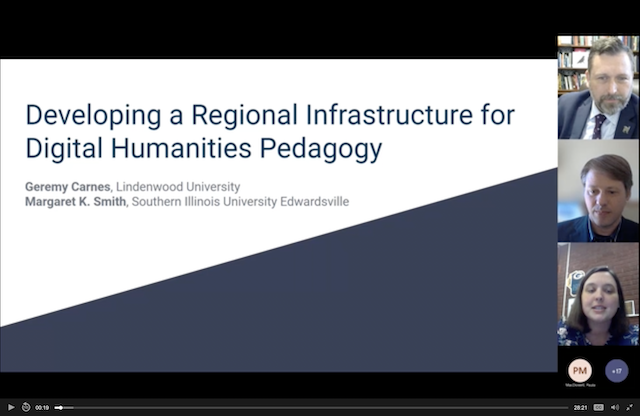
Watch here a presentation on challenges |
Digital Humanities pedagogy is not only relevant at the university level. Educational institutions, at both the university and secondary school levels, in St Louis, Missouri, have formed a consortium funded by the National Endowment for the Humanities. This is a network for supporting and disseminating methods in digital humanities pedagogy. The goal of the network is to not only bridge the K-12-college divide, but advance digital humanities pedagogy and access for underserved populations, with a focus on student learning.
This focus is key, particularly at institutions in which students, ‘especially those from poorer or more marginalized backgrounds, miss out on learning the valuable, 21st-century skills that DH can train them in’. Their white paper (Carnes and Smith, 2022) and presentation outline the difficulties of integrating DH teaching and learning at institutions that do not necessarily have the staff trained in DH methods, nor the resources, to engage in praxis-based teaching. The consortium-based approach was taken to expand access, narrowing the inequality gap.
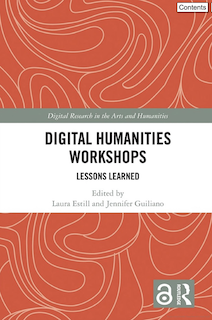 |
Another area of DH pedagogy beyond university level, is peer-to-peer training outside of formal curricula. In recent years, workshop designers have been embedding, beyond DH theories and methods, a third pillar into their training: that of social justice. The 2023 open access edited collection Digital Humanities Workshops: Lessons Learned, pictured on the right, demonstrates how important professional DH training beyond the Global North in building local expertise and networks (for example, in chapters on the Indian, African, and Taiwainese experience), but also how to build into one’s curriculum design (no matter where one teaches) social justice concerns, as in Kush Patel, Ashley Caranto Morford, and Arun Jacob’s chapter on ‘Workshops in Anti-Colonial Digital Humanities Towards Building Relationships With Critical University and Community Movements’ (whose work also features as a case study in this unit).
Here we highlight several courses, at the undergraduate, MA, and professional levels, that embed in their instructional design, a number of the aforementioned theoretical approaches. These, at the time of writing, have syllabi or another format of online presence. Courses are presented from the most recent to the oldest. The majority are from North America as these institutions most frequently tend to make syllabi available online. We acknowledge that this list is incomplete and would very much welcome further examples. If you have a course you would like us to feature, please email socialjusticeDT@gmail.com with course details providing the information below. If there is no additional information available online, you can send us a PDF of the syllabi, and we can upload it into the #dariahTeach database.
II. Project-based teaching
 |
As mentioned above, many courses utilise project-based assessments. Here we drill down into how some instructors have taken a praxis-based approach. As was the case with syllabi, this is only a very small sample of project-based assessments. If you would like your project-based assessment listed here, please email socialjusticeDT@gmail.com with information similar to what is below. We welcome contributions from conference or symposium panels and instructors. If there is no additional information available online, you can send us a PDF of the or conference abstract syllabi, and we can upload it into the #dariahTeach database.
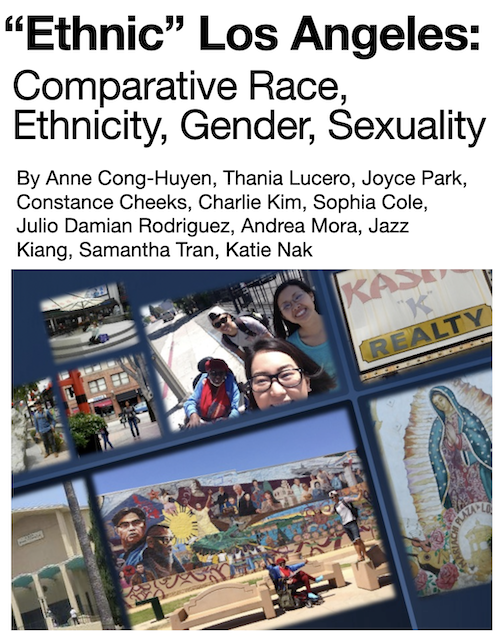
A good place to start with project-based assessments at the intersections of social justice and the DH is the 2015 panel on Teaching and the Digital Humanities held at Emory University. Panel participants stressed the importance of projects that encourage students to critically engage with digital tools while producing work that is relevant to their communities, providing opportunities for students to be critical, not only of the digital tools and methods they employ, but the communities in which they live and work. An example of this is Anne Cong-Huyen’s course at UCLA in which she guided her students in creating an open-access digital book in Scalar entitled Ethnic Los Angeles (pictured on the left and published in 2014). Students conducted research by immersing themselves in communities they would not have normally visited and reflected on the politics of publishing as they were producing the book. Ultimately, the book revealed the racial and ethnic tensions in Los Angeles, allowing students to write an alternative representation of their city. Cong-Huyen remarks:
It was proof that undergraduate students can do high-level, original scholarly research if we provide them with innovative, interdisciplinary digital methodologies and analytic frameworks.(Teaching and the Digital Humanities, 2015)
At the same symposium, William G. Thomas III, a historian at the University of Nebraska-Lincoln, described how he encourages students to engage in projects that are publicly available on the WWW. These allow students to reflect on the affordances available, becoming ‘producers working in a critical fashion with an in the digital medium’. He cited a few examples from his teaching, including student contributions to established projects like The Valley of the Shadow (University of Virginia) and History Harvest (University of Nebraska-Lincoln). 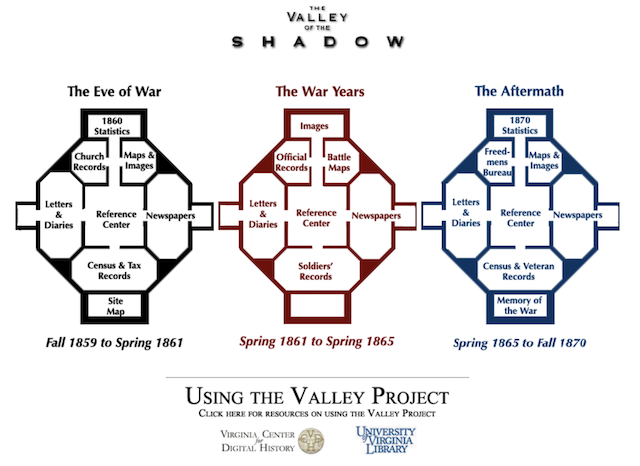 The Valley of the Shadows project is a digital archive of primary sources from people from Virginia and Pennysylvannia who experienced the American Civil War. In teams, undergraduate students contributed new content to add to the archive. In one instance, a sub-project on US coloured troops became so popular it received emails from the public, and the student team continued to manage the site and engage with the public years later. History Harvest, on the other hand, is a collaborative project where students themselves make history by creating digital resources documenting the history of their communities. In creating this digital archive, students engage community members in sharing their stories and artefacts, ultimately to ‘create the possibility and digital space for a more diverse, inclusive, and democratic narrative of American history’ (Teaching and the Digital Humanities, 2015). According to Thomas III, such projects become:
a kind of transitional, porous engagement in which students long after remained responsible for and committed to an ongoing interactive engagement in the digital medium. (Teaching and the Digital Humanities, 2015)
Another example of praxis-based pedagogy centres on community engagement and collaboration, which is central to UCLA’s Data Justice Scholars program. This program is open to UCLA juniors and seniors from all disciplines. Beyond reading courses on the social justice implications of working with data (this year, “Whose Lives Count?: Race, Gender, and Data” and another related course of their choosing), students also conduct data-based research that impacts their community. This gives them a chance to work with LA community partners and apply what they learned in a real life context. The current cohort of students will present their research in the 2024 spring Undergraduate Research week. The scholars also help enhance the Los Angeles Data Justice Hub, an online educational resource featuring resources on how to use, analyse and present data for data justice projects, curated open datasets and project samples.
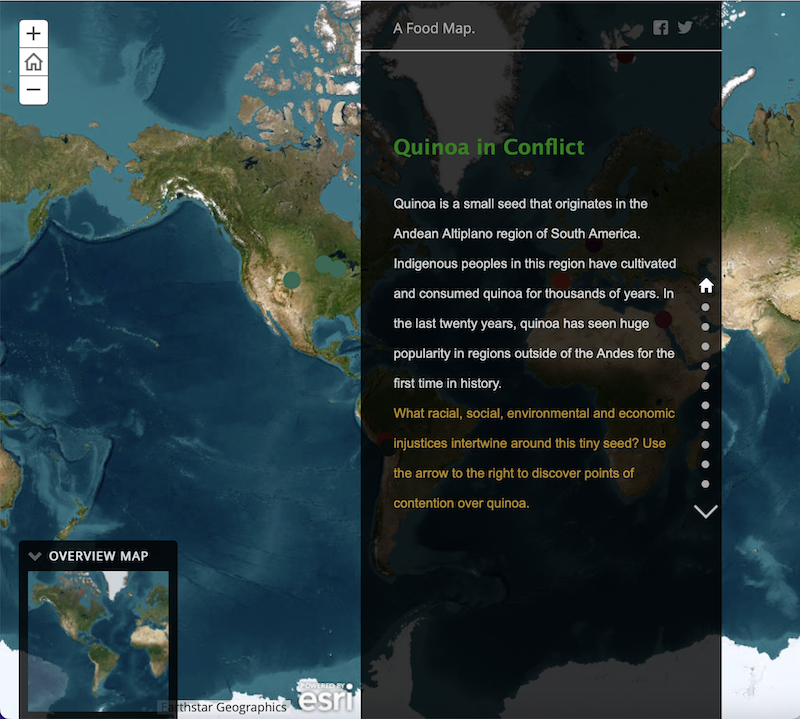
Apart from the larger projects mentioned above, there are examples of students engaging in smaller-scale research. This is being done for example at the Gender, Women and Sexuality Studies (GWSS) division at the University of Minnesota, which uses ‘academic technologies for feminist pedagogies and to situate the digital turn in higher education for the purposes of social change’ (‘Digital humanities for Social Justice’, 2023). Students produce media that engage core concepts in their programmes and contribute to social change. Among them are documentaries, digital essays and interactive maps (see examples below). Through such projects, students not only think critically about media and digital tools, but also reflect on how to apply their technical skills to create change-making media.
 |
|
|
Queerbaiting, an award-winning |
Quinoa in Conflict, an interactive map |
III. Resources
For educators who would like to integrate social justice pedagogy into their DH teaching (or conversely integrate digital methods into explorations of social justice issues), there are a number of resources available which we list here:
- Creative and Critical Precepts of Critical DH: This guide, started by Roopika Risam, micha cardenas, and participants of the 2015 HILT conference, is useful for DH projects committed to social justice. Questions around access, materiality, method, and ontology and epistemology are useful in getting participants/students to reflect and make sure inequalities or injustice are not reproduced when engaging in such projects. The resource also includes examples of social justice DH projects.
- Data Feminism: This book by Catherine D’Ignazio and Lauren F. Klein outlines 7 principles drawn from intersectional feminism to keep in mind when working with data. (Add link to Data Feminism case study; also an image with the 7 principles)
- Social Justice in the Digital Humanities course, #dariahTeach: This open educational resource explores how digital humanists are intervening in issues of social justice in research and teaching, as well as issues to be considered when developing DH projects with a social justice theme. Some of our featured case studies also include exercises that can be integrated into class (e.g. link and link).
- Digital Pedagogy in the Humanities: an MLA sponsored collection of resources for digital pedagogy in the humanities, with particular themes, including social justice, access, diaspora, gender, digital divides, indigenous, intersectionality, queer, sexuality curated by scholars. Each keyword contains ten ‘artefacts’ - useful resources for teaching that topic - and a curatorial statement. These resources are reusable and re-mixable, and users can curate their own collections.
- FemTechNet: a digital pedagogical workbook developed by the FemTechNet network for ‘overburdened teachers’ teaching Critical Race and Ethnic Studies in our information culture. This comprehensive living document includes a syllabus, readings, multimedia, sample learning activities and assignments (like this - maybe add as an image/thumbnail one of them), and examples of community-based projects. It is continually being improved by the contributors.
- Los Angeles Data Justice Hub – UCLA Community Engagement: Described as “a pedagogical tool to empower students, community organisations, and faculty to use data to rectify harm and access open data”, this online resource contains tutorials for educators and students on how to access and use open source data, perform basic analysis and how to produce visualisations for social justice projects (Data Training and Education). There are also open source datasets, mostly focused on the USA and California (Data and Dashboards), as well as Recommended Readings on data justice. Student-led data projects related to LA social justice issues will be featured later in a gallery.
- San Diego State University Library’s Listing of Digital Humanities Tools. Quite a number of the resources listed here involve Social Justice themes, including Digital Literacy Against Digital Violence: A Handbook for Library Workers, the EDI Toolkit for Digital Scholarship, and SAFElab @ Columbia University. The university also has a TeachDH portal which was established to help faculty teach during and beyond the quarantine. One of the subsections of this portal focuses on Social Justice & Activism which contains resources, projects and sample lessons to help students use DH to think critically about the digital and make a difference. There is also a page for digital tools that can be incorporated into classes or used in those change-making student projects (including comprehensive guides for each).
- SaturdaySchool Social Justice Teach-In Guide: A guide for teachers who would like to engage students on social media platforms created by Professor Rhonda Ragsdale of Lonestar College. She engages students through #SaturdaySchool on Twitter (now X), writing about particular social justice issues and encouraging students - and the public - to join in the discussion.
Author Bio*:
Susan Schreibman is Professor of Digital Arts and Humanities at Maastricht University. She works at the intersections of computationally-based teaching and research in the interplay of the digital archive, cultural innovation, and participatory engagement design, processes and projects. A focus of her research is in the design, critical, and interpretative analysis of systems that remediate publication modalities and manuscript culture from the analogue world, while developing new born-digital paradigms. Her areas of specialisation include Digital Humanities, Media Studies, Literary Modernism, and Irish Cultural Studies.
Anna Villarica is a research assistant on the #dariahTeach project. She is a junior lecturer at Maastricht University currently teaching courses on design thinking, digital transformations, the philosophy of technology, research skills, and museology. She received her MA in Media Studies Digital Cultures from Maastricht University and her BA in Communications and New Media from the National University of Singapore. While she does not specialise in anything (yet), she loves all things digital and is always learning and creating.
*Bios and affiliations are accurate at the time of writing
References
- Adam, Taskeen. "Between Social Justice and Decolonisation: Exploring South African MOOC designers’ conceptualisations and approaches to addressing injustices [presentation, O-143]." In The Care in Openness. 2020.
- Carnes, Geremy. 2022. Improving Digital Humanities Pedagogy in St. Louis White Paper. https://digitalcommons.lindenwood.edu/mhc_grant.pdf
- Carnes, Geremy and Smith, Margaret K., "Session 7: A Regional Network to Address Inequities in Digital Humanities Education" (2023). Panel Presentations. 2. https://digitalcommons.lindenwood.edu/etfe2023/2.
- Estill, Laura, and Jennifer Guiliano, eds. Digital Humanities Workshops: Lessons Learned. Taylor & Francis, 2023.
- Keddie, Amanda. "Schooling and social justice through the lenses of Nancy Fraser." Critical Studies in Education 53, no. 3 (2012): 263-279.
- Hodgkinson-Williams, Cheryl Ann, and Henry Trotter. "A social justice framework for understanding open educational resources and practices in the global south." Journal of Learning for Development 5, no. 3 (2018)
- Teaching in the Digital Humanities held at Emory University. 2015.