

1.1 The Logic of Design
1.1.2 Wicked Problems Demand Design Thinking
 |
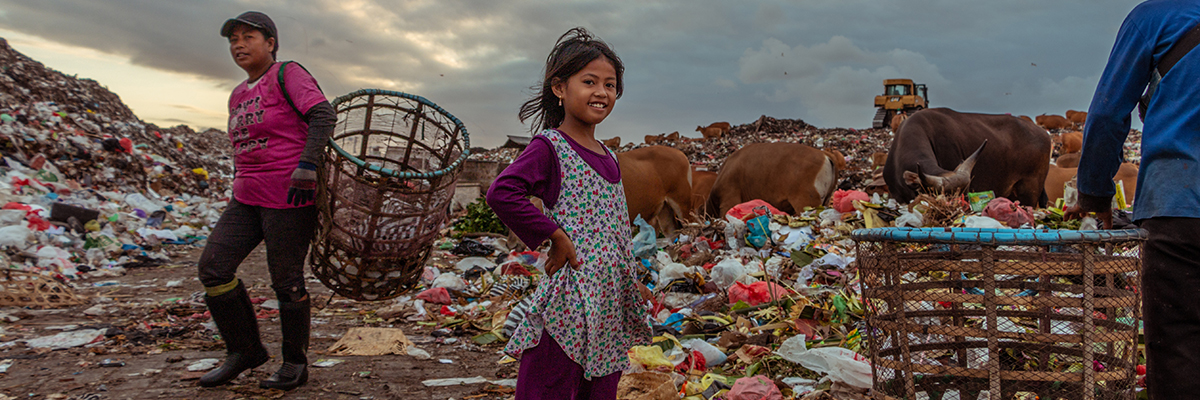 |
| Environmental and plastic pollution are wicked problems |
Wicked problems are complex problems. They are ambiguous because many people may have different views and contradictory stakes. Also, there are many factors contributing to the problem. 'Wicked' should not be interpreted as ‘evil’ but rather as changing all the time. Each action affects the situation, even conducting research. Wicked problems were first described in the field of social planning (Rittel and Webber, 1973). They formulated several criteria to define wicked problems, such as, ‘there is no stopping rule,’ or, 'there is no true or false, but better or worse’. They opposed the prevailing paradigm that any problem can be analyzed and structured into several subproblems; each with specific causes and each of them ‘solvable’.
| Wicked Problems: Information Design (YouTube) |
 Exercise: select the correct answer.
 In another highly influential paper, Buchanan (1992) argued that dealing with wicked problems is the essence of design thinking, as these problems resist straightforward analyses. To solve these, that is, change a situation into a more preferred one, one needs to resort to design thinking. Buchanan frames design as a kind of argumentation because in a way, making a design is an argument for what action to take, and others then respond to this. Put simply: design is devising and testing ideas to see what works best for those most involved. Over time it has become more and more accepted that to tackle wicked problems there is no better alternative than design thinking.
Exercise: select the correct answer. References
- Rittel, H. W., & Webber, M. M. (1973). Dilemmas in a general theory of planning. Policy Sciences, 4(2), 155-169.
- Buchanan, R. (1992). Wicked problems in design thinking. Design issues, 8(2), 5-21.