

4.3 Ideation Techniques
4.3.1 Principles
|
|

To generate ideas many techniques are known.
There are many techniques known to help generate ideas. One of these, called brainstorming, is often named. However, it is not the only technique that you can use. There are various techniques, of which several are explained on the Internet and in popular books, such as '101 design methods' (Kumar, 2012). We will not discuss all these methods but will present key principals and some rules of thumb for a successful session.
The key to successful ideation is to understand its principles:
- More is better
As Linus Pauling, two-fold Nobel price laureate, once said: ‘the only way to have good ideas is to have many’. In order to get as many ideas as possible, criticism is a no-go. Regardless of whether you are working on your own or in a team, when generating ideas you should refrain from criticizing the things that pop up in your mind. No, ‘what a stupid idea’, no, ‘…but…’s. Embrace the unusual. If someone comes up with a ‘weird’ idea, it is likely that these may incite many more; - Association and combination
If you combine ideas you will inevitably get new ones. If you have to ‘force-fit’ your problem with something else, e.g., a ‘sheep’, which seems totally irrelevant, you are forced into new ways of looking at your problem. This often incites new and above all fresh ideas. You are literally reframing. Many famous ideation techniques, such as using cards, biomimicry, or synectics are based on this principle; - Leave out or change something
When we have a problem, we often tend to get stuck as we are overwhelmed by the many problems we face. By leaving out some part of the problem (‘let’s imagine a car that does not need wheels’), we can think more freely. Likewise, by changing something in the problem, we can develop radical other ways of thinking (‘let’s imagine that a car has no motor but has to be pulled’); - Alternate divergent and convergent thinking
Diverging is the process of generating new ideas; converging is the process of sorting out and filtering the best ones. By meticulously keeping these stages apart and going through these stages several times, good results can be obtained. This means that you do not criticize when generating ideas and are not coming up with new ideas when making choices. In ideation workshops, there is often a focus on the divergent stage. For example, by attempting to conceive as many ideas as possible to feel confident (‘we had more than 200 ideas!’). This can be a pitfall. Clustering ideas and choosing only a few is just as arduous and difficult as conceiving ideas.
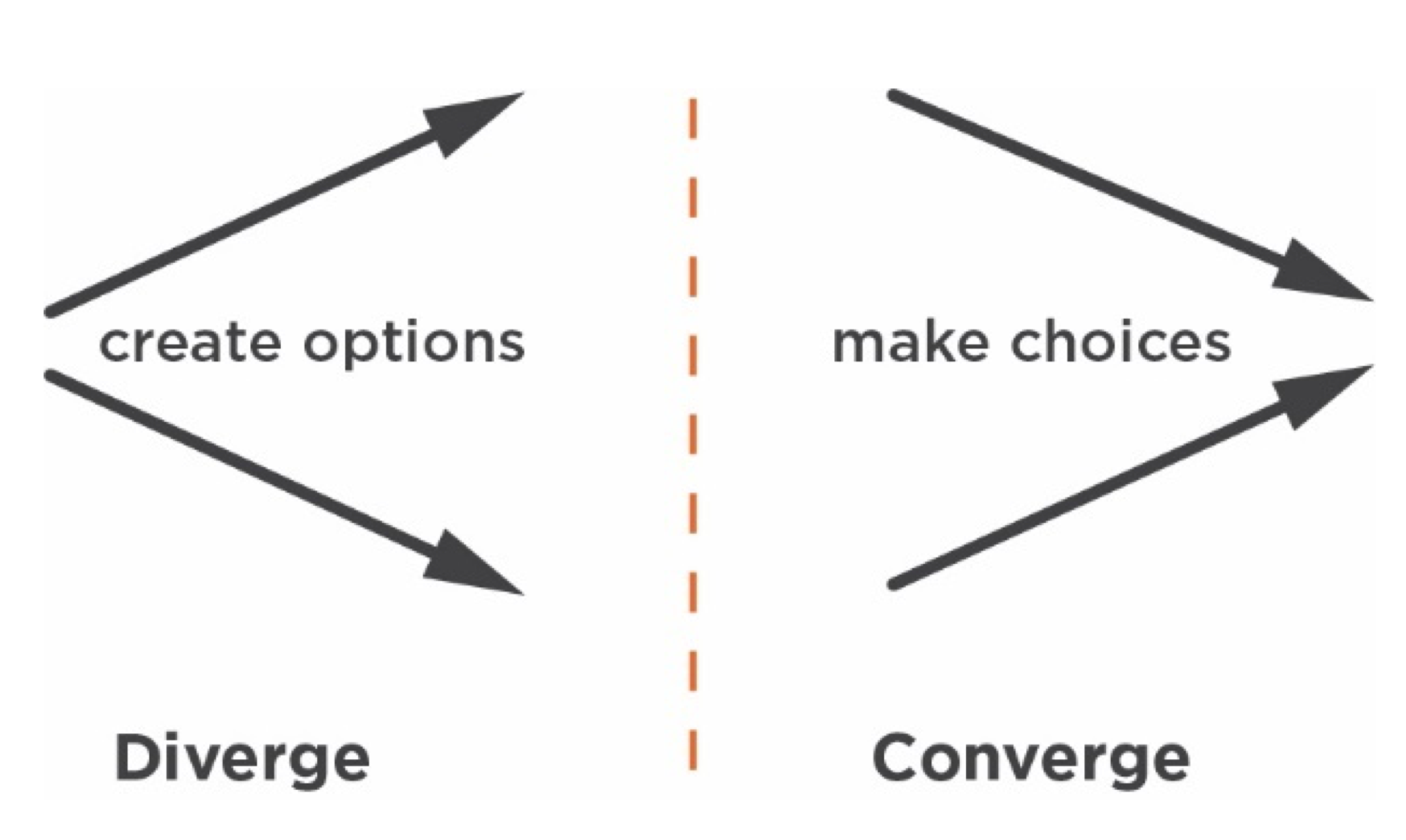 |
| Divergent and convergent thinking |
 Case study: Future of Food exhibition
To show these principles, let’s imagine that we have to conceive new ideas for an exhibit of the ‘Future of Food’ exhibition. How can we show what food may be like in the future? The first principle is to have many ideas; anything will do in a workshop. Consider the obvious ones like ‘cultured meat’ and ‘genetically manipulated foods’, but less obvious -strange- ideas as ‘shit as food’ or ‘Mars-grown foods’ may incite totally new ideas for the exhibit.
 |
| Food grown on Mars (Click to enlarge the figure) |
The second principle concerns association and combination. For example, combine ‘Future of food’ with ‘water’ and new ideas will emerge, such as ‘showing sea-grown vegetables’ or demonstrate how dehydrating and rehydrating food will minimize logistics considerably.
The third principle concerns leaving out or changing things. How about having an exhibition without a museum hosting it? You may come up with ideas like having food trucks as a temporary exhibition. Or having an online exhibition for which visitors can order a box with ‘weird’ samples to try at home.
The last principle, which is more process-oriented, concerns diverging (what we showed already) and converging. Of all the ideas mentioned in this example, which is best? Maybe the food trucks incited much enthusiasm, as it enables us to have a ‘traveling’ exhibition that will attract more visitors.
References
-
Kumar, V. (2012). 101 design methods: A structured approach for driving innovation in your organization. John Wiley & Sons.