

1.4 The Expanded Double Diamond
1.4.1 The omission of the Double Diamond
 |
In course 1 on Design Thinking, the Double Diamond was presented and explained by using the four stages of design: Discover, Define, Develop, and Deliver. You may wonder where the framing takes place in these four stages, as no reference is made to frames or reframing in the Double Diamond by those who developed it. As was explained in this unit, framing is not an option, but a necessity for design thinking; its logic requires that multiple frames are explored and compared to learn what works best.
Recent insights provide explanations for this omission. The Double Diamond was developed by the British Design Council in 2005. Ever since, it has been acknowledged by the creators that even though the framework is very useful, it suggests a linear approach and downplays the contribution of creativity and out-of-the-box thinking. Furthermore, seasoned practitioners felt uncomfortable with the model, seeing it as 'neat but wrong'. For a good reflection, read the article Ditch the Double Diamond, where Gauhman (2018) explains how the Double Diamond overlooks framing processes.
Perhaps a better explanation of why there is no reference to framing is that the Double Diamond originated from product design practices. In this field, tangible objects, such as cars and furniture are designed and engineered. The rationalistic engineering background of this practice surfaces in the way they model their process; with a strict distinction between problem setting and solution creation. They first analyze and make a list of requirements, then they follow with designing and engineering. If you need to design the next generation of a popular car, this makes perfect sense: the frame is implicitly set, yet quite strict. However, by studying seasoned (product) designer, Dorst and Cross (2001) discovered that this distinction is merely a conceptual one, as 'problem space' and 'solution space' co-evolve in practice. This means that while designing possible solutions, the problems become better understood as well. By articulating the problem, possible directions for solving emerge. The activities cannot be separated entirely.
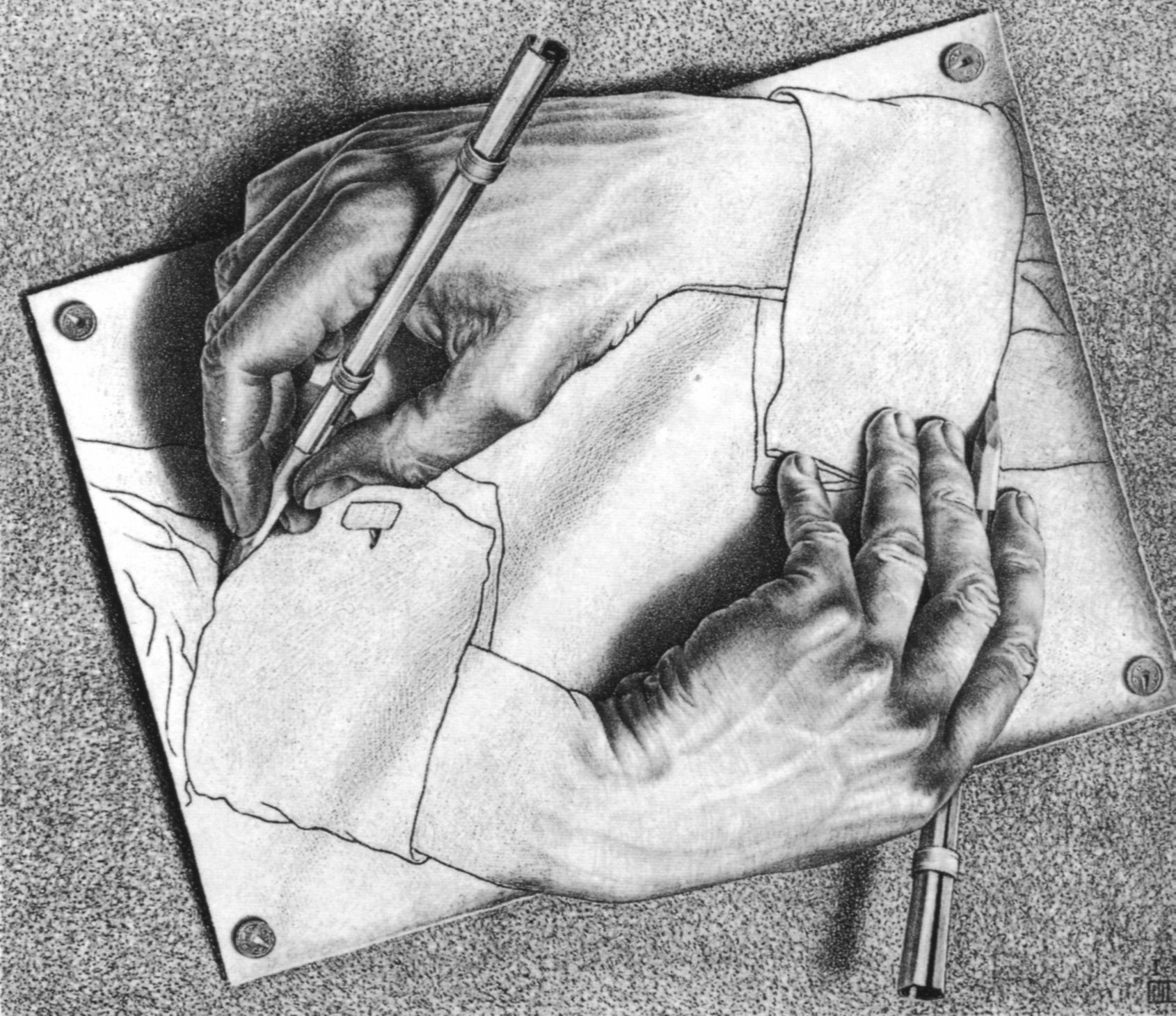
You can compare design thinking to Escher's famous drawing of the two hands. The left-hand draws the right, and the right one the left. The activity of problem setting informs the design process, just as the design process informs the problem setting. The only way to deal with this inevitable circular reasoning is by exploring frames.
References
-
Dorst, K., & Cross, N. (2001). Creativity in the design process: co-evolution of problem–solution. Design studies, 22(5), 425-437.