

1.1 Introduction to Design Thinking and Maker Culture
1.1.8 Why combine these approaches?
 |
A review of the literature of design thinking and maker culture reveals few sources that explore the combination of these approaches within a humanities/digital humanities context. In a 2011 article, Burdick and Willis argue that the Design Thinking community, with their focus on the 'relevance of design methods and cognition in the face of global-scale challenges and complex contemporary issues', and the digital humanities community which has championed the integration of technology as a core modality of the humanities pedagogy and scholarly communication meet at certain vectoral points: 'constructive thinking, problem-solving, collaboration, and multimodality' (546). To this, we would add two additional points of intersection within a teaching and learning paradigm, project-based learning and authentic assessments, which is a design feature of the IGNITE curriculum through its case-based approach.
Combining these approaches creates capacity through balance (Ingalls, 2015, p. 21), both not only with their toolkits and methods, but their theoretical underpinnings and values that promote creative solutions to what designers call wicked problems: problems that seem intractable or impossible to solve. These may be organizationally, community, or society-based: what the United Nation has termed Global Issues or the European Union Societal Challenges.
How the humanities and the creative and cultural sector can be part of addressing those challenges is addressed in the next section: Challenging the Humanities. Balance is about using ones hands as well as one's mind to solve problems. it combines creative and critical thinking. It encourages experimentation and iteration in the realisation that not all solutions (maybe not many solutions) can be found with the first idea that comes to mind. That solutions need not just thinking (or talking), but doing and experimenting, creativity and exploration. Both approaches encourage tinkering and iterating, involving users, customers or audience to be part of the design process: designing with and not only for. Our combination of these approaches encourages the integration of practical responsibility with practical thinking skills (Ingalls, 2011, p. 22).
Both approaches advocate new literacies crucial for 21st century education and work, creativity and eLiteracy within a digital, increasingly networked society in which careers are no longer thought of as linear progressions through an organisation, but, for better or worse, less secure and more mobile. We know the technical skills we teach and learn today will not necessarily be the same we use in five, ten or twenty years. Hence it not about teaching skills, but rather ways of thinking about technology, not as a set of skills that need to be mastered, but fostering a creative approach to new technologies, not only today's but the yet to be invented.
Technology transformations and creative confidence
Burdick and Willis make the point that design thinking's approach to ways of knowing aligns closely with the types of skills that are increasingly valued in our society with increasingly rapid cycles of technology transformation. Nigel Cross terms this ‘constructive’ thinking building upon Charles Sanders Peirce ‘abductive’ reasoning, in which one works from incomplete information and evidence, requiring more intuition and creativity in the decision making process (2011, pp. 548- 549). They further note that 'abduction is a form of reasoning that can function best by making something, reflecting on what’s been made, and iterating', major tenets of both maker culture and design thinking (p. 549).
This approach problem solving may seem to take more time, and it might be felt within an organisation that using precious time for what may seem to be more playful and less serious than other approaches is not a good use of employee time. Yet, providing the space for creativity has been proven to ultimately save time , with a better solution reached. Ultimately, what both approaches have in common is fostering what David Kelley describes as creative confidence.
| #dariah Teach, David Kelley, How to build your creative confidence (YouTube) |
We too believe that everybody has latent creativity, no matter what profession you are in or go into and that there are many ways of approaching new projects or old problems. With the twin underpinnings of Design Thinking and Maker Culture, we feel with the IGNITE course, we are on a powerful journey of discovery and meaning-making.
 |
Exercise: Thinking through making |
Creative brainstorming in practice
|
|
As described on this page, combining design thinking and maker culture gives opportunity for understanding phenomena through constructive thinking, collaboration, multimodality, problem-solving, project-based learning and authentic assessment. Using a creative approach to both use and understand technologies, we can gain new vantage points to deal with complex issues we encounter today, and may encounter in the future.
Exercise instructions
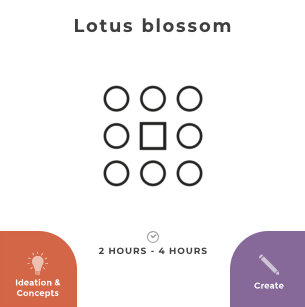
For this exercise, watch Johanna Drucker’s video below in which she gives us her take on thinking through making, and how this relates to Digital Humanities. The design method card on the right is a visual tool that can aid towards adopting a more creative approach towards problem solving and critical thinking and making. Click on the on the following link: lotus blossom card to navitage to the instructions on how to use this card.
As for step 1, use relation between digital humanities, knowledge, and technologies as the center theme to kickstart your creative brainstorming process.
| #dariah Teach, Johanna Drucker on 'Thinking through making' (YouTube) |
References
- Burdick, Anne, and Holly Willis. “Digital Learning, Digital Scholarship and Design Thinking.” Design Studies, vol. 32, no. 6, 2011, pp. 546–556., doi.org/10.1016/j.destud.2011.07.005.
- Ingalls Vanada D. (2015) 'Practically Creative: The Role of Design Thinking as an Improved Paradigm for 21st Century Art Education. Techne Series A, 21(2), 21-33.