

2.1 Mind the Gap - or Is There Really One?
2.1.1 What the Arts and Humanities Bring
 |
This unit was authored by Marianne Ping Huang with the assistance of Esther Kamara and Stephanie Ochiel.
When moving the humanities into the field of complex and real-life challenges, responding to e.g. the UN SDGs, climate, inequity, lack of inclusion, we immediate feel compelled that our competences for critical inquiry as well as the deep knowledge of the many domains will matter. But we also find – not least in the way these domains are taught, and henceforth how learning is provided and in what learning environments – that the humanities has been confronted with a not necessarily smooth transition from content to problem-based learning. The process of moving disciplinary curricula and scholarly traditions anchored in more or less siloed fields of knowledge into more problem-based and cross-disciplinary domains is, as we have seen over the past decades, not easily made on an institutional level, let alone for a student versed in traditional humanities, digitally enabled or not. While many researchers in the humanities study critical societal challenges in domains such as post-colonial studies, globalization, the post-humane condition, and gender and equality studies, knowledge domains that will help us transition towards a future of more equitable and sustainable living. Despite this, and despite emerging and inherently transdisciplinary such as environmental humanities and medical humanities, the 'traditional humanities' as well as the emerging fields, more than the sciences and the social sciences, have struggled to turn highly valuable and historically-tested knowledge into critical and creative problem-solving solutions for real-world challenges.
This was succinctly articulated by N. Katherine Hayles who wrote in her 2012 volume How We Think:
The humanities have specialized in education that aims at enriching a student’s sense of the specificity and complexity of our intellectual heritage, including major philosophical texts, complex literary works, and the intricate structures of theoretical investigations into language, society, and the human psyche. Nevertheless, there must also be a place for problem-based inquiry within the humanities as well as the sciences and social sciences. […] The implications of moving from content orientation to problem orientation are profound. Project-based research, typical of work in the Digital Humanities, joins theory and practice through the productive work of making. Moreover, the projects themselves evolve within collaborative environments in which research and teaching blend with one another in the context of teams with many kinds of skills, typically in spaces fluidly configured as integrated classroom, laboratory, and studio spaces. (Hayles, p. 9)
In this process, we realise that problem solving is a collaborative and multi-disciplinary process, in many cases working not only across disciplines, but sectors. This approach – also called working in a quadruple helix– is connected to design thinking, maker cultures and new learning environments, according to Hayles “spaces fluidly configured as integrated classroom, laboratory, and studio spaces.” This is the underlying proposition in stating that the gap between humanities and the engagement in real-time change making is a myth, but a myth harboured in strong structures governing how knowledge is applied, what counts when applying knowledge. We approach the practices of knowledge production as situated, informed by the not yet told and the unexpected, and definitely not solely based in disembodied reflection. IGNITE curriculum will engage in theories and not least case-studies on how humanities – history, philosophy, heritage studies, aesthetics, letters – are engaged with ways of understanding and learning with technology, showing that no gap need to claimed between humanities and technology or between learning with the humanities and learning for change-making.
In this lesson we will engage with digital divides as social and audience development areas, with the way crafts traditions change innovation, the way contemporary art and aesthetics impact our understanding of how to approach problem definition and solving as well as design processes – overall we will look into how humanities and art blend into collaborative work, and contribute new and unexpected insights into how a new normal may look and how we may learn to be change-makers.
N. Katherine Hayles in conversation with Stacey Cochran
In this 2009 conversation on Artist's Craft with Stacey Cochran, on how technology-innovated literature and humanities knowledge is branching out and answering back with reflective power. The interview also provides insight into N. Katherine Hayles herself as a as a cross-disciplinary scholar and practitioner.|
N. Katherine Hayles (YouTube) |
The Ink After Print Poetry Machine
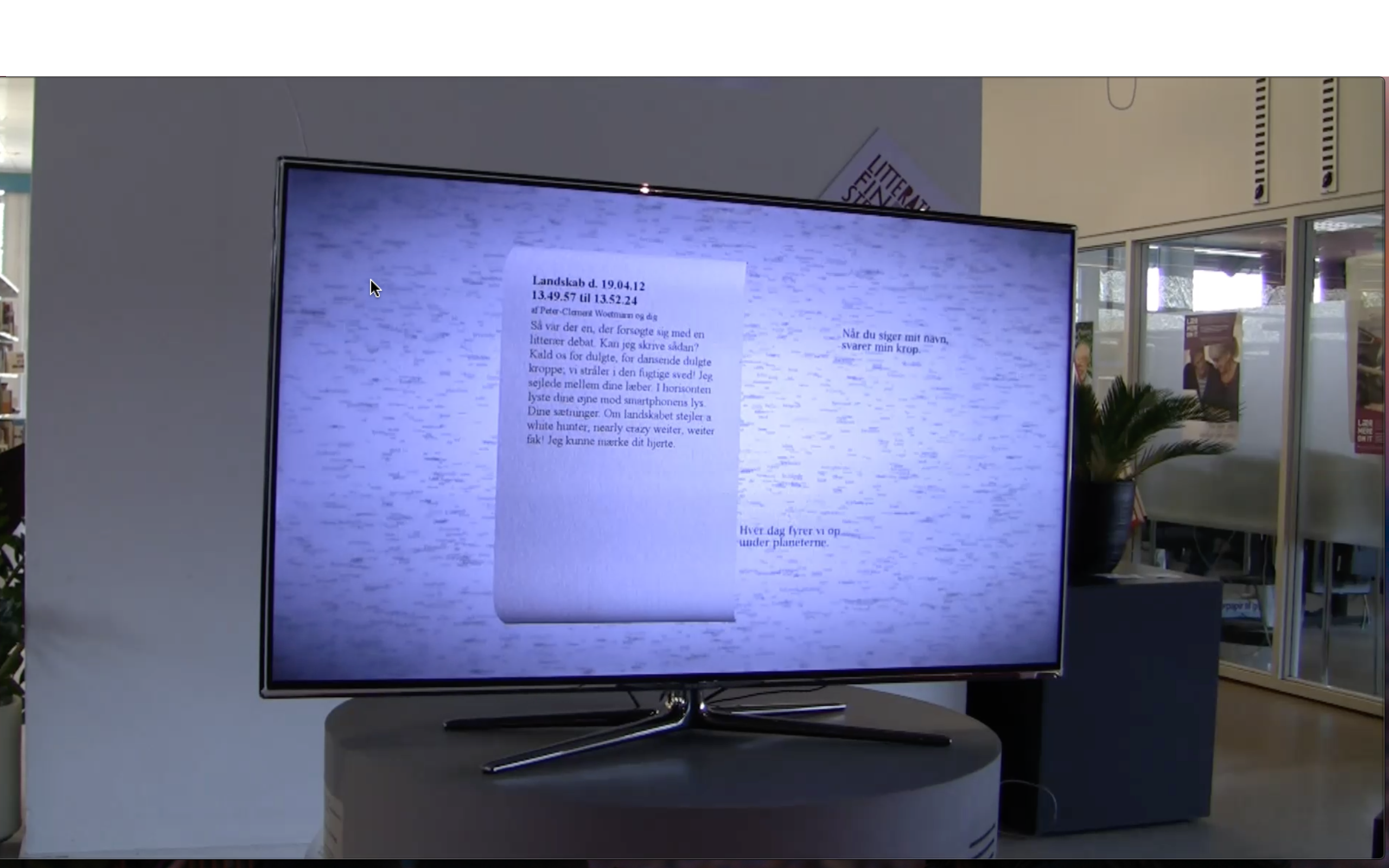
Having watched N. Katherine Hayles in the interview about Electronic Literature, literarity in the digital age and the fluidity of digital writing, distributed authorship, and the robust materiality and strong technology of print matter, we may recognize how core knowledge from literature studies motivates Hayles' interdisciplinary engagement with new literary forms, and new audiences. With reference to the expanded field of literature, we will finish this introduction to what humanities, art, and technology bring by drawing your attention to The Ink After Print Poetry Machine, developed in collaboration between Participatory-IT researchers and TEKNE Productions at CAVI (Aarhus University), who worked with contemporary authors, and public libraries across Scandinavia. The Poetry Machine is designed for audiences to engage and experiment with the fluid materiality of digital writing as well as with the materiality of poetry–lines, rhythm and meter, metaphors–and the imaginative work of an author. The machine also introduces the materiality of print books, as book volumes are connected into a sensor system allowing the reader/writer at the machine to use these volumes to point, select, and sample lines from poetry lines floating on the screen into her own poem, which is then printed onto a paper strip very similar to your library receipt. The screen visualisation of The Poetry Machine draws on a database of poems and texts by Radu Vancu (Romania), Yan St-Onge and Benoit Bordelieu (Quebec), Morten Langemand (Norway), Harald Woetmann and Ursula Ankjær Olsen (Denmark). The latter turned patoum, a traditional Malaysian folk poem in lines repeated in patterns, into her contribution for The Poetry Machine.The Poetry Machine has been hosted by several libraries, and presented at various conferences, including the Electronic Literature Organisation Conferences and at the closing event for the Creative Europe project Turn On Literature. Contrary to experiments with machine writing, the Poetry Machine incorporates–or embodies–high quality literature written in complex structures and for the ergodic qualities of electronic poetry. Click on the image below to view the Poetry Machine in action.
 |
|
The Poetry Machine Demo, with Playful Researchers and Developers |
 Exercise: Types of electronic literature
References
- Belfiore, Eleonora & Bennett, Oliver, The Social Impact of the Arts, Palgrave Macmillan, 2008
- Fritsch J, Pold SB, Vestergaard LS, Lucas M. “INK – Designing for Performative Literary Interactions”. Personal and Ubiquitous Computing. 2014.
- Hayles, N. K., Writing Machines, MIT Press, Cambridge MA, 2002; Electronic Literature. New Horizons for the Literary, University of Notre Dame Press, 2008; How We Think. Digital Media and Contemporary Technogenesis. University of Chicago Press, 2012
- Pold, Søren Bro and Christian Ulrik Andersen. “Post-digital Books and Disruptive Literary Machines: Digital Literature Beyond the Gutenberg and Google Galaxies”. Formules/Revue Des Creations Formelles. 2014.
- The Public Value of the Humanities, (ed. Jonathan Bate), Bloomsbury Academic 2011
- The Poetry Machine–Collaboratively Generated Literary Interface: http://www.inkafterprint.dk/
- Turn On Literature: http://www.turnonliterature.eu/