

2.1 Mind the Gap - or Is There Really One?
How the humanities leap into human-centered problem-solving
2.1.8 Art as Enabling Human-Centred Design
 |
Inviting artists to innovate with technology has grown into a mega-trend with research programmes such as the European Horizon 2020, where lighthouse projects provide funds for artists to disturb or disrupt more linear technology innovation. Such incentives come with a double sided aim–on one side to test new technologies for more imaginative and critically informed outcomes which may be further explored and exploited, on the other side for the artists to frame and experiment with new technologies in ways that may create better societal impact in a fuller picture–or at least show pathways for such impact.
Obviously, artworks and artistic research with or on technology are widely found outside major research and innovation programmes, otherwise we wouldn’t find the demand from these programmes–art-driven research into technology is done by single artists as well as with artist collectives, art institutions and within the research programmes at Arts Academies. Yet, integrating art and artistic research in transnational, highly profiled R&I programmes and with high level research institutions such as Geneva-based European Physics Centre, CERN turns the table 180” to an explicit demand for other takes on innovation than can found within Science and Technology themselves. Collaborations between artists, scientists and engineers are about finding new ways, when it comes to basic research (as with CERN) it is not just about new solutions to challenges, but new ways of thinking about challenges. Such collaborations are very much about learning across disciplines and cognitive approaches, integrating associative and lateral thinking with analysis and experimentation as well as with synthesis and construction: applying the making practices in studios and labs in what very much resembles design processes.
|
|
|
| Art at CERN |
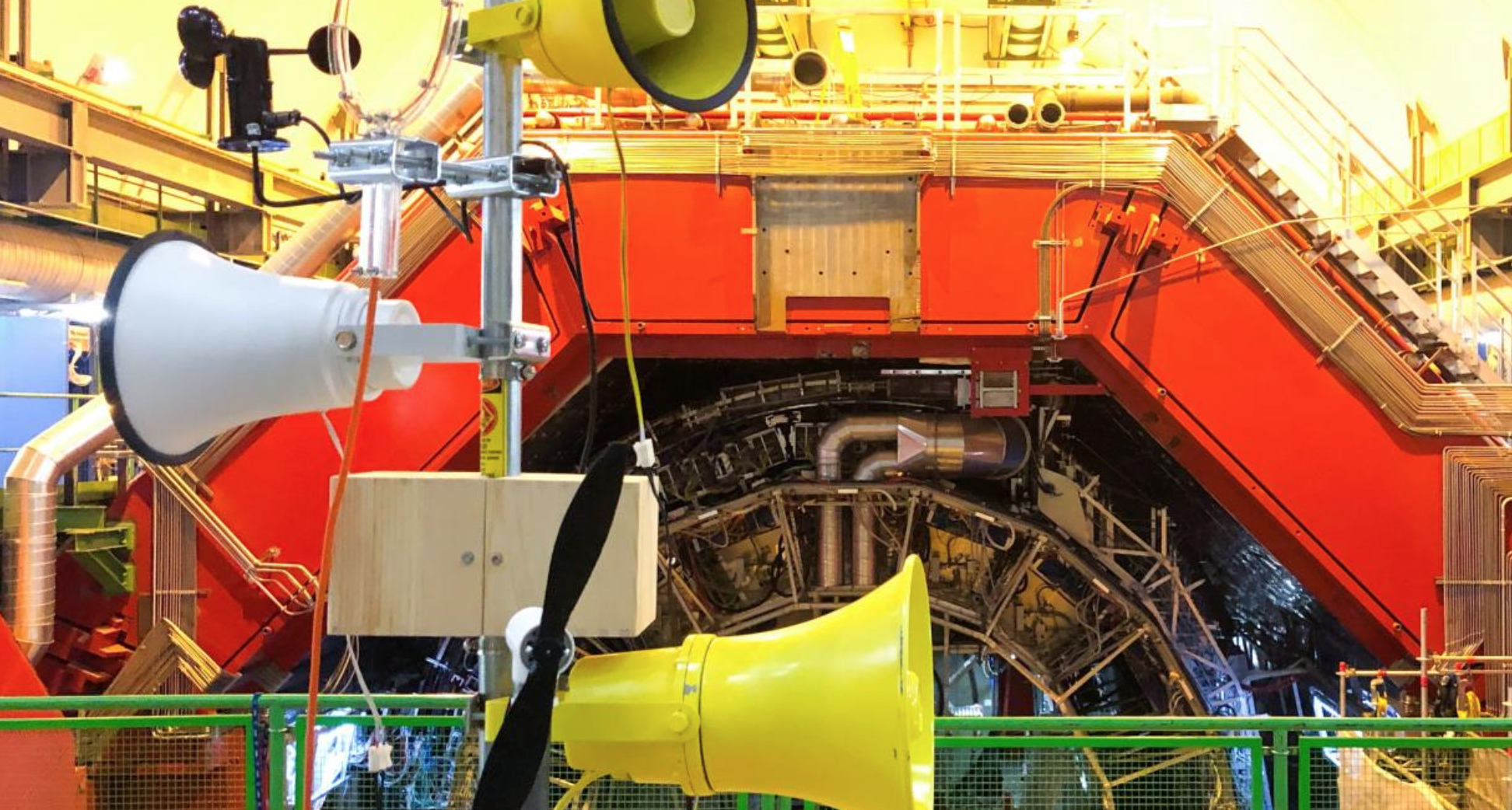
At CERN, the ART AT CERN initiative has been running as a lab-based residency programmes since 2011, instigating co-creation between CERN scientists and engineers. Since 2011 more than 40 artists and artist collectives have contributed on basic research. ART AT CERN also reaches out to wider audiences through collaboration with internationally renowned art institutions and festivals such as Ars Electronica in Basel.
Ge Wang Looking for Artful Design
In 2018 Associate Professor, Ge Wang (Stanford University’s Center for Computer Research in Music and Acoustics) published the ‘Musiccomic Manifesto’ of Artful Design, an investigation into and teaching approach for making and designing with engineering, art, humanities and social sciences. In the short video, Ge Wang presents his book project and the way it is grounded in his own research and practice as a computer music artist, designing and teaching with technology for music and sound production. His overall message "is really trying to look at engineering, art, humanities, and social sciences not as things to necessarily put together, but as things that should have never been taken apart".| Stanford professor pens design manifesto in comic book form (YouTube) |
What literally strikes you at the first glance at Artful Design is the innovative approach Wang takes to academic and textbook production. Artful Design is in itself a piece of design, and in the format of a ‘photo-realistic comic book’ it stands out as walking the talk of connecting people through expressive technologies. Ge Wang’s book-design is based on print technology, an old and still impactful technology with great material qualities and creative potentials, which in the case of Artful Design also fuses with the media format of photo-documentary or the visual essay. Furthermore, Wang uses the art of the comic book–or graphic novel or essay–in designing his narration, e.g. visual panels and page design, and he inserts himself as a visually recognisable and guiding narrator. In eight chapters, with etudes, interludes and a coda (referencing musical composition) he takes us through definitions of design, cases of designing and coding, designing for interaction, designing for play and designing for the social. Ge Wang puts his design cases in dialogue with the materiality of technology and with co-creating as a social encounter, thus referencing maker cultures as an artistic approach, and he underpins each approach highlighting that the ethics of design is found in the ways truth and beauty make good design ‘embeddable’ into everyday life. Finally, this is all mirrored in Wang’s concluding eight ‘Laws of Artful Design’ (pp. 458-59):
|
|
|
Ge Wang's Artful Design Comic Book
|
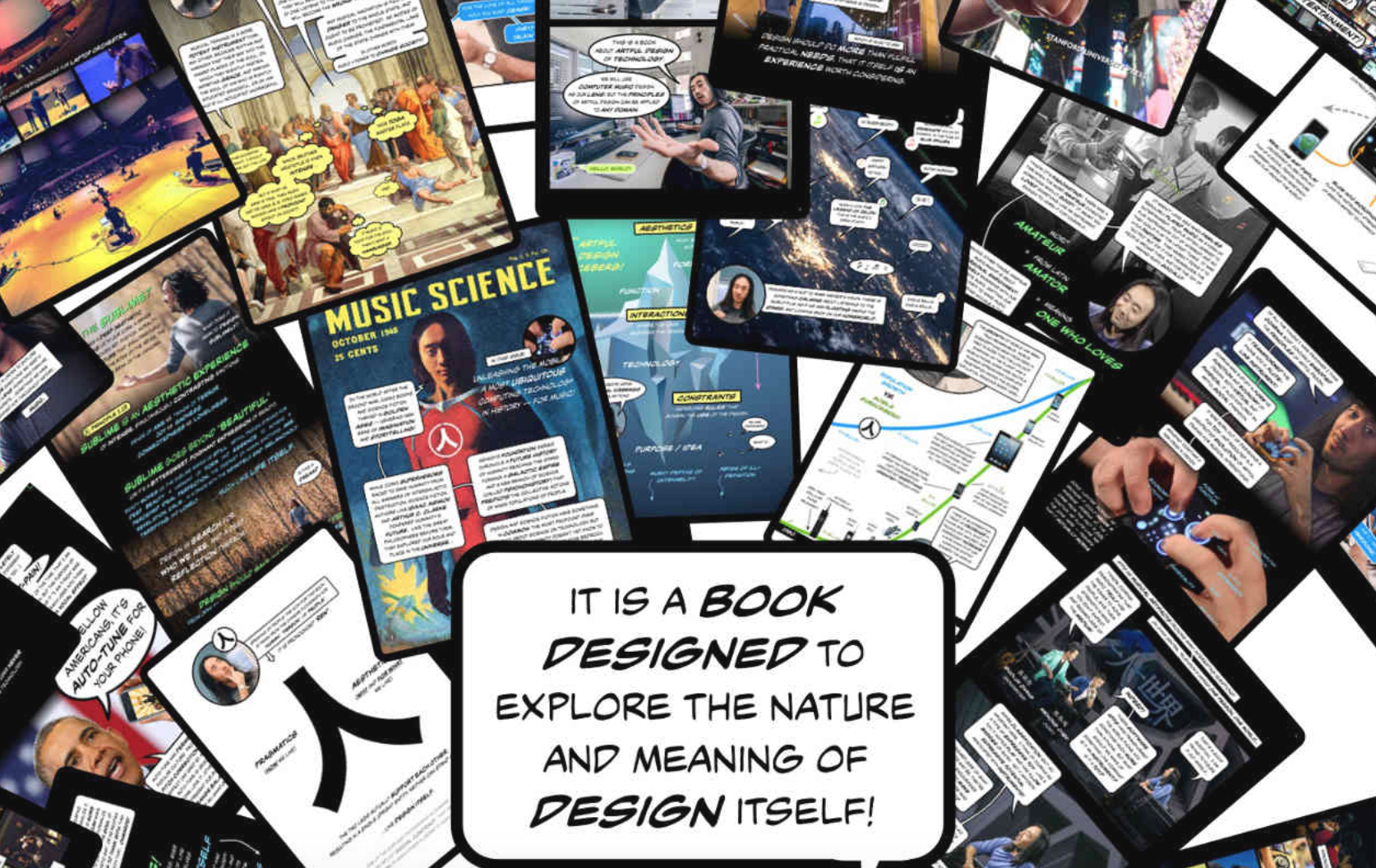
 Exercise: Based on Ge Wang's Artful Design philosophy, try and identify the eight Laws of Artful Design
In the video above, Wang alludes to the pillars of Western philosophy as guidelines for designing. There will be epistemology, ethics and aesthetics involved in each design decision, but he also turns to Eastern philosophy (pp. 278-303) when interluding in dialogue with ‘zen master’, Perry Cook, on how to design computer music instruments. The comic book dialogue basically goes through the intertwining, social and embodied rhythms of designing, thinking, and making. In the Coda for Artful Design, Wang turns to the notion of the sublime–of the very small things, of the immense, and of the invisible–as a way of pointing to where artful design, the synthesis of the ‘means-to-ends’ of design and the ‘ends-in-themselves’ of art, goes beyond itself into the frames of a Bigger Picture.
Art, design, and engineering are at the forefront of Ge Wang’s Artful Design, but it is also obvious how Humanities disciplines such as philosophy, literature studies, media studies, anthropology, and of course musicology create fundamental strands of knowing within Wang’s thinking, designing, making, researching and very importantly, teaching artful design.
For how making and designing combines, watch Ge Wang’s TEDX Talk on The DIY Orchestra of the Future.
| Ge Wang: The DIY orchestra of the future (YouTube) |
References
- Art at CERN: https://arts.cern/
- Journal of Artistic Research: https://www.jar-online.net/
- Rancière, J. (2000). Le Partage de sensible. La Fabrique, Paris
- Wang, G. (2018). Artful Design: Technology in Search for the Sublime. A MusiComic Manifesto. Stanford University Press