

1.1 Telling Stories: From the Analogue to the Digital
1.1.1 Narrative and Storytelling
 |
This unit was authored by Susan Schreibman and Marianne Ping Huang with the assistance of Esther Kamara and Stephanie Ochiel.
Telling stories, narrating what is important about our lives and our culture, what is important for our civilization, our culture, and our way of living, is as old as mankind. Even older. Before writing systems were invented, even before humans evolved as a species, Neanderthals at three sites in Northern Spain created cave paintings some 64,000 years ago, more than 20,000 years before the earliest humans arrived in Europe.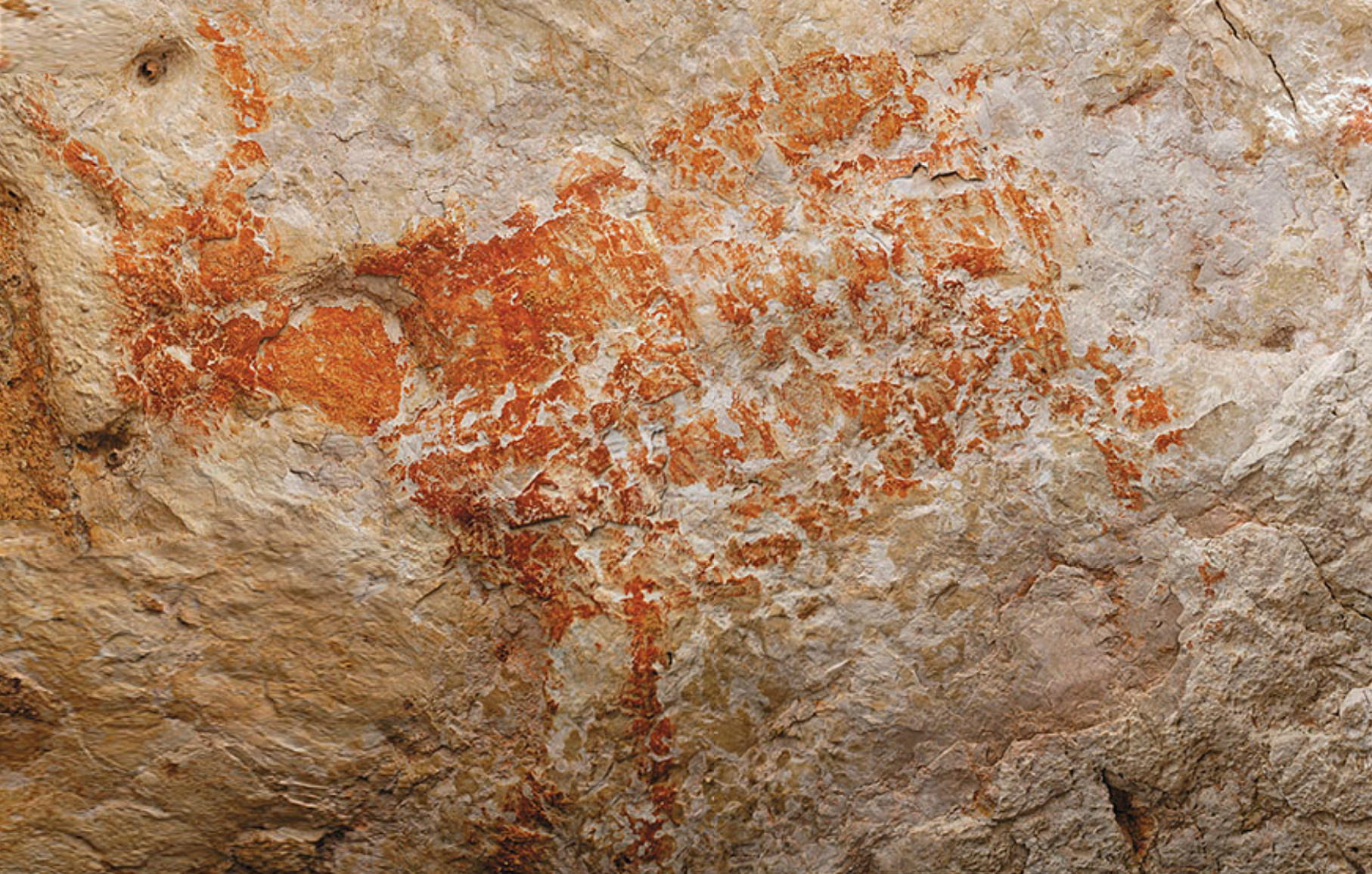 |
|
Cave Art from Lubang, Borneo. Click image to enlarge. |
Some of the earliest known cave art created some 17,000 years ago by humans is found in Lascaux, France. These paintings, not unlike the paintings from their paleolithic predecessors, depict animals associated with the hunt. Perhaps this is because it is one of the most important things in their lives, their source of sustenance.
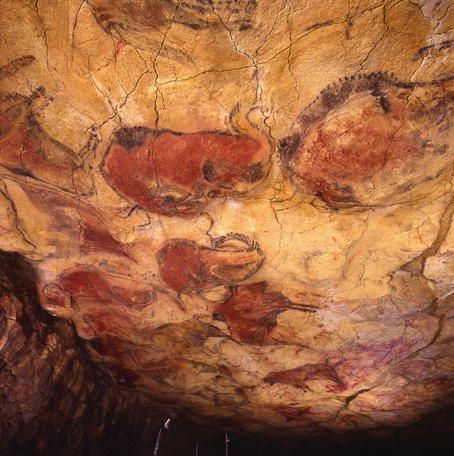
Why did the earliest humans, and even before them the Neanderthals, feel the need to record their lives, to make something beautiful and iconic, to depict the world around them? What stories do these cave paintings tell about the people who inhabited these places? What was important to them? How did they view the world around them. Perhaps a difference between the earlier cave paintings and those created at Lascaux is that in the latter paintings there is a clearer narrative element. The paintings teem with animals in motion. In these paintings one can almost feel the adrenaline rush of the hunt, the magnitude and the magnificence of nature. A theory about these paintings is that they do not represent the everyday, but the lives of these early people as they would wish them to be: full of plentiful game and success in the hunt (Chatterton, 2017).
 |
|
Cave Art found in the Altamira Caves in Northern Spain. Click image to enlarge. |
No single period or society can do without narratives. And, a good number of contemporary thinkers hasten to add, whatever you say and think about a certain time or place becomes a narrative in its own right. From the oldest myths and legends to postmodern fabulation, narration has always been central. Postmodern philosophers may submit that there are no longer any grand, encompassing narratives, but they also con- tend that everything amounts to a narrative, including the world and the self. If that is correct, then the study of narrative is not just a pastime for literary theorists in their ivory towers. Instead it unveils fundamental culture-specific opinions about reality and humankind, which are narrativized in stories and novels. (Luc and Vervaeck, 2005, p. 1).
Show, Don't Tell
The stories we tell today can be just as iconic and full of mystery as those told by ancient peoples. Stories that invite the reader in, to share the world being created, or to complete the narrative, are the most powerful. Showing not telling is used in domains as diverse as creative writing and marketing. When audiences are active in making meaning they are more likely to remember the story, empathize with protagonists, or spend time working out the moral or kernel of the story.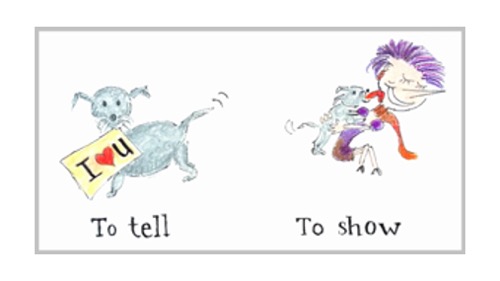 |
|
An example of Show, Don't Tell. Image source: Enchanting Marketing. Click image to enlarge. |
The goal of storytelling is not about providing audiences with information, although specific details: who, what, where, when how, are be used to make the story cohere, to convey the story's raison d'être, to build a narrative world as evocative and full of mystery as the prehistoric cave paintings. Narratives can be utilised as forces for good or for evil: and our interconnected media-driven society produces both at a dizzying rate.
During the writing of the content of this course, its authors were in lockdown due to the Covid-19 pandemic. While misinformation about the origins of the pandemic, as well as possible cures flourished, what rose above much of the misinformation, what we we chose to capture and share as a society, through news outlets but even more so on social media, were stories of heroism and of faith, of love and of loss. We retold stories through social media of artists singing from their balconies and cities cheering healthcare workers. When researchers look back at this time they will find a multiplicity of interlocking narratives: official government narratives, as well as the individual, those that were shared and liked. These individual and societal gestures speak to us as we try to make sense of the un-reality of our lives. They are just as powerful to the people who experience them today as the narratives created by our ancient ancestors were in depicting the world around them. It reminds us that despite the differences between our society(ies) and theirs, despite the millennia between us, what binds us as humans is more powerful than what separates us.
 Exercise: Read the statements below and select the right answer
References
- Aubert, M., Setiawan, P., Oktaviana, A.A. et al. Palaeolithic cave art in Borneo. Nature 564, 254–257 (2018) doi:10.1038/s41586-018-0679-9.
- Images courtesy of Thomas Quine - Cave paintings, CC BY-SA 2.0, https://commons.wikimedia.org/w/index.php?curid=22855657; And 5-five5: http://5-five-5.blogspot.com/2017/01/cave-of-altamira-and-paleolithic-cave.html.
- Chatterton, S. (2017, December 5). What the Lascaux Cave Paintings Tell Us About the Nature of Human Desire. Retrieved from https://medium.com/@stevechatterton/what-the-lascaux-cave-paintings-tell-us-about-the-nature-of-human-desire-4c8d06deef83.
- Hoffmann, D. L. , C. D. Standish, M. García-Diez, P. B. Pettitt, J. A. Milton, J. Zilhão, J. J. Alcolea-González, P. Cantalejo-Duarte, H. Collado, R. de Balbín, M. Lorblanchet, J. Ramos-Muñoz, G.-Ch. Weniger, A. W. G. Pike. U-Th dating of carbonate crusts reveals Neandertal origin of Iberian cave art. Science 23 Feb 2018 : 912-915.
- Luc, Herman and Bart Vervaeck (2005). Handbook of Narrative Analysis. University of Nebraska Press.