

1.1 Telling Stories: From the Analogue to the Digital
1.1.7 Storytelling as Meaning Making in Multiple Perspectives
 |
As described earlier in this unit, we experience storytelling in many forms, modalities, and media. And relinquishing the Grand Narratives, the Big Theories and the teleological historiography of Western thinking,we find ourselves in a rich and complex mesh of histories, stories and storytelling modalities, cutting across time and space while increasingly transmitting in non-stop flows of text, images, videos, and sound. During the 20th Century storytelling in the modes of secondary orality and interchanging media ecologies grew to become interwoven with our everyday lives and to a large extent the communities we live by.
By late 20th Century, the Western master tropes collapsed and opened up to insights into a multiplicity of culturally intersecting perspectives, histories and archives, providing varieties of point-of-views for making sense of ourselves and the world. Having left behind a teleological, Western dominated historiography of intellectual, technological and material progress and growth to enter cultural openings of multiple identities, and also to encounter the black boxes of globalised economies and politics, another defining contour of time and space emerges by the early 21st Century with the Anthropocene. The Anthropocene goes beyond traditional understanding of history, spanning the present interglacial, geological era (formerly known as the Holocene), during which Earth has been transformed beyond repair by mankind, and into a future of millions of years in which the impact of humankind, even after its extinction, will have geological effects. The perspective of the Anthropocene positions humanity in other ways with technology and nature, and challenging anew the way we tell stories to make meaning of our interdependences: in the crossing between anthropology, geology and climatology.
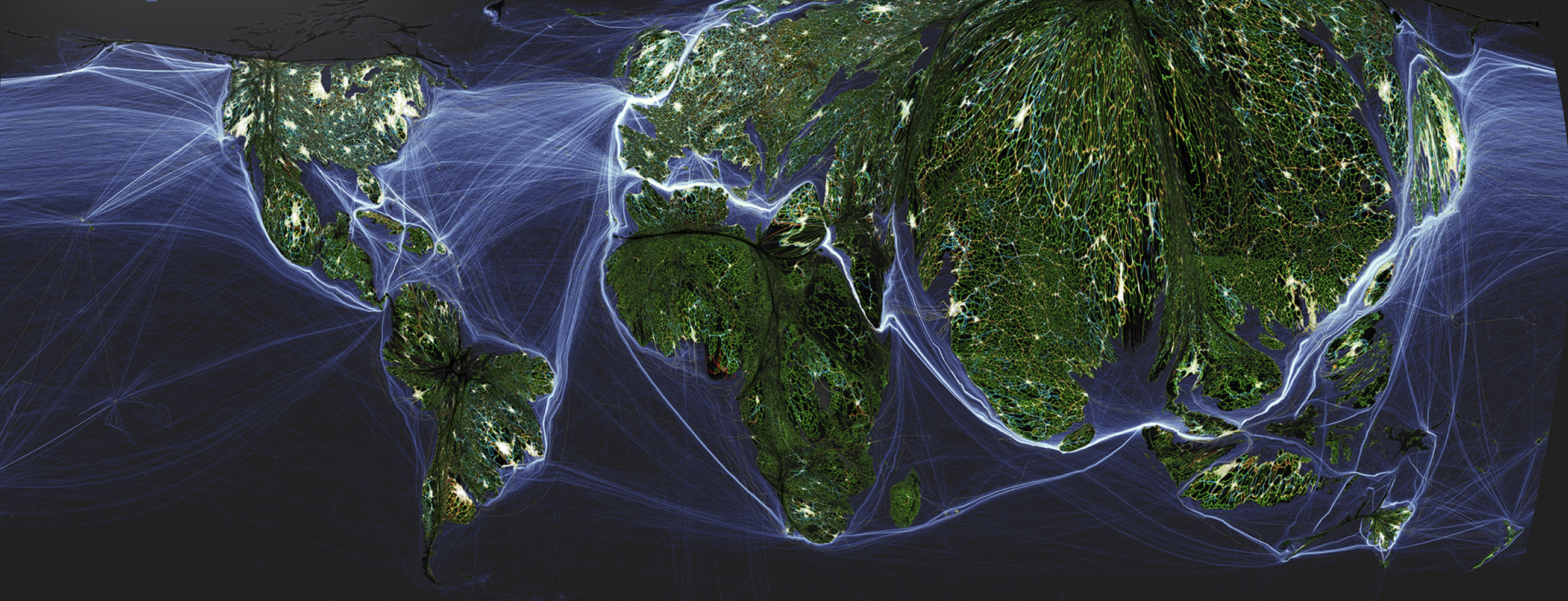
Human exchange and communication leave major footprints on a global scale. The cartogram below (assembled by Globaïa, an organisation raising awareness of global changes in the Anthropocene) shows a mesh of densely populated areas, light pollution from megatropolises, roads and railway lines, shipping routes, pipelines, transmission lines and submarine cables. The mesh clearly indicates how resource, information and communication infrastructures shape our world. One might call this map an Anthropocene story of the Global Village, into which our daily communications and micro-stories flow.
 |
|
World Map showing global interconnectedness in ship routes, roads, railways and urban light pollution. Click image to enlarge. Source: http://www.viewsoftheworld.net/?p=4515 |
Facing Gaia
French sociologist of science, Bruno Latour, has in his latest writings, entered into what one may consider a grand experiment of telling the story of the Anthropocene and how it might reframe science, politics, and religion in new ways. In Facing Gaia (2017), Latour writes about 'the fatal date of 1610:Why 1610? Because the reforestation of the American continent had, by that date, led to the stocking of so much atmospheric CO2 that climatologists could use it as a minimum quantity on the basis of which they could measure its regular increase. But why this massive reforestation? Very simply [...] because the extermination by the sword, but also by contagion and disease, of nearly fifty-four million Native Americans, in the wake of Columbus's "discovery of America." The "great discoveries," colonization, the fight to occupy territories, forests, carbon dioxide – it's all here, defining the Anthropocene: anthropology plus climatology in a violent land grab.
But 1610, as you surely remember, was also the year Galileo published Sidereus Nuncius, the "Messenger from the Stars" that is said to have brought universal history out of its "closed world" to propel it into the "infinite universe." Remember what Brecht said: "Today is 10 January 1610. Today mankind can write in its diary: Got rid of heaven." We have to acknowledge that these two references to 1610 resonate quite well together, since the first brings us to the limits of the Earth from which the second had initially pulled us away; whereas we believed we were in a nature finally indifferent to human action, we find ourselves plunged back onto an earth that has never stopped reacting in response to the unforeseen consequences of our acts of domination." (Latour 2017, pp. 184-85)
Latour's writings correspondend with e.g. Isabelle Stengers' post-humanist approach and Donna Haraway's seminal theories on what it means for humans to make kin, to acknowledge and live in interspecies relations or kinship. The storytelling perspective comes with references to and practices akin to science fiction writing as in Harraway's "The Camille Stories" (Haraway, 2016), making meaning by experimenting with a new order and temporality. This can be found also in Latour's 'tale' on "how to convene the various peoples (of nature)," (Latour 2017, Chapter 5) or how climate challenges may or may not bring politics, science, and religion back to earth and into partnerships. Not surprisingly, Latour compares this tale with Game of Thrones. In the above quotation, though, Latour brings together – in a snapshot of 1610 – the workings of the anthropocene, and how the effects of catastrophe seem almost irrevocable as we live in times long past catastrophe itself.
When looking for perspectives to take on storytelling within this global, temporally and spacially frame, you may choose an aerial or even galactic perspective or you may zoom into the material, almost haptic. Try the sliding images below.
 Interactive: Click and hold the slider at the top of the image and drag it down vertically to reveal the second image
| © Mutua Matheka/ProKraft Africa(YouTube) |
In the perspective of digital storytelling, all above contexts have impact – most obvious is the way storytelling happens in many modalities and on converging platforms, from Facebook, and Twitter to YouTube and Instagram. Storytelling is a way of building brands, identities, communities, and audiences; very much dependent on a participatory prosumer-culture and its prerequisite in easy accessible technologies – Twitter being possibly the best example of the present. In this flux of stories, in which also news and journalism at large are embedded together with governmental declarations, meaning may collate and stick temporarily, creating communities but also controversies, conflict, and echo chambers, to be approached critically and analytically. Storytelling, on the other hand, which explicitly strives to suggest new meaning and make sense of past and future states, relies on critical knowledge about material aspects of media and modalities used and of cross-archival and cognitive structures for connecting a vast backdrop of time and histories with future insights.
Memories and perspectives: Nostalgia for the Light
In his 2010-documentary, Nostalgia for the Light, Chilean filmmaker Patricio Guzmán approaches the trauma of Chile's recent history and the loss of public memory following the 1973-coup against Salvador Allende's government by the Pinochet Junta. Nostalgia for the Light brings both individual memory and loss of recollection into voice as we witness oral and embodied histories of great force, going across generations. This is a known way of telling stories in documentaries, but Guzmán also works intricately with deeper historical and wider galactic perspectives.|
Patricio Guzmán, Nostalgia for the Light, Icarus Film 2010 (YouTube) |
In Michael Fox' interview (see video below), Guzmán starts by saying: "A country without a documentary is like a family without as photo album". This positions the documentary as public memory, between family memories and official history, and it also states the documentary as a critical counter-modality to the flux of media-transmitted news stories, which Guzmán explicitly critiques for taking part in a loss of public – or collective – memory. Nostalgia for the Light is also a call for an audio-visual revolution. Guzmán makes the individually told stories of atrocity and grief into a constellation which forms a post-memory.
His film essay also visually – and metaphorically – provides a grand scale, temporal and spatial scenario for this post-memory storytelling, with the choice of location in the Atacama Desert of Northern Chile. The Atacama is the one place on earth without humidity, which provides extraordinary conditions for advanced astronomy and the desert houses a number of observatories which would have positioned Chilean astronomy as trail-blaising in science. Atacama, the size of Portugal, also holds rich archaeological finds from numerous pre-Columbian cultures.
But Atacama has also become the location of trauma: as the site where concentration camps for political prisoners was located during the Pinochet era, where political opponents to the regime were pushed from helicopters, and as the location for mass graves for Chile's disappeared. In the Atacama, where cultural and galactic origins are researched and we recognise an echo of the Anthropocene, Guzmán encounters the women searching in the sand for the remains of their loved ones.
The telescope and the landscape both serve as visual metaphors for meaning making in grand perspective, the galactic and the earthbound also connect in some of the stories told: one of the women wishes that the telescope could be turned towards the earth and reveal where her relatives are buried, another finds some reparation in knowing that minerals found in the galaxies also are found in our bodies and the bone fragments scattered in the desert. In Nostalgia for the Light, Guzmán connects forms and modalities of storytelling in a critical approach to media-conveyed stories, official history writing and archival loss or bias, and he also succeeds in a brilliant creation of post-memory whilst stating that to him, truth is no longer found in history, but maybe in the stars. Watch Michael Fox' interview with Guzmán, to learn more about the filmmaker's approach to storytelling and media, public memory and history:
|
Michael Fox: Nostalgia, Memory, and Revolution: |
Telling stories with awareness of contexts and the points-of-view which establishes the single narrative thread or element in the interconnectedness of formats and media, is part of a design thinking and human-centred approach to the challenge of discovering possible pathways for future states, as well as how such pathways have already been with us throughout history. In his small political design theory, Weltentwerfen (2017), Friedrich Borries distinguishes between design that creates (entwerfen) and design that subjects its creative powers (unterwerfen) as a distinction that comes with being able to relinquish the effectiveness of many design and communication systems, and to stay with the chaos of multiple points-of-view, as it is to stay in the world with an eye for its small tales and details. Because designing always comes with intervention and all designs – be it services or products – impact the world we inhabit, we need to further the ability to design with storytelling which make sense of the futures nested in our everyday lives.
 Exercise: Read the statements below and select the right answer
References
- Borries, Friedrich: Weltentwerfen. Eine politische Designtheorie. Edition Surhkamp, 2017.
- Fox, Michael: "Nostalgia, Memory, and Revolution: An Interview with Patricio Guzmán" (YouTube, 2012).
- Goméz-Barris, Macarema: "Atacama Remains and Post Memory", Media Fields Journal 5, 2012.
- Guzmán, Patricio: Nostalgia for the Light, Icarus Film, 2010.
- Haraway, Donna J.: Staying with the Trouble. Making Kin in the Chthulucene. Duke University Press, 2016.
- Latour, Bruno: Facing Gaia. Eight Lectures on the New Climatic Regime. Polity Press 2017.
- McLuhan, Marshall: The Gutenberg Galaxy. University of Toronto Press, 1962.