

4.1 Introduction to Phygital Heritage
4.1.1 Introduction
 |
This unit was authored by Eslam Nofal.
Heritage forms the evidence of the fruitfulness and diversity of our past. Accordingly, most heritage artefacts represent a vast amount of information, ranging from simple factual aspects to more complex qualitative, tacit qualities and values. Following the current movement towards the democratization of culture (Gattinger, 2011), there exists a general tendency towards making heritage information more available and accessible to the wide public, such as to make people aware of the value and richness of their and others’ heritage. Heritage information tends also to be communicated to support its deeper understanding, or to engage and even immerse visitors in heritage environments (Rubegni et al, 2010). Most typical forms of communication occur via conventional means, such as written labels or audio guides in museums. Yet following the rapid advancements offered by modern digital technologies, heritage information is now also increasingly represented via more dynamic and interactive formats, including websites, smart phone applications or virtual and augmented reality worlds. In addition, recent developments like the Internet of Things (IoT) (Vongsingthong and Smanchat, 2014) demonstrate how digital technologies are now becoming deeper integrated within the fabric of our physical reality. As such, it is claimed (Vongsingthong and Smanchat, 2014) that the Internet will no longer be only about people, media and content, but also will include real-world physical assets as networked objects able to exchange information, interact with each other as well as with people. Along with these emerging technological movements, an overarching term “phygital” has been proposed (Uspenski, 2013; Teo, 2013; Nakazawa and Tokuda, 2007; Lupetti et al, 2015; Bazzanella et al, 2014) that conceptualizes the blending of the physical and the digital, in so far that they do not simply complement, but rather reinforce each other. Accordingly, the term “phygital” was coined (Uspenski, 2013) to denote how everyday objects are connected to their environment, gathering the information and adapting their performance accordingly without human intervention.The field of marketing has used the term “phygital” (e.g. (Teo, 2013) as a conceptual idea that bridges e-commerce tools to physical stores, often to connect the digital presence of a brand or product to an immersive real-world experience, wherein a digital action can trigger a physical reaction, or vice versa, a physical action can result in a digital reaction, as in the below video. Such endeavor can be typically achieved by making the physical world a type of information system, such as by embedding machine-readable traces or sensors into physical objects so that they are able to communicate to users through digital interfaces (Teo, 2013).
| Phygital Marketing (YouTube) |
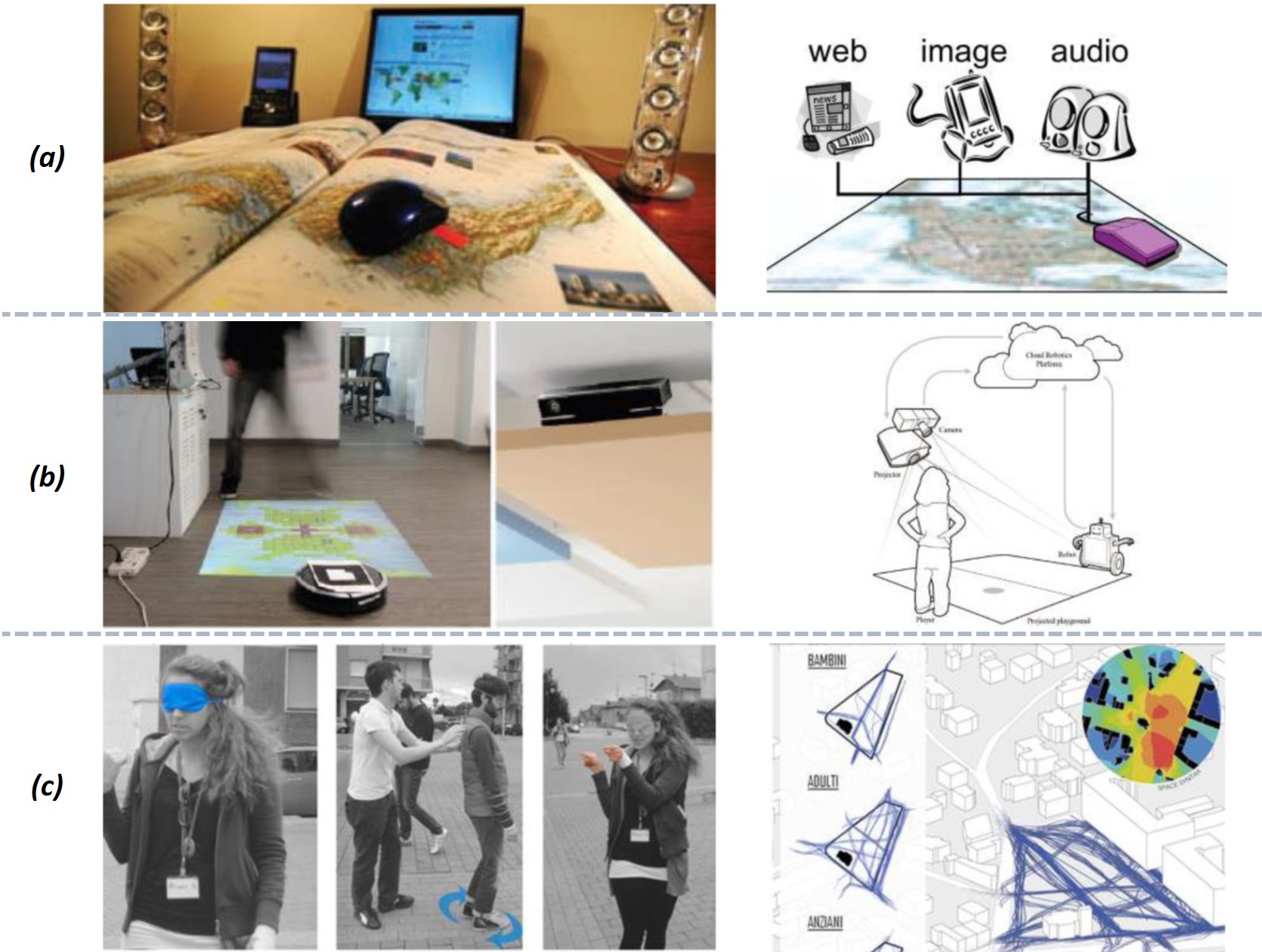
However, phygital characteristics can also be recognized beyond the field of marketing and retail, with application domains as diverse as education, gaming and tourism. For instance, phygital map exploits the physical advantages of paper-based Atlases such as the ease of navigation and the tactile impression of browsing, and merges these with the qualities of digital media, like allowing access to a wide range of audio and video content, which even can be regularly updated (Nakazawa and Tokuda, 2007). Similarly, phygital game adds a physical experience to a compelling digital game in order to reduce the necessary screen time in favour of more healthy forms of physical engagement (Lupetti et al, 2015), hereby allowing the embodiment of the user into a robot as the manifestation of the virtual into the physical. The idea behind phygital can even be deployed as a participative method, as the project phygital public space demonstrates how citizen engagement can be fostered via digital blogs for easily sharing and shaping their public space by stimulating interaction between the participants, gathering information and reporting the analogic data on a shareable bases (Bazzanella et al, 2014). Here, the project also merges physical onsite workshops and analyses such as sound and visibility surveys to capture the flow map of pedestrian’s movement in the public space, and merges all this data into a phygital experience.
 |
|
Examples of phygital approaches: (a) phygital map: paper-based Atlas merged with digital media contents (Nakazawa and Tokuda, 2007); (b) phygital game: projected playground with robot (Lupetti et al, 2015); (c) phygital public space: digital blogs and physical surveys to share and shape public spaces (Bazzanella et al, 2014). (Click to enlarge the figure) |
References:
- Bazzanella, L.; Roccasalva, G.; Valenti, S. (2014). Phygital public space approach: A case study in Volpiano. Interaction Design and Architecture(s) Journal (IxD&A), 20 (2014), pp. 23-32.
- Gattinger, M. (2011). Democratization of culture, cultural democracy and governance. In Canadian Public Arts Funders (CPAF) Annual General Meeting, Future Directions in Public Arts Funding: What Are The Shifts Required? Whitehorse, Yukon.
- Lupetti, M.L.; Piumatti, G.; Rossetto, F. (2015). Phygital play HRI in a new gaming scenario. In Proceedings of the 7th International Conference on Intelligent Technologies for Interactive Entertainment (INTETAIN), Turin, Italy, 10-12 June 2015, pp. 17-21, DOI: https://doi.org/10.4108/icst.intetain.2015.259563
- Nakazawa, J.; Tokuda, H. (2007). Phygital map: Accessing digital multimedia from physical map. In Proceedings of the 21st International Conference on Advanced Information Networking and Applications Workshops (AINAW ’07), Niagara Falls, Ont., Canada, 21-23 May 2007, pp. 368-373, DOI: https://doi.org/10.1109/AINAW.2007.288
- Rubegni, E.; Di Blas, N.; Paolini, P.; Sabiescu, A. (2010). A Format to design narrative multi-media applications for cultural heritage communication. In Proceedings of the 2010 ACM Symposium on Applied Computing (SAC ’10), Sierre, Switzerland, 22-26 March 2010, pp. 1238-1239, DOI: https://doi.org/0.1145/1774088.1774350
- Teo, V. (2013). The Internet of Things: Let’s Get Phygital, retrieved online on July 25th 2016 from: https://www.clickz.com/the-internet-of-things-lets-get-phygital/39692/
- Uspenski, I. (2013) Shared in confidence: A machine to a machine (The Birth of post-semantic aesthetics). In Proceedings of the International Conference Beyond AI: Artificial Golem Intelligence, Romportl, J.; Ircing, P.; Zackova, E.; Polak, M.; Schuster, R. (Eds), Pilsen, Czech Republic, 12-14 November 2013, pp. 41-57, ISBN 978-80-261-0275-5
- Vongsingthong, S.; Smanchat, S. (2014). Internet of Things: A review of applications and technologies. Suranaree Journal of Science and Technology, 21 (4), pp. 359-374, DOI: https://doi.org/10.14456/sjst.2014.38