

4.3 Evaluation of Phygital Heritage
4.3.4 Evaluation Framework of Phygital Heritage
It is clear that we deployed a mixed-methods evaluation methodology in the scenarios of phygital heritage in order to assess the communication of heritage information and user engagement. Methods such as observations, interviews, and questionnaires are commonly used in the field of HCI to evaluate usability and functionality of interactive systems [Wania et al, 2006]. However, phygital heritage has broader aspects that needed to be covered in the evaluation process, such as learning, usability, and social interaction among heritage visitors. Therefore, we presented novel evaluation methodologies such as sketching, mapping the visitors’ focus of attention, logging their angle of view, playful questionnaire, and pre and post interviews.
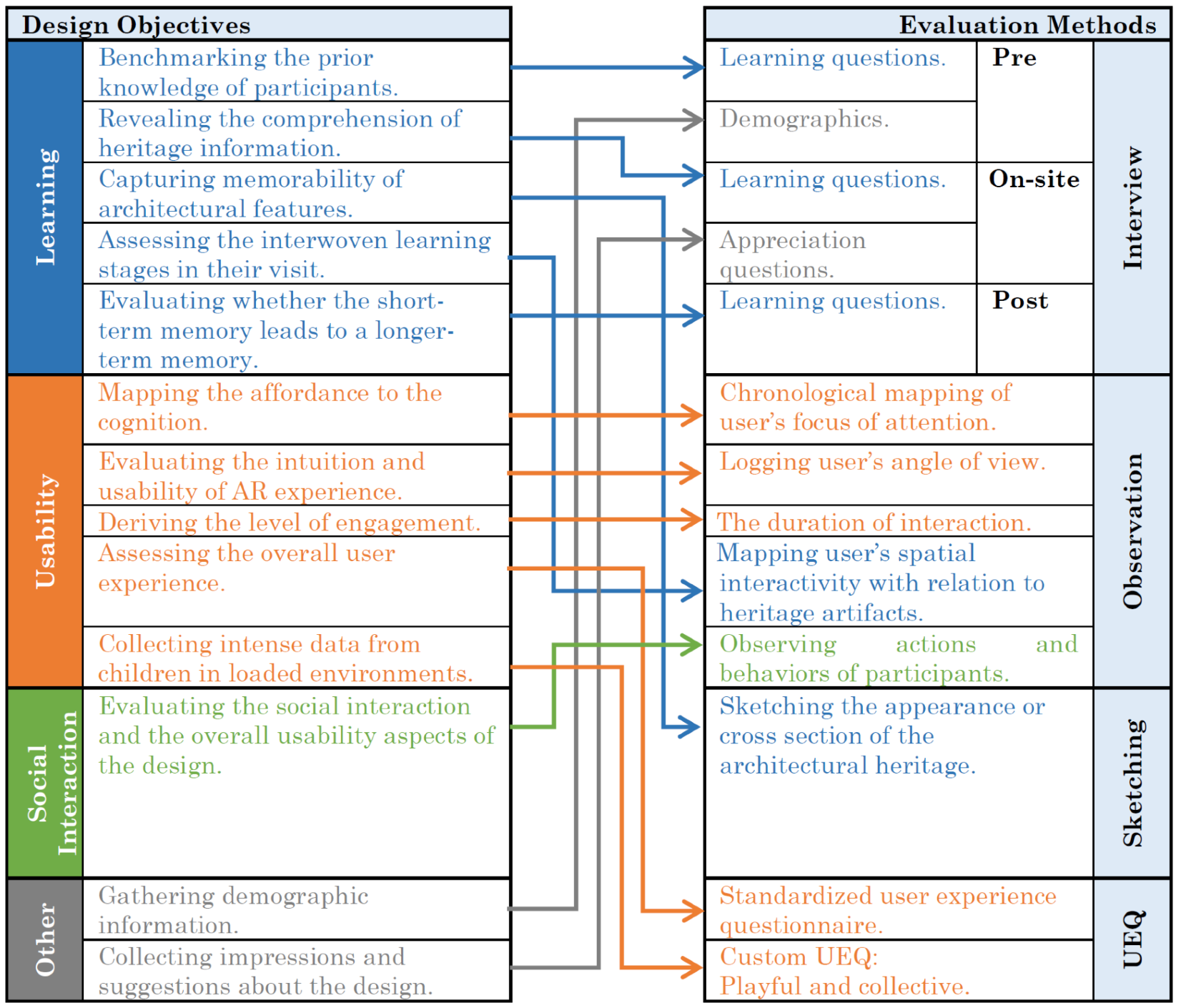
Accordingly, we present an evaluation framework of phygital heritage communication [Nofal, 2019], indicating when and how to use the different methods based on the design objectives. For instance, inviting visitors to sketch the architectural heritage to captures their learning and memorability of architectural features (e.g. spatial dimensions). Likewise, the use of pre and post interviews benchmarks the prior knowledge of visitors and evaluates their memorability of heritage information. Moreover, for evaluating the usability aspects such as mapping affordance to cognition, visitors’ focus of attention needs to be observed and mapped, while logging their angles of views evaluates the intuition of interface. In addition, we custom-designed a playful and collective user experience questionnaire to collect data from children in loaded environments. In general, we consider this framework as a guideline for future research of communicating heritage information through phygital mediums to general visitors.
 Exercise: Evaluation Methods
Accordingly, we present an evaluation framework of phygital heritage communication [Nofal, 2019], indicating when and how to use the different methods based on the design objectives. For instance, inviting visitors to sketch the architectural heritage to captures their learning and memorability of architectural features (e.g. spatial dimensions). Likewise, the use of pre and post interviews benchmarks the prior knowledge of visitors and evaluates their memorability of heritage information. Moreover, for evaluating the usability aspects such as mapping affordance to cognition, visitors’ focus of attention needs to be observed and mapped, while logging their angles of views evaluates the intuition of interface. In addition, we custom-designed a playful and collective user experience questionnaire to collect data from children in loaded environments. In general, we consider this framework as a guideline for future research of communicating heritage information through phygital mediums to general visitors.
 |
|
Framework for the evaluation methodology of phygital heritage communication (Nofal, 2019). Click to enlarge image. |
Exercise: Evaluation Methods
References:
- Nofal, E. (2019). Phygital Heritage: Communicating Built Heritage Information through the Integration of Digital Technology into Physical Reality. PhD Thesis, Department of Architecture, KU Leuven, Belgium, DOI: 10.13140/RG.2.2.20718.25920
- Wania, C.E.; Atwood, M.E.; McCain; K.W. (2006). How do design and evaluation interrelate in HCI research? In Proceedings of the 6th conference on Designing Interactive systems (DIS ’06), University Park, PA, USA, 26-28 June 2006, pp. 90-98, DOI: https://doi.org/10.1145/1142405.1142421