

1.1 Telling Stories: From the Analogue to the Digital
1.1.5 Case Study: Rhyzomic Narrative
 |
This case study was created by Susan Schreibman and Dora Vrhoci
Letters 1916-1923: A Study in Rhyzomic Narrative
Begun in 2013, Letters 1916-1923 seeks to revise the narrative of the revolutionary period in Irish history through a project of social relevance that breaks down barriers between public and traditional academic research. It does this by creating a virtual collection of letters written between November 1915 and December 1923, a period of enormous social change, punctuated by conflict and political unrest. As such, it collects, transcribes, encodes, and publishes letters (c. 7000 at the time of writing) through a participatory process from some 100 public and private sources in Ireland and abroad. Letters were chosen as expressions of the personal, of the everyday, and as significant documents in organising and shaping lives. Letters are a unique conduit from the past that impinge on our present, conveying a mosaic of life lived, messy and complex, eschewing our notions of a collective past that tends to be flattened by traditional narratives. Letters are made available to be transcribed by the public: the transcription process, the very act of typing out another’s words, serves to create a personal bond across the century (Schreibman, Gupta, and Rooney 2017).
The very act of digitising, involving, and making the results available to the public was designed as an act of recovery. This act of recovery allows for a surfacing of hidden stories and networks, as well as alternative loci of power and influence, providing the raw materials to rethink and reevaluate the period (see this and this chapter on Data Feminims). The structuring of the database was designed to provide theme and event-based search results which are not weighted towards the famous or canonical (although filtering is available to drill down to specific individuals or collections), further facilitating the acts of recovery central to curation ethos of the project.
Database-driven Rhyzomic Narratives
As a database-driven project (as opposed to a narrative-based text in which the author leads the reader through a specific narrative or narratives of the period), can the Letters 1916-1923 project itself be considered narrative-based? Or is it simply a primary source for individuals to unearth narratives that are created outside the database structure. Scholars of new media and digital humanities have differing views on this.
In The Language of New Media (2001), media theorist Lev Manovich conceptualizes the database as a correlate of narrative, rather than as a medium that produces narratives in itself. Manovich argues that new media objects, like the database, “do not tell stories” because their fragmentary structure does not allow them to “organize their elements into a sequence” (p. 194). Instead, Manevich writes, they function as “collections of individual items, where every item has the same significance as any other” (p. 194).
Not everyone shares this view. Norman M. Klein (2007), for example, observes that the database simply tells a different kind of a story – one that is driven by data (database-driven stories and narratives) and requires much more interpretive effort on the users’ part in piecing the data into a coherent narrative. We expand on this below, as well as introduce theoretical lenses that allow us to shed light on readers' agency in the narrative-generating process of databases as a medium. But first, we will explore Ed Folsom’s 2007 article that inspired many reactions from media studies and digital humanities scholars on the storytelling-potential of databases and archives. The article was in part written as a response to Manovich’s The Language of New Media, especially Manovich’s thoughts on the database. Folsom describes the database as rhizomorphous and highlights its “multiplicity of identity” (p. 1573). A database, in Folsom’s understanding, is a medium with “no central root but an intertwined web of roots” (p. 1573). He further compares the database to the archive, drawing clear distinctions between the two based on the archive’s “physicality” and the “virtuality” of the database: “Archive suggests physicality, idiosyncratic arrangement, partiality, while database suggests virtuality, endless ordering and reordering, and wholeness” (pp. 1576-77).
Both Manovich and Folsom started rethinking the database as a genre, as well as reflecting on its story-telling potential. While Manovich did not give any story-telling agency to the database, Folsom does reflect on its potential to function as a genre by comparing it to the way Walt Whitman shuffled the order of his poems in the various editions of Leaves of Grass, a process that, in Folsom’s view, resembles the fragmentary and ‘shuffled’ order of items in a database. Folsom’s conceptualization of the binary between the archive and the database, however, becomes problematic when we think of digital archives – archives that lose their “physicality,” are embedded in a digital, data-driven environment, and essentially function as databases, as is the case with Letters 1916-1923.
The Narrative-generating Process
From the lens of reception theory, readers have the ability to generate narratives through the reading process (i.e., through the different actions involved in responding to a text) and agency that we have as human beings (cf. Iser, 1972). Narratives, as a result, emerge from the different interactions between humans and non-humans (in this case, texts).
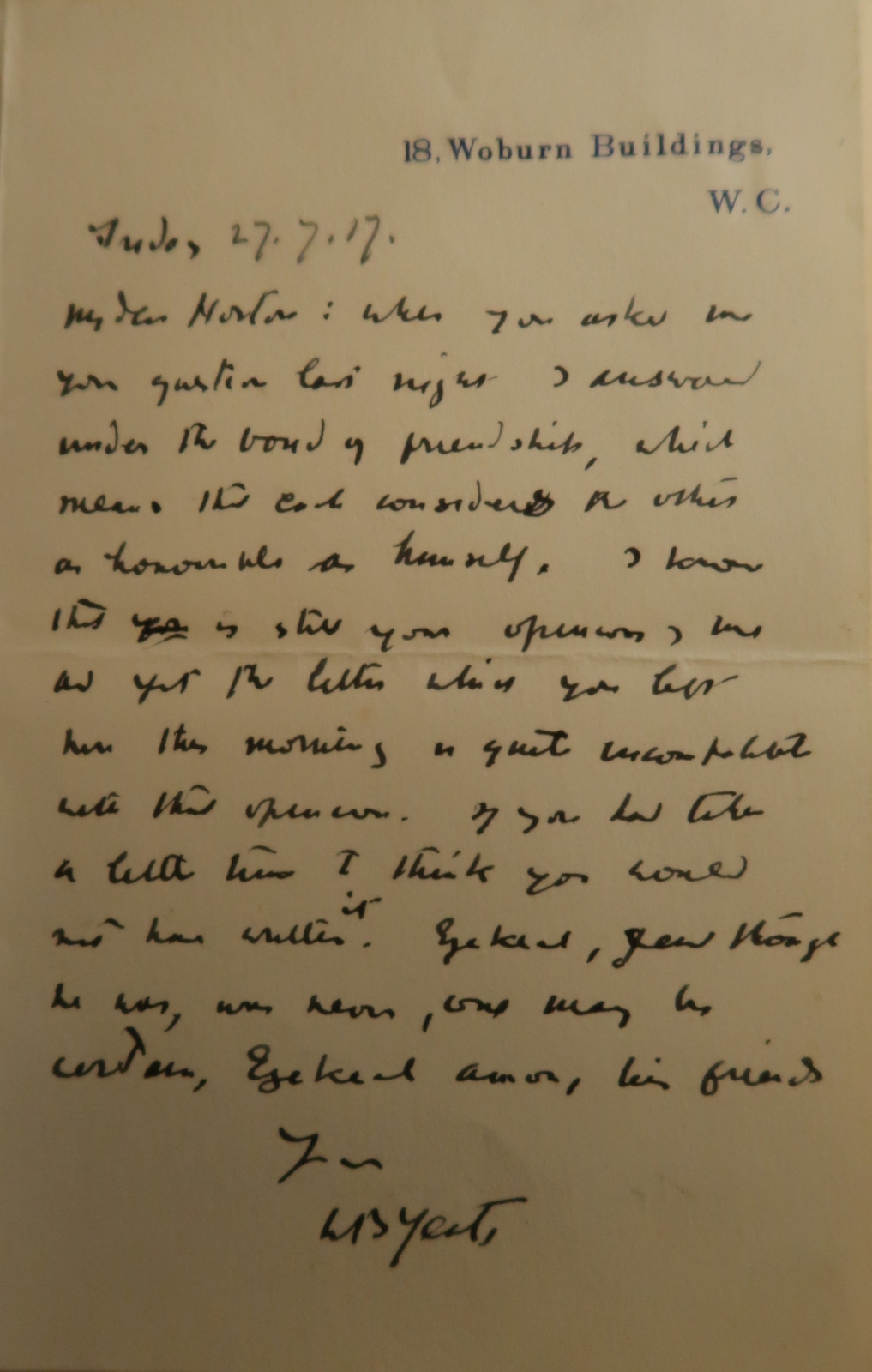 |
| Fig. 1- Letter from W. B. Yates to W. T. Horton, 27 July, 1917. An example of a letter, or ‘micro-narrative,’ that can be found on the Letters 1916-1923 website. Click image to enlarge. |
Seen from this lens, the interaction between humans and non-humans, such as algorithms, in a digital archive puts these agents together into a co-creative, narrative-generating process. Different agents, however, can add different meanings to the data on the web site. In a digital archive, the users can only see items that are displayed at the level of the interface. However, there are many behind-the-scenes mechanisms, or underlying data structures, involved in the building and design of a digital archive that the users cannot see, but that are central to meaning-making. In the case of Letters 1916-1923, there is meaning invested in the way the letters come into display and the filters and categories that allow users to navigate the web site.
Letters 1916-1923 provides the user with micro-narratives in the form of individual letters (see fig. 1). The user, on the other hand, generates narratives on a meta-level by drawing connections between different letters and invests them with meaning that might be different from the meaning given, on envisioned, by the database. All agents (human and non-human), essentially, gesture what they deem important through the metadata and structure choices of the database.
Along these lines, digital archives are also performative sites in which humans can generate narratives through their computational actions. For example, a user can choose a specific entry-point into the digital archive Letters 1916-1923 by selecting one of the filters or categories on the left side of the web page. This entry point will bring each user to a different narrative; s/he could start with medicine, politics, or personal relations. The performative act of choosing a specific entry point will result in different narratives emerging from the interaction between the user and the interface. As Marie-Laure Ryan (2002) writes: “Narrative comes into existence not by being told but by being enacted” (p. 584, our emphasis).
The narratives of Letters 1916-1923 can also expand as new letters are continuously being made public. This way, new information from the added letters may remodel an existing narrative of a specific event, such as the Easter Rising, that the user has in his/her mind. New characters may emerge in the story and the plot can change its course as new letters are being added to the database and its many narratives. Letters 1916-1923 is a fluid set of data – an open data set – that changes over time, and exemplifies how data-driven scholarship and narratives are not fixed.
Conclusion
Although we are focusing on the narrative-generating processes in relation to a digital archive, these processes are ways in which many database-driven narratives come to us. Understanding the ways humans and non-humans (algorithms; the ‘behind-the-scenes’ mechanisms) participate in the co-construction of narratives in digital media is an essential skill of the twenty-first century.
To put into perspective, while digital archives are one type of data-driven productions, another type are online retail web sites, such as Amazon, which uses a learning algorithm (vs. non-learning algorithms in digital archives) that essentially tries to match customer desires with relevant products. This can also be seen as a way of generating stories, or narratives; the algorithm displays different products for different users, and the user, by actively engaging with the website through his/her computational actions and thought processes involved in browsing the products and choosing the one that matches his/her desires, becomes an active participant in the narrative-generating process. The users are also aware of what is happening in the process and the non-human actors involved in it. We know, in other words, that Amazon, Google, and Facebook use algorithms that tailor the web site's content to our preferences, and this knowledge has become part of our day-to-day digital reality.
While many databases of historic or cultural artefacts are not as sophisticated as commercial sites in generating user-tailored narratives, as performative sites they allow for user-generated stories through human/computation interaction, thus creating new narratives each time this interaction occurs.
 Exercise 1: Experience a Rhyzomic Narrative
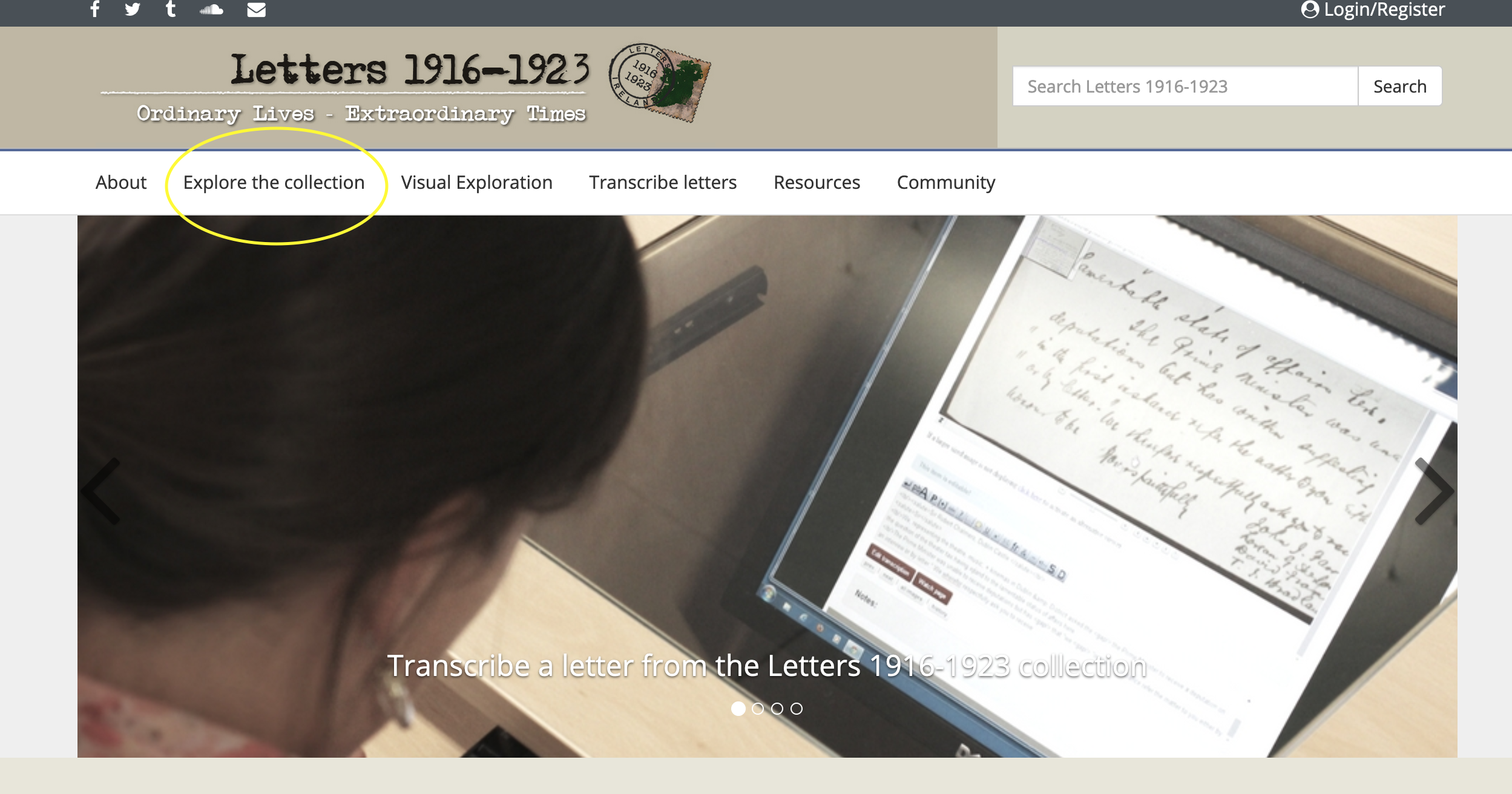
One way of experiencing a rhyzomic narrative is engaging with the Letters 1916-1923 digital archive. The website allows you to explore the digital archive, but the (meta-)narratives that you will generate will depend on how you navigate your way through the collection by interacting with its filters. Start by clicking “Exploring the Collection,” after you enter the website.
 |
|
Explore the collection on the Letters 1916-1923 website. |
On the left side of the website, you will see a number of filters. You can choose the keyword “Easter Rising Ireland 1916,” for example, which will lead you to a collection of letters written during, or about, the Easter Rising, an armed insurrection during Easter Week in April 1916.
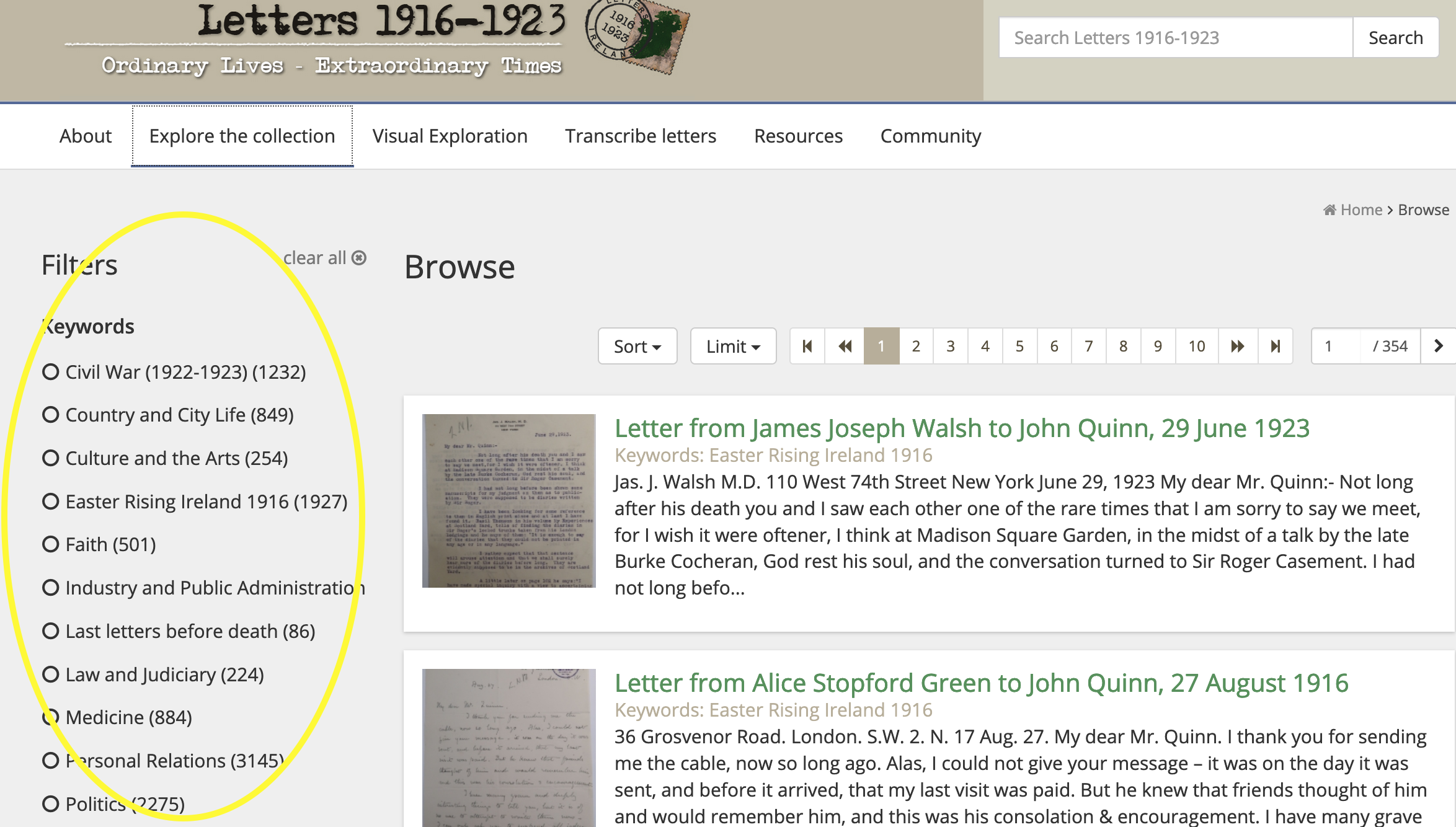 |
| Explore the collection by using filters on the Letters 1916-1923 website. |
Another entry-point to the collection’s various narratives is the search engine in the upper-right corner of the web site. If you type “James Finn” into the engine, letters from the correspondence between James Finn and May Fay will emerge. Which narrative(s) emerges from the letters written between 4th and 9th March?
Exercise 2:Explore Rhyzomatic narratives using Design Thinking
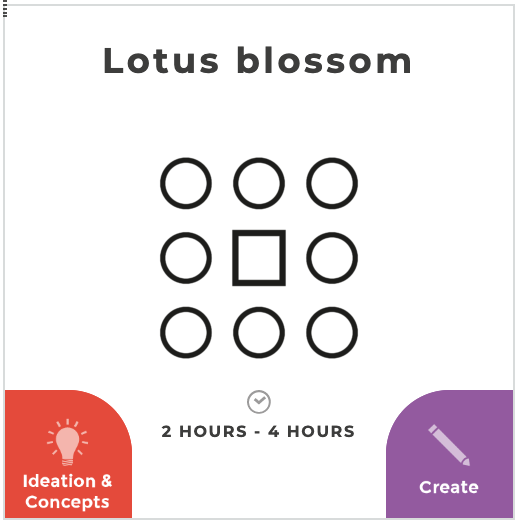
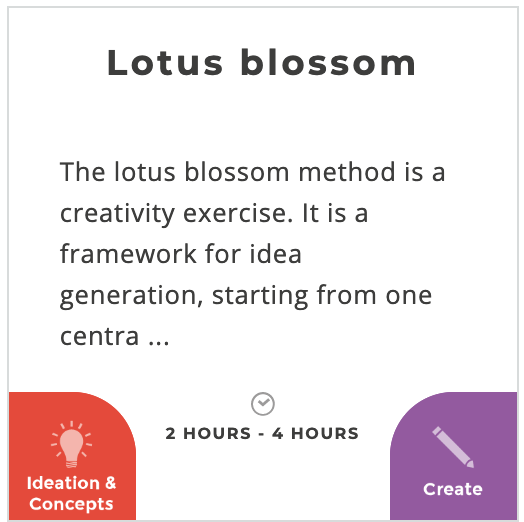
Another way of engaging with the Letters 1916-1923 digital archive is by using a design thinking method. For this exercise, we will use the Lotus Blossom ideation technique, developed by Yasuo Matsumura of Clover Management Research. We have adjusted the technique to our needs of engaging with the digital archive and narrative-generating processes. We follow Digital Society’s Method Toolkit in developing the exercise.
|
|
Task
Enter the Letters 1916-1923 database, and go to “Explore the Collection.” Scroll down to the bottom of the page. On the left side of the interface, you will see two search boxes under “Date Sent.” There, select a date from which the letters you will be working on were sent. For example, June 8. Often, it suffices to enter only one date (i.e., “sent from”), instead of adding two dates between which the letters were sent. This way, the web page will only list letters sent on that specific day. Also, try to find a date that allows you to see at least eight to ten letters.
Next:
- Draw a square in the middle of your paper and write down the central theme that emerges from the letters. In this case, this will be the event or date around which the letter set is structured.
- Identify eight related sub-themes in the letter set and write them around the square using a new square for each.
- Take each of the eight previous sub-themes and create eight new sub-themes around it.
- Write them in new squares. Blossom as far as you think is relevant and, once you sense that the amount of themes is enough. Then, put the themes together into a narrative form; compose a little story that emerges from the lotus blossom.
The letter-set from June 8, 1916 (fig. 2), gives us glimpses of the various (‘micro’ and ‘macro’) events that were happening in Ireland that day. These events can be seen as taking place on three levels: the international level, the national level, and the private level.
|
|
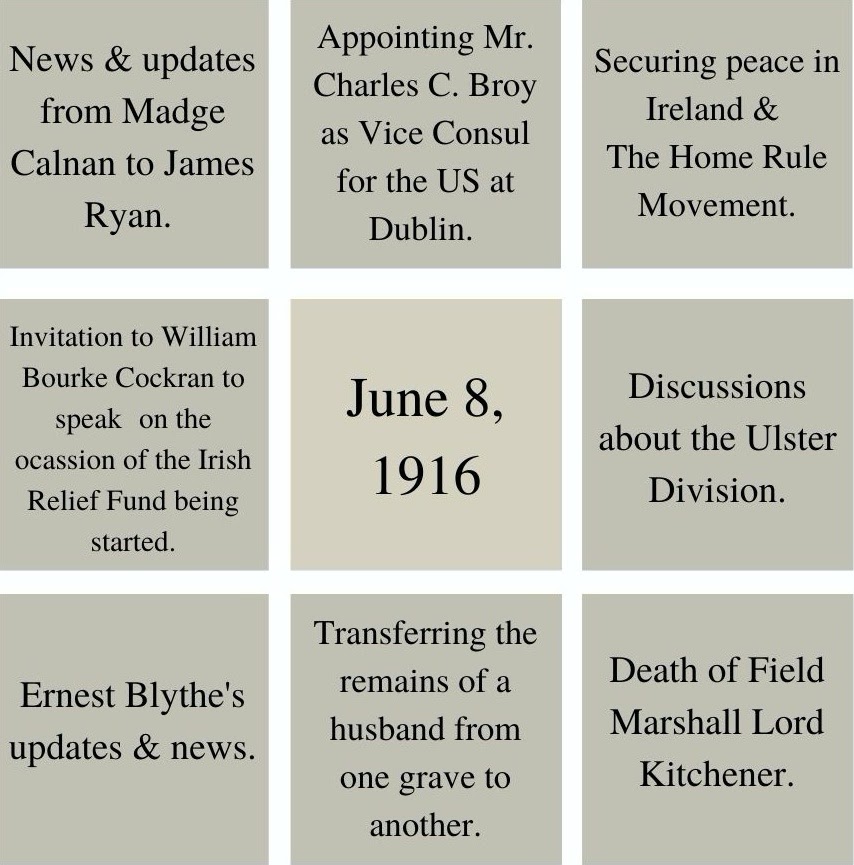
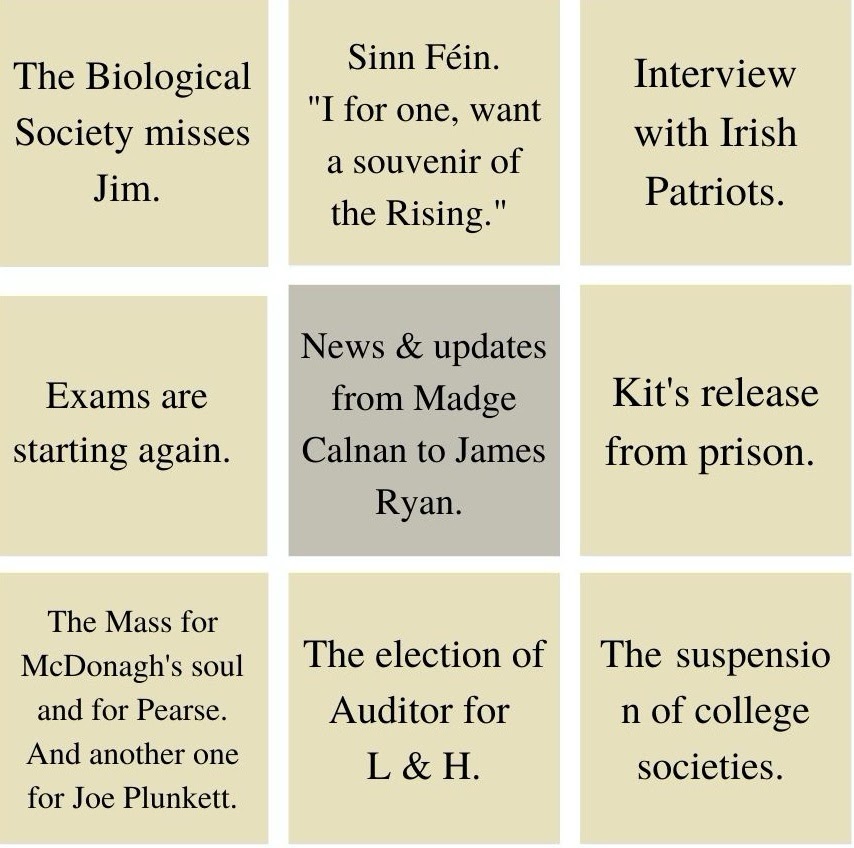
The letter-set from June 8, 1916 (fig. 2), gives us glimpses of the various (‘micro’ and ‘macro’) events that were happening in Ireland that day. These events can be seen as taking place on three levels: the international level, the national level, and the private level.
The events on the international level concern Irish-American relations. William Bourke Cockran, an Irish-American politician who served as a United States Representative from the East Side of Manhattan for seven terms, was invited to speak at the event of the founding of the Irish Relief Fund. Mr. Charles C. Broy was appointed as Vice Consul of the US at Dublin.
On the national level, the death of Field Marshal Lord Kitchener on June 5, 1916, was an event that resonated across Ireland, as it is visible in the letters from the collection. On the political front, the tensions between the Irish Home Rule Movement, the dominant political movement of Irish nationalism from 1870 to the end of World War I, and the Ulster Division, which was opposed to the Home Rule Movement, were much discussed in several letters from June 8.
These (inter)national events can be seen as forming a ‘thematic backdrop’ against which smaller, private events were taking place. The events that some of the letters address have little to do with either the Irish-American relations or the tensions between the Home Rule and the Ulster Division. Instead, they take us into the microcosm of different individuals, such as Ernest Blythe or Madge Calnan (see fig 3.).
The letters written on June 8, 1916, can be seen as constituting a multiple-narrative story of that particular day (cf. William Faulkner’s novels). While the date itself functions as a nodal point connecting the different letters, each of the letters reveals a different event, turning the focus either toward the (inter)national or the private.
References
- Folsom, E. (2007). Database as Genre: The Epic Transformation of Archives. PMLA, 122(5), 1571-1679.
- Iser, W. (1972). The Reading Process: A Phenomenological Approach. New Literary History, 3(2), 279-299.
- Klein, N. M. (2007). Waiting for the World to Explode: How Data Convert into a Novel. In V. Vesna (ed.), Database Aesthetics: Art in the Age of Information Overflow. Minneapolis, MN: University of Minnesota Press.
- Manovich, L. (2002). The Language of New Media. Cambridge, MA: The MIT Press. Schreibman, Susan, Vinayak Das Gupta, and Neale Rooney. 2017. “Notes from the Transcription Desk: Visualising Public Engagement.” English Studies 98 (5): 506–25. https://doi.org/10.1080/0013838X.2017.1333754.
- Ryan, M. L. (2002). Beyond the Myth and Metaphor; Narrative in Digital Media. Poetics Today 23(4), 581-609.