

4.1 Introduction to Phygital Heritage
4.1.2 Why Phygital Heritage?
 |
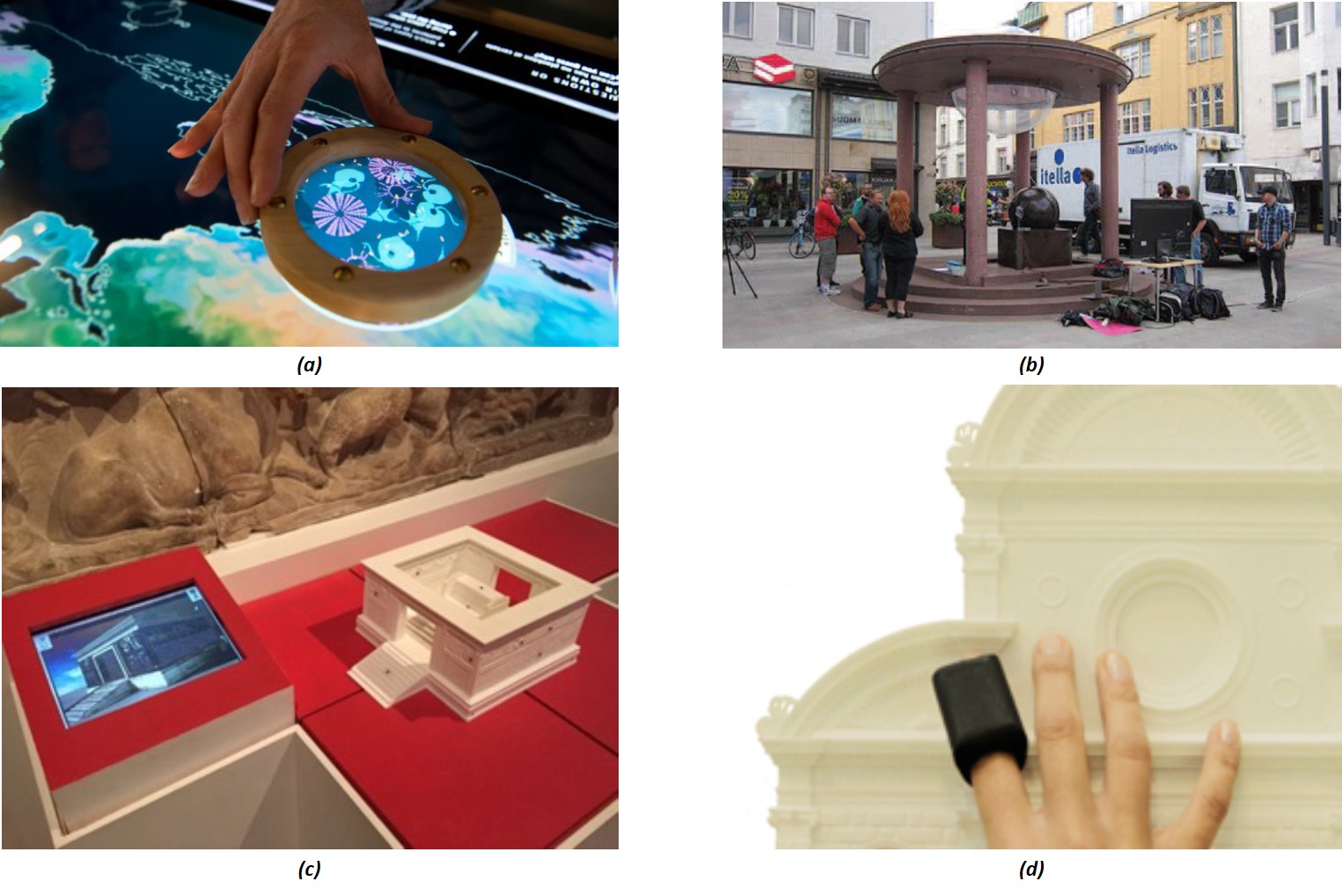
Several related domains have already demonstrated the value of the physical in human-computer interfaces. For instance, in comparison to traditional graphical user interfaces (GUIs), tangible user interfaces (TUIs) are perceived to be more compelling and intuitive to use. TUIs do not only afford objects in an abstract physical form, but they also allow the incorporation of material attributes (e.g. size, shape, texture, color, weight) in order to convey information [Macaranas et al, 2012]. Well-considered TUIs can also provide lay users with more intuitive affordances that steer digital actions, as physical objects tend to be more familiar, approachable, and less abstract to use than traditional digital interfaces [Claes et al, 2015.a]. As such, heritage communication has already benefited from recent TUI advances. For instance, tangible smart replicas have been used in museum exhibitions to provide an additional layer (narrative content) of storytelling on top of factual information presented on text labels, typically located next to the original heritage objects [Marshall et al, 2016]. Furthermore, anecdotal evidence shows that the touch and manipulation affordances of TUIs in interactive exhibits tend to attract more visitors, even persuade them to explore further and deeper [Ma et al, 2015]. Tangible installations can also be deployed in outdoor heritage environments where lack of power supplies or digital networks can exist. For example, the interactive belt [Petrelli et al, 2014] supports the visit of archaeological sites by enabling visitors to select the story they want to listen to and to be part of it, triggering by specific points of interests. Another example is the utilization of a monument of urban space ‘City Mouse’ as a tangible user interface [Häkkilä et al, 2014], a landmark of a large stone sphere representing the globe, which people could push to a rolling motion in order to rotate a 3D image of the Earth that is visualized on a screen next to the landmark.
These examples, among others, demonstrate how the combination of physical and digital is still relatively unexplored, but potentially particularly valuable for the field of heritage communication, such as when the digitally augmented experience makes some sort of meaningful connection to the actual heritage context, such as the social, cultural and physical characteristics of the physical reality.
 |
|
Examples of exploiting the value of tangible interaction in several domains; (a) Using a physical ring on a multi-touch table for investigating a scientific content in a museum context (Ma et al, 2015), (b) A rolling a large stone ball resting on a water fountain in a public space in order to rotate a 3D model of the Earth presented on a screen (Häkkilä et al, 2014), (c) a smart physical replica including sensors at Allard Pierson Museum in Amsterdam (Capurro, et al, 2015), and (d) Audio communication of artworks and architecture via 3D replicas and NFC tags for assisting blind people (Tooteko.com). (Click to enlarge the figure) |
| Tangible interaction and museums on the web (YouTube) |
Mixed reality is defined as “…anywhere between the extrema of the virtuality continuum” [Milgram and Kishino, 1994], a continuum that extends from the completely real through to the completely virtual environment, with augmented reality and augmented virtuality taking on positions in-between. However, mixed reality relies more on displays and screens, a medium that a relatively contextless and lacks material qualities. On the other hand, we believe that phygital focuses on exploiting material-driven affordances, where the medium does not only conveys visual but also tactile qualities, in addition to physical affordance and playfulness. In the future, phygital heritage can thus be grounded on the combination of the key characteristics of both digital and physical realms for the goals of communicating and interacting with digital as well as physical present heritage information.
In turn, the phygital features combine the key characteristics of the physical realm that include, but are not limited to:
References
- Capurro, C.; Nollet, D.; Pletinckx, D. (2015). Tangible interfaces for digital museum applications: The Virtex and Virtex light systems in the Keys to Rome exhibition. In Proceedings of the Digital Heritage Conference, Granada, Spain, 28 September - 2 October 2015, pp. 271-276, DOI: https://doi.org/10.1109/DigitalHeritage.2015.7413881
- Chen, S.; Pan, Z.; Zhang, M.; Shen, H. (2013). A case study of user immersion-based systematic design for serious heritage games. Multimedia Tools and Applications, 62 (3), pp. 633-658, DOI: https://doi.org/10.1007/s11042-011-0864-4
- Claes, S.; Vande Moere, A. (2015). The role of tangible interaction in exploring information on public visualization displays. In Proceedings of the 4th International Symposium on Pervasive Displays (PerDis ’15), Saarbrucken, Germany, 10-12 June 2015, pp. 201-207, DOI: https://dl.acm.org/citation.cfm?doid=2757710.2757733
- Dragicevic, P.; Yvonne Jansen, Y. (2012). A Chronological List of Physical Visualizations and Related Artifacts, retrieved online on January 20th 2017 from http://dataphys.org/list/
- Häkkilä, J.; Koskenranta, O.; Posti, M.; He, Y. (2014). City landmark as an interactive installation: Experiences with stone, water and public space. In Proceedings of the 8th International Conference on Tangible, Embedded and Embodied Interaction (TEI ’14), Munich, Germany, 16-19 February 2014, pp. 221-224, DOI: https://doi.org/10.1145/2540930.2540980
- Hurtienne, J.; Israel, J.K. (2007). Image schemas and their metaphorical extensions intuitive patterns for tangible interaction. In Proceedings of the 1st International Conference on Tangible, Embedded, and Embodied Interaction (TEI ’07), Baton Rouge, LA, USA, 15-17 February 2007, pp. 127-134, DOI: https://doi.org/10.1145/1226969.1226996
- Jansen, Y.; Dragicevic, P.; Fekete, J.D. (2013). Evaluating the efficiency of physical visualizations. In Proceedings of the ACM Conference on Human Factors in Computing Systems (CHI ’13), Paris, France, 27 April - 02 May 2013, pp. 2593-2602, DOI: https://doi.org/10.1145/2470654.2481359
- Jansen, Y.; Dragicevic, P.; Isenberg, P.; Alexander, J.; Karnik, A.; Kildal, J.; Subramanianet, S.; Hornbæk, K. (2015). Opportunities and challenges for data physicalization. In Proceedings of the 33rd Annual ACM Conference on Human Factors in Computing Systems (CHI ’15), New York, NY, USA, 18-23 April 2015, pp. 3227-3236, DOI: https://doi.org/10.1145/2702123.2702180
- Ma, J.; Sindorf, L.; Liao, I.; Frazier, J. (2015). Using a tangible versus a multi-touch graphical user interface to support data exploration at a museum exhibit. In Proceedings of the 9th International Conference on Tangible, Embedded, and Embodied Interaction (TEI ’15), Stanford, California, USA, 15-19 January 2015, pp. 33-40, DOI: https://doi.org/10.1145/2677199.2680555
- Macaranas, A.; Antle, A.N.; Riecke, B.E. (2012). Bridging the gap: attribute and spatial metaphors for tangible interface design. In Proceedings of the 6th International Conference on Tangible, Embedded and Embodied Interaction (TEI ’12), Kingston, Ontario, Canada, 19-22 February 2012, pp. 161-168, DOI: https://doi.org/10.1145/2148131.2148166
- Marshall, M.T.; Dulake, N.; Ciolfi, L.; Duranti, D.; Kockelkorn, H.; Petrelli, D. (2016). Using tangible smart replicas as controls for an interactive museum exhibition. In Proceedings of the 10th International Conference on Tangible, Embedded, and Embodied Interaction (TEI ’16), Eindhoven, The Netherlands, 14-17 February 2016, pp. 159-167, DOI: https://doi.org/10.1145/2839462.2839493
- Milgram, P.; Kishino, F. (1994). A taxonomy of mixed reality visual displays. IEICE Transactions on Information and Systems, 77 (12), pp. 1321-1329.
- Nofal, E.; Reffat, R.M.; Vande Moere, A. (2017). Phygital heritage: An approach for heritage communication. In Proceedings of the 3rd Immersive Learning Research Network Conference (iLRN2017), Coimbra, Portugal, 26-29 June 2017, pp. 220-229, DOI: https://doi.org/10.3217/978-3-85125-530-0-36
- Petrelli, D.; Ciolfi, L.; Van Dijk, D.; Hornecker, E.; Not, E.; Schmidt, A. (2013). Integrating material and digital: A new way for cultural heritage. ACM Interaction Magazine, 20 (4), pp. 58-63, DOI: https://doi.org/10.1145/2486227.2486239
- Petrelli, D.; Lechner, M. (2014). The meSch project - Material encounters with digital cultural heritage: Reusing existing digital resources in the creation of novel forms of visitor’s experiences. In Proceedings of the Annual Conference of CIDOC: The International Committee for Documentation of ICOM, Dresden, Germany, 06-11 September 2014, pp.01-10.
- Reffat, R.M.; Nofal, E. (2013). Effective communication with cultural heritage using virtual technologies. International Archives of the Photogrammetry, Remote Sensing and Spatial Information Sciences, Volume XL-5/W2, pp. 519-524, DOI: https://doi.org/10.5194/isprsarchives-XL-5-W2-519-2013
- Rekimoto, J.; Ayatsuka, Y.; Hayashi, K. (1998). Augment-able reality: Situated communication through physical and digital Spaces. In Proceedings of the 2nd IEEE International Symposium on Wearable Computers (ISWC ’98), Pittsburgh, PA, USA, pp. 68-75, 19-20 October 1998, DOI: https://doi.org/10.1109/ISWC.1998.729531
- Vlahakis, V.; Ioannidis, N.; Karigiannis, J.; Tsotros, M.; Gounaris, M.; Stricker, D.; Gleue, T.; Daehne, P.; Almeida, L. (2002). Archeoguide: an augmented reality guide for archaeological sites. IEEE Computer Graphics and Applications Archive, 22 (5), pp. 52-60. http://dx.doi.org/10.1109/MCG.2002.1028726