Context
The
Djoser pyramid complex in
Saqqara was built for pharaoh
Djoser around the mid-27th century BCE, designed by Imhotep, who is one of the greatest known architects in ancient Egypt. The complex is recognized as the world’s oldest large-scale stone structure. Its entrance colonnade consists of a limestone ceiling, loaded by pairs of limestone fluted columns composed of drum shaped segments. The columns are not free-standing, but attached to their side wall by masonry projections, hereby composing 42 individual
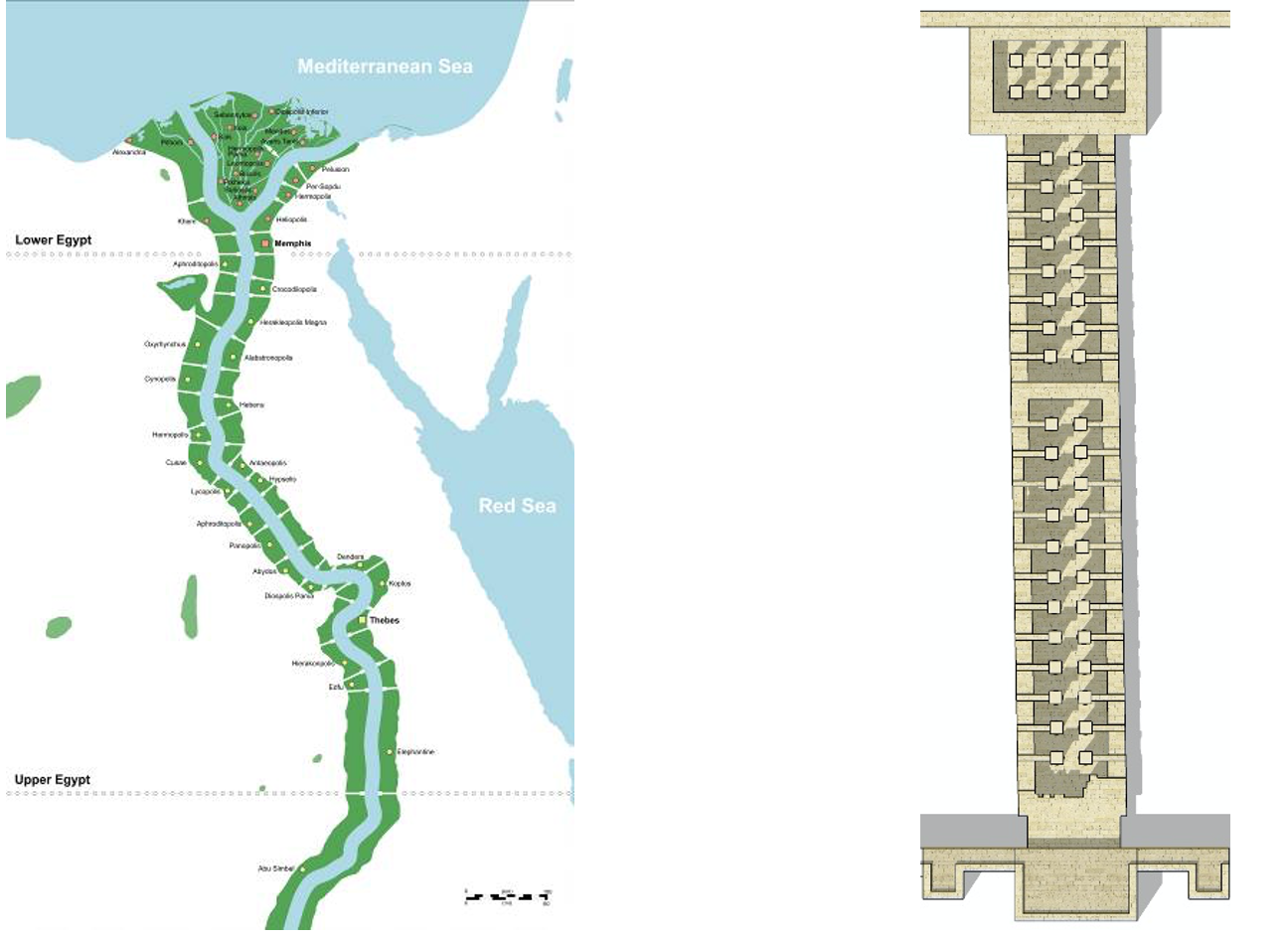
niches, which are the spaces created between adjacent columns. The combination of complex architectural features of this impressive entrance colonnade carries a peculiar cultural meaning, as its particular physical layout can possibly be associated to the historical journey the pharaoh undertook along the Nile to visit each of the 42
nomes, the administrative territorial divisions of ancient Egypt, and their local gods. Some Egyptologists propose that each
niche in the entrance colonnade represented a shrine where the
nome gods of ancient Egypt were accommodated during an annual festival. This working hypothesis is believed to be plausible because the number of niches and
nomes are equal (42). As such, the architect Imhotep may have designed the architectural layout of the colonnade to portray symbolically the Nile River, and consequently the end chamber would represent the Delta region.
Therefore, this study aims to communicate this historical knowledge via phygital forms of interaction, which will lead to more collaborative forms of interaction and more profound recall of heritage meanings by general museum visitors.
 |
|
The chosen tacit knowledge; the historical hypothesis that the 42 niches in the entrance colonnade (right) represent the 42 nomes of ancient Egypt along the Nile River (left); the end chamber would have represented the Delta; and that the processing of pharaoh Djoser along the corridor and passing by each nome shrine would have been a ritualized version of the pharaoh’s journey along the Nile to visit each of the nomes and their local gods (Nofal et al, 2018). (Click to enlarge the figure)
|
Experimental Conditions
In order to recognize the causal influence of phygital interaction on the communication of historical knowledge of built heritage, the experimental approach was based on a between-group comparative study design at the
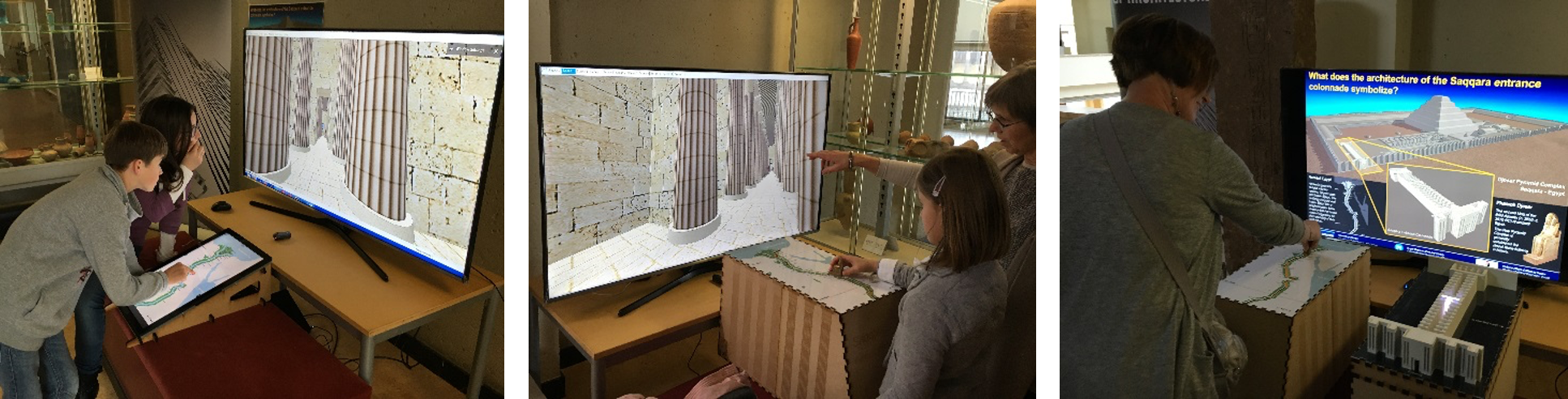
Art and History Museum in Brussels. The evaluation study consisted of three different conditions. Each condition was comprised of a distinct interactive navigation (input) and a representation (output) component that differed in terms of modality.
 |
|
Different conditions for communicating the architectural story of the entrance colonnade of Djoser Pyramid Complex: (left) Touch-Dix: touch navigation and digital representation; (middle) Tang-Dix: tangible navigation and digital representation; and (right) Tang-Phys: tangible navigation and physical representation (Nofal et al, 2018). (Click to enlarge the figure)
|
Touch-Dix
The navigation modality in this condition occurred via a touch-enabled LCD display. Participants dragged a small ‘you are here’ icon along the Nile as depicted on a map of ancient Egypt. The position and rotation of this icon was directly translated to that of a camera viewpoint inside a virtual 3D model of the colonnade that was simultaneously displayed on a larger LCD screen in front of the smaller touch-enabled display. The real-time connection between the touch display and the 3D world was accomplished via the
Edddison plugin within the
SketchUp application.
|
| The Role of Tangible Interaction to Communicate Tacit Knowledge of Built Heritage [Touch-Dix] from Research[x]Design (Vimeo) |
Tang-Dix
In the navigation modality of this condition, participants were invited to physically move a 3D-printed statue of pharaoh Djoser along a narrow slot representing the Nile River, which was equally shown on a map of ancient Egypt. Similarly to Touch-Dix, the relative position and rotation of the statue was directly linked to that of the camera viewpoint inside a virtual 3D model of the colonnade that was displayed on a large LCD screen. The relative location of the statue was tracked via a webcam underneath the map, which was then linked to the
SketchUp model on the large LCD screen via a feature of the same
Edddison plugin.
|
| The Role of Tangible Interaction to Communicate Tacit Knowledge of Built Heritage [Tang-Dix] from Research[x]Design (Vimeo) |
Tang-Phys
The navigation modality was identical to Tang-Dix, yet moving the statue along the Nile River caused a sequential row of LED lights to illuminate within a graspable and physical manifestation of the colonnade, to denote the position of the
nome along the Nile with its corresponding niche. On a technical level, the distance of the physical statue was linked to a custom-developed electronic setup that controlled an
Arduino LED strip that was integrated into the colonnade mock-up. Participants were allowed to pick up the model to look through it, potentially increasing the comprehension of spatial aspects such as scale and proportionality.
|
| The Role of Tangible Interaction to Communicate Tacit Knowledge of Built Heritage [Tang-Phys] from Research[x]Design on (Vimeo) |
References
- Nofal, E.; Reffat, R. M.; Boschloos, V.; Hameeuw, H.; Vande Moere, A. (2018). The role of tangible interaction to communicate tacit knowledge of built heritage. Heritage 2018, 1 (2), pp. 414-436, DOI: https://doi.org/10.3390/heritage1020028

