

1.2 Preserving Heritage: From an Analogue Past to a Digital Future
1.2.3 Analogue to Digital: Remaking Material Culture
 |
 Flip Cards: Remaking in Three Dimensions
 As you saw in the flip cards above, 3D remaking can be divided into three main categories: 1) Digitising features in their current state; 2) Reconstructing features in their original state; 3) Printing features in their current or original state. It should be noted that the three categories are not mutually exclusive and in most cases a 3D project may include more than one processes. For example, in order to 3D print an object you should have its digital/3D version which has been obtained either by means of digitisation or reconstruction. Similarly, a 3D reconstruction project may use as a basis digitised material. This course covers the first and the third category, while you will learn more for the second category in the Course 'XR: Extended Reality'. Here we will particularly refer to some essential concepts related to the notion of 'remaking' to provide you with a grounding for the following lessons.
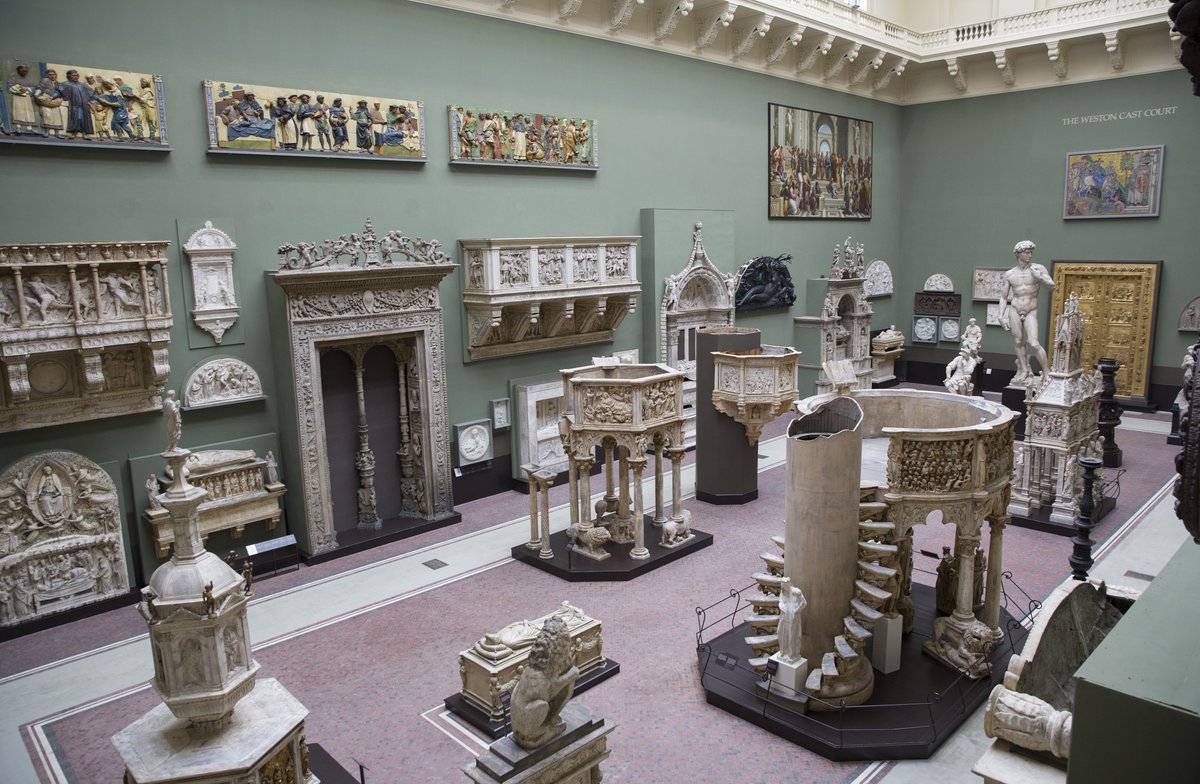 |
| Victoria & Albert Museum, London, UK - Casts Court |
Digital technologies, and particularly 3D visualisation methods, have provided new ways of remaking material culture. Laser scanners, photogrammetry, reflectance transformation imaging, additive manufacturing, and 3D modelling are methods which are increasingly deployed in cultural heritage in an attempt to capture more information than conventional recording as well as to develop new avenues for heritage analysis, interpretation, and dissemination. It is critical to remember though that 3D visualisation is not only a product but also a process, and as a process, it it does not only present knowledge but also produces knowledge, which is also influenced by any technological constraints and human choices.
Similarly to the notion of replication, 3D visualisation has suffered from the notion of 'reconstruction' (Clark 2010). The word ‘reconstruction’ can be defined as the process of bringing something back to its original state. The fallacy of the term is ingrained in the practice of many disciplines and did not emerge with the digital tools and methods. For example, we saw in the previous section that archaeology and heritage have always been trying to produce reconstructions of past reality which are not only limited to objects and architecture but also include social and cultural process. Also, all the media used to realise these, such as text, photography, and illustration provide a distorted reflection of the past since they attempt to convert the three-dimensionality of the world into a two-dimensional production. 3D visualisations refashion, reform, and repurpose these media (Bolter & Grusin 2000), therefore, retaining or leaving behind some of their characteristics.
Photorealism, i.e. the creation of hyper-realistic representations, have fueled the debate around the notion of 'reconstruction'. Photorealism appeared in computer graphics in the 90s when computational power and software capabilities could support an image quality close to or indistinguishable from real life. Especially between 1995 and 2005, photorealism created a long and heated discussion in heritage studies especially due to the ultra-realistic nature and high-fidelity of computer graphic visualisations; scholars often argued that that the high visual stimulus that these images provide, especially due to their ingrained realism, deceive viewers that what they see is a precise image of the past, also conveying ideas and meanings that rarely derive from evidence (see for example Miller and Richards 1995; Eiteljorg 2000; Gillings 2005). In the sliding image below you can see a comparison of a photograph and of a 3D model of the Experimental House at the Neolithic settlement of Çatalhöyük, Turkey, produced by ArtasMedia. Can you guess which is the real and which the virtual?
Real or Virtual? Move the slider to compare the images
Do you think that you guessed the image correctly? The first image (left part of the slider) is an actual photograph of the building, while the second image (right part of the slider) is a computer graphic 3D representation of the building. As mentioned earlier, computer graphics have made it possible to create visualisation that cannot be distinguished from real life. The sense of authority that these images carry has long been debated and alternative ways of approaching this conundrum by downgrading, blurring and colouring visualisations to demonstrate the decision making, ambiguity, and interpretation have been proposed (Papadopoulos 2018). Without neglecting the powerful visual impact they have, we should move a step forward, since we have come to realize that different levels of ambiguity are inherent in the nature of heritage and consequently in the images produced. This means that since there is no way to avoid the nature of these images, the stimuli that 3D visualisations provide should be used by thoroughly evaluating and critically approaching hypotheses and results.
 |
|
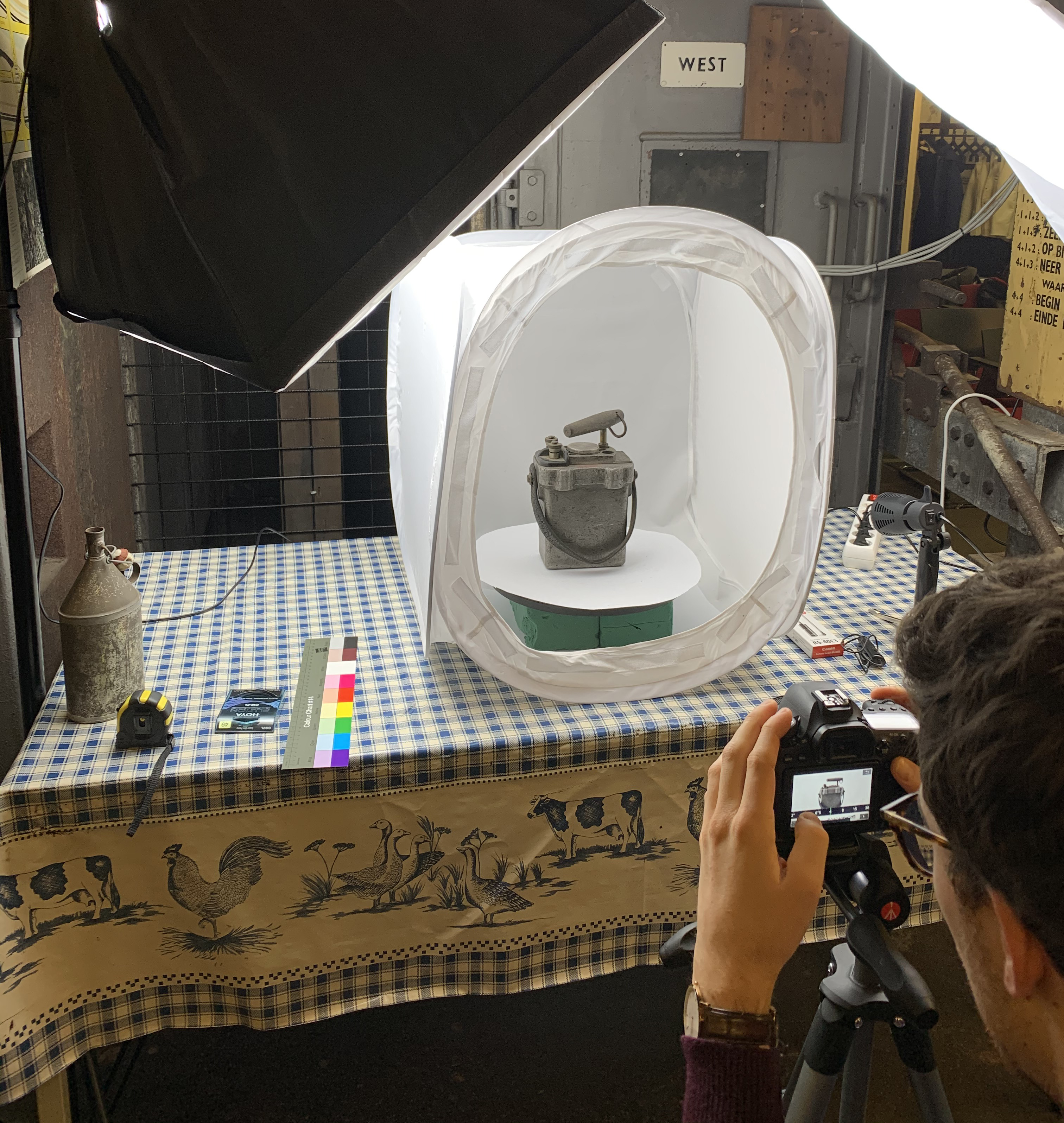
3D Digitisation by means of Photogrammetry in the |
Different forms of 3D visualisations should not be treated as records but should be seen as means of visualising concepts and ideas, decision-making processes and interpretations. In such a way, interpretations materialized in the form of 3D visualisations become heuristic sources and working hypotheses in the production of knowledge, as part of a never-ending translation process, augmenting perception and providing stimuli to expand our interpretive vocabulary.
References
- Bolter, J. D. & Grusin, R. (2000). Remediation: Understanding New Media. MIT Press.
- Clark, J. T. (2010). The Fallacy of Reconstruction. In Forte, M. (ed.) Cyber-Archaeology, pp. 63–73, British Archaeological Reports Series 2177. Oxford: Archaeopress.
- Eiteljorg, H. (2000). The Compelling Computer Image – A Double-Edged Sword. Internet Archaeology 8. http://intarch.ac.uk/journal/issue8/eiteljorg_toc.html
- Foster, S., & Curtis, N. (2016). The Thing about Replicas—Why Historic Replicas Matter. European Journal of Archaeology, 19(1), 122-148. DOI: https://doi.org/10.1179/1461957115Y.0000000011
- Foster, S. & Jones, S. (2019). The Untold Heritage Value and Significance of Replicas, Conservation and Management of Archaeological Sites 21(1), pp. 1-24, DOI: https://doi.org/10.1080/13505033.2019.1588008
- Gillings, M. (2005). The Real, the Virtually Real and the Hyperreal, In Smiles, S. and Moser, S. (eds) Envisioning the Past: Archaeology and the Image. pp. 223-39. New York: Blackwell.
- Miller, P. and Richards, D. (1995). The Good, the Bad, and the Downright Misleading: Archaeological Adoption of Computer Visualization, In Huggett, J. and Ryan, N. (eds) Proceedings of the 22nd Conference on Computer Applications and Quantitative Methods in Archaeology (CAA’94). pp. 19-22. BAR International Series 600. Oxford: Tempus Reparatum. http://proceedings.caaconference.org/files/1994/03_Miller_Richa rds_CAA_1994.pdf
- Papadopoulos, C. (2018). Photorealism and Digital Reconstruction. In S. López Varela (Ed.), The Encyclopedia of Archaeological Sciences Wiley-Blackwell. https://doi.org/10.1002/9781119188230.saseas0454
Further Readings
- Garstki, K. (2017). Virtual representation: the production of 3D digital artifacts. Journal of Archaeological Method and Theory 24(3), 726–50. https://doi.org/10.1007/s10816-016-9285-z
- Jeffrey, S. (2015). Challenging heritage visualisation: beauty, aura and democratisation. Open Archaeology 1(1). https://doi.org/10.1515/opar-2015-0008
- Rabinowitz, A. (2015). The work of archaeology in the age of digital surrogacy. In Olson, B. & Caraher, W. (eds) Visions of Substance: 3D imaging in Mediterranean archaeology, pp. 27-42. Grand Forks (ND): The Digital Press at the University of North Dakota.