Computed Tomography started being used for cultural heritage objects soon after its introduction to medical facilities. The first application, as was the case with X-Rays, seems to have been to mummified bodies in 1977 in Canada (Harwood-Nash 1979). Research has demonstrated that the results obtained for mummies by means of CT scanning in comparison to those humans, are superior, since there is no humidity, and therefore less noise in the obtained data which in turn helps in producing higher contrast and resolution models (Hughes 2011, p.59). In most cases, CT scanning has been applied to cases where researchers are interested in investigating the inner parts of objects without disturbing or often destroying the outer part. A mummified body is a typical example, since in order to access the body, the wraps have to be destroyed. Since destruction is not anymore considered a method that should be followed, CT scanning has provided the means to investigate such cases with minimal destruction. On this page you will explore some characteristic applications of Computed Tomography in a range of object types and materials.
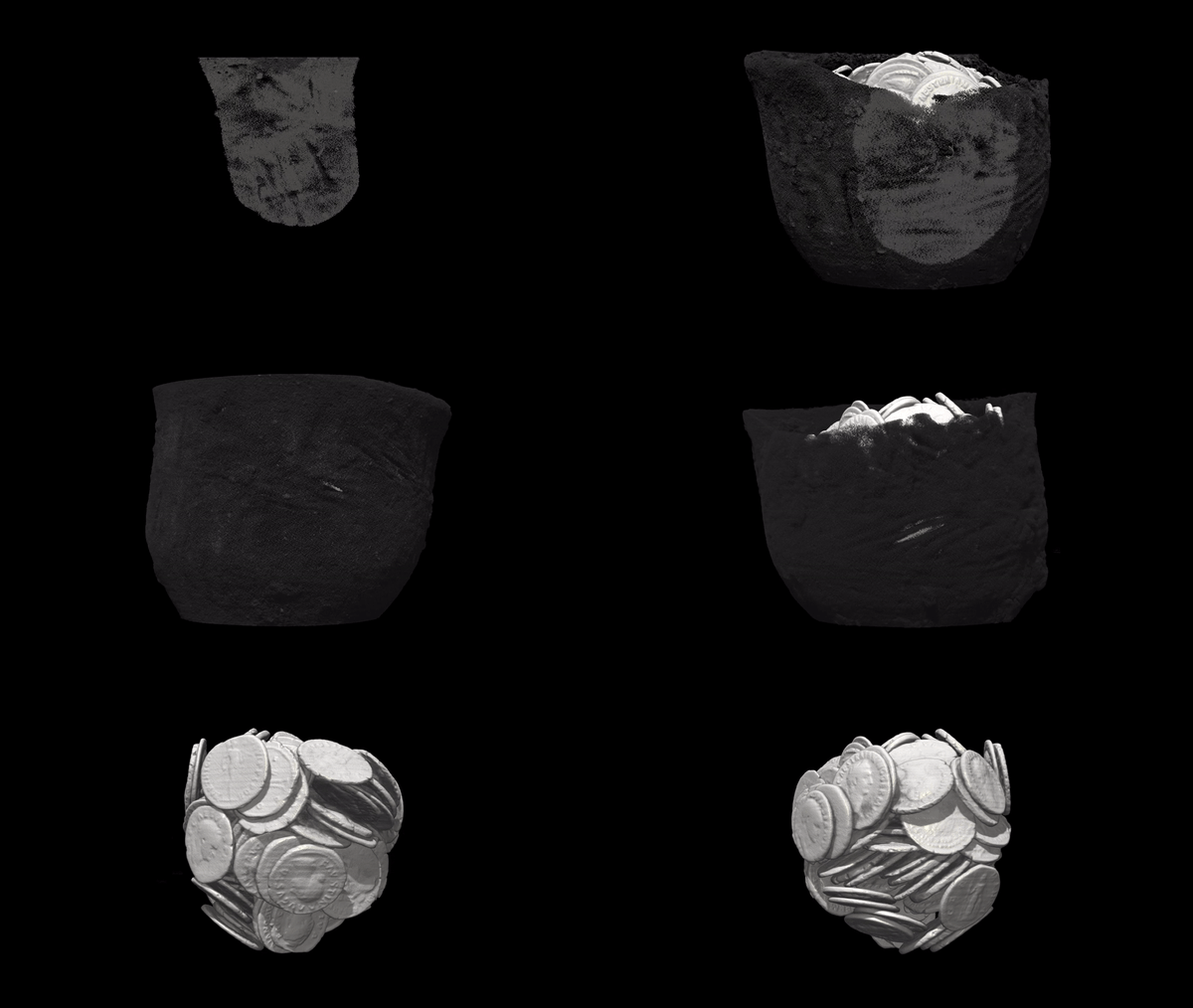
CT Scan of the Selby Coin Hoard. Animation. (Miles et al. 2016). See more images in the slideshow below. (Click to Enlarge)
The first application to be discussed is a coin hoard contained within a pot found in Selby in East Yorkshire, UK (Miles et al. 2016). Typically such coin hoards are excavated by conservators, however, in this case, the hoard was first scanned by means of Computed Tomography, so the results can be compared with its physical excavation that followed. CT scanning allowed not only the identification of the content of the pot, but also the identification of individual coins. It has to be noted, however, that to reach that amount of detail (see images in the slideshow below), longer scanning times are needed as well as targetted scanning of specific areas (rather than the pot as a whole). In addition, in the case of the Selby hoard the 3D models of the individual coins were not in most cases sufficient to read the exact inscriptions on the coins. Therefore, the data obtained by CT scanning were further used in a Virtual Reflectance Transformation Imaging (V-RTI) application (see Lesson 3.3), which can enhance subtle surface details by photographing an object via raking light. This is based on the principle that light from a low angle produces harsh shadows that enhance surface details. In this case, since there was no 'real object' to apply this method to (as the coins were all compacted in the pot), the method was adapted to simulate RTI in a virtual environment. The virtual excavation of such finds allows conservators to know in advance the composition and distribution of materials, therefore, making more efficient and conservation and cleaning process. There may be also cases, where a physical excavation, especially in cases where the material seems to be too fragile, could be avoided.
The eruption of Mount Vesuvius in AD 79 is probably the mos well known volcanic eruption in history, mostly because it buried under tones of ash, lapilli, and mudflow the Roman settlements of Pompeii, Herculaneum, Oplontis and Stabiae. Herculaneum was a wealthy city and as is the case with Pompeii, it was preserved more or less intact. However, in the case of Herculaneum more wooden and organic materials were also preserved as they were carbonised; a characteristic example is the c. 1.800 papyri scrolls unearthed in the Villa of the Papyri in 1752. The scrolls are extremely fragile and therefore unwrapping has not proven easy as in many cases it is equal to destruction. Conventional methods of unwrapping have included immersion in water, pouring mercury and suspension in various gases (Seals et al. 2011, np.) Modern technologies, including X-Ray, Reflectance Transformation Imaging, Multispectral Imaging, and Computed Tomography have proven more powerful that conventional methods, therefore enabling the virtual unwrapping of the scrolls and in certain cases the extraction of text. The latter has been quite challenging since the carbon black inks used for writing have low contrast to the papyrus substrate. In the video below you can watch the application of these methods as part of The Digital Restoration Initiative - Virtual Unwrapping at the College of Engineering of the University of Kentucky.
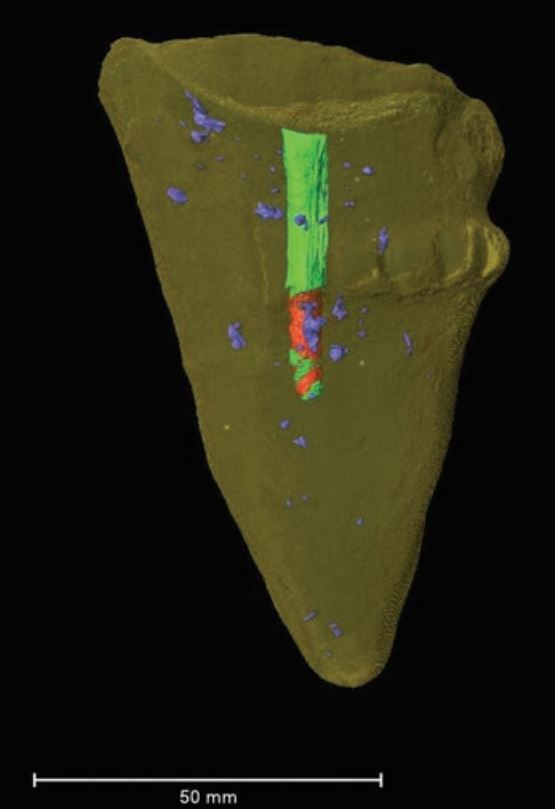
CT Scan of a Koma Figurine. The green and red colours indicate deliberate cavities during the manufacturing process (Insoll et al. 2016). See more images in the slideshow below.
Another interesting case in which Computed Tomography has been applied to is figurines. Figurines are diverse representations of anthropomorphic, zoomorphic, hybrid or abstact entities made of different materials, including clay, stone, ivory, and metal, and produced in a diverse range of temporal and spatial contexts. They have diverse uses and meanings, often interpreted as toys, representations of fertility, used in rituals, but also for healing or magic. Figurines were constructed in many ways, including ceramic joints, moulds, cores made of sticks or reeds, separate pieces joined together etc., and could also be pierced to both help in the firing process but also to be worn, e.g. as pendants. Holes and cavities could also be made to add materials or for libations. One such example comes from Koma Land in northern Ghana (Insoll et al. 2016). The CT scanning of the figurines revealed a series of cavities that were made for a particular purpose. Since not all of them preserve such a feature, researchers think that these were not made to help the firing process or to allow the attachment of additional parts. Although research is still ongoing possible interpretations of these cavities include the offering of libations or to allow the insertion of other materials or substances. At the same time, it cannot be excluded that the cavities were left open to symbolise the internal and the external (Insoll et al. 2016, pp. 29-30).
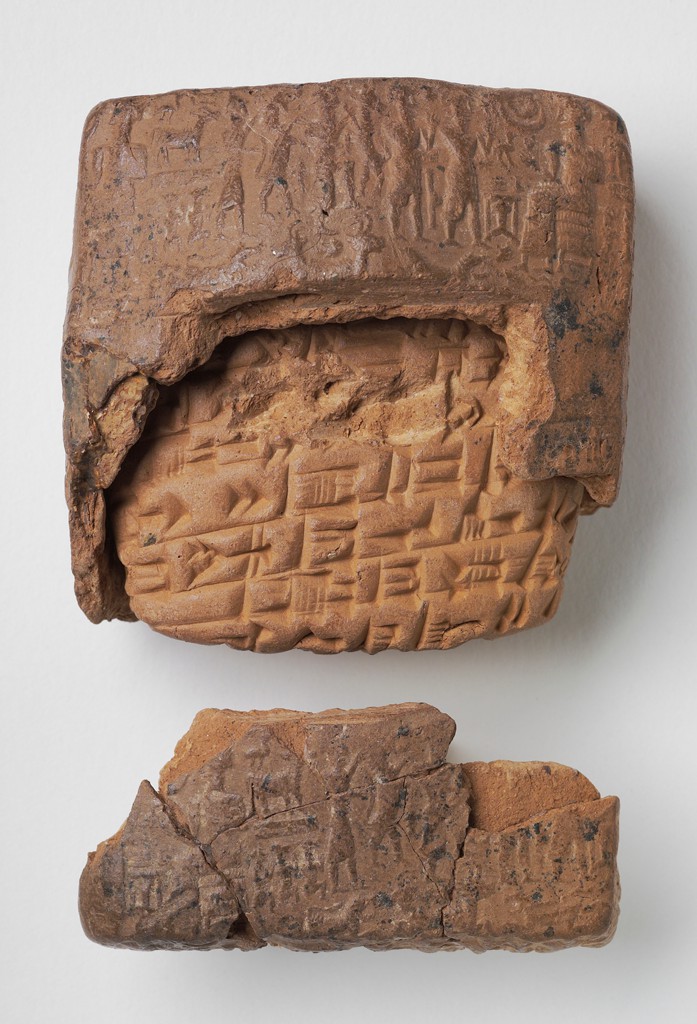
Cuneiform Tablet and Envelope: Old Assyrian Letter. Harvard Art Museums/ Arthur M. Sackler Museum, Gift of Leslie Cheek, Jr. and Purchase through the generosity of Sol Rabin and the Marian H. Phinney Fund. Click Image to enlarge.
Another characteristic example of the application of Computed Tomography to reveal the inner part of cultural heritage objects is the cuneiform tablets. Cuneiform writing is one of the earliest forms of writing invented by Sumerians in ancient Mesopotamia and seems to have started to document everyday transactions, such as livestock. These were inscribed on clay tablets and were then sealed in a clay container; something like a letter and an envelop. The clay envelope also ensured the authenticity of the document since any form of tampering would first require to break the clay envelope. The scribe would also write a shortened version of the letter (i.e. a summary) of the text on the envelop and would also include his seal. Researchers today face a similar problem; In order to read the writing on the letter the clay envelope needs to be broken. As destruction is not considered anymore an appropriate method to study material culture, researchers had to find other ways to get access to the inside without breaking the outside part. Recently, The Netherlands Institute for the Near East (NINO 2018) in collaboration with the Delft University of Technology, applied micro-Computed Tomography scanning to an envelope containing an administrative tablet from the Ur III period (c. 2200-2100 BCE) regarding the receipt of sesame seeds. Rients de Boer, curator at NINO, confirmed thanks to the CT scan that the tablet (letter) has a few more details than the envelope. While the latter informs that 15,280 liters of sesame seeds were delivered, the letter specifies that 11.050 liters were delivered the first time and 4.230 liters the second time. In the video below the results and the interpretation of the CT scan are shown:
The virtual reading of the clay tablet. Video by Dr. Dominique Ngan-Tillard (NINO 2018)
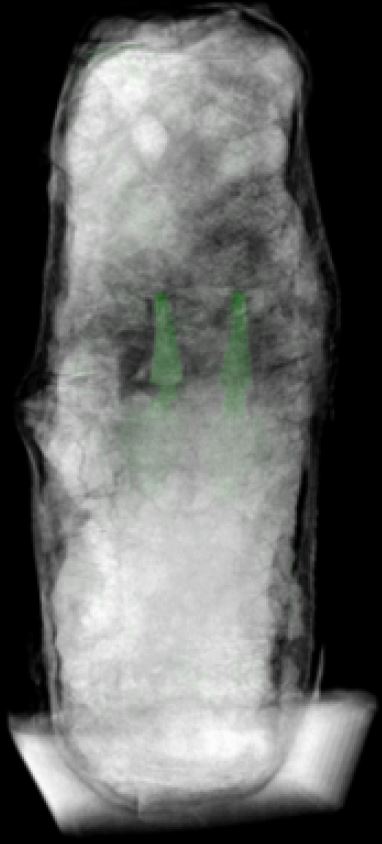
CT Scan of a block of soil containing a bronze belt (Re et al. 2015). Click image to enlarge.
The last example of the application of CT scanning is the virtual excavation of a soil block. In many cases, and due to the pace of an excavation, constraints that may have to do with time, access, and resources, as well as the fragility of finds, it is not uncommon not to complete the excavation of an object on site but in the lab. This is the case especially for fine and fragile items that require special skills and knowledge to be excavated, essentially without destroying them. However, even in cases where a block of soil is removed from the site and transferred to the lab its excavation is a very slow and challenging process since it is not always clear what that block contains, where its contents are located, and how fragile they are. However, such a micro excavation can yield far more results than the process in situ, since small fragments and delicate materials can be preserved and possibly restored. For this reason, a CT application can provide valuable information that can make the recovery and restoration more efficient. An example of that is a 6th-4th c. BCE soil block from the necropolis of Villalfonsina in Chieti (Abruzzo, Italy). The block of soil under discussion included a bronze belt for men, composed of two engraved buckles and a metal belt strap (Re et al. 2015). Thanks to the CT scan, not only the distribution, shape and dimension of artefacts were revealed but also the presence of other non-metal materials (such a leather and bone) as well as some indication about the state of preservation. This also allowed to take preventive conservation measures, thus facilitating the restoration process.
Slide Show:Examples of CT Scanning in Cultural Heritage
Insoll, T., Kankpeyeng, B., and Fraser,S. (2016). Internal Meanings: Computed Tomography Scanning of Koma Figurines from Ghana, African Arts 49:4, 24-33. https://doi.org/10.1162/AFAR_a_00264
Miles, J., Mavrogordato, M., Sinclair, I., Hinton, D., Boardman, R., and Earl, G. (2016). The use of computed tomography for the study of archaeological coins. Journal of Archaeological Science: Reports 6: 35-41. https://doi.org/10.1016/j.jasrep.2016.01.019
Re, A., Corsi, J., Demmelbauer, M. et al. X-ray tomography of a soil block: a useful tool for the restoration of archaeological finds, Heritage Science 3(4). https://doi.org/10.1186/s40494-015-0033-6
Seales, W. B., Griffioen, J., Baumann, R., & Field, M. (2011). Analysis of Herculaneum papyri with x-ray computed tomography. In International Conference on non-destructive investigations and microanalysis for the diagnostics and conservation of cultural and environmental heritage (ART 2011), 13-15 April 2011, Florence, Italy (Art 2011). https://www.ndt.net/article/art2011/papers/FIELD%20-%20M%2014.pdf



 Slide Show: Examples of CT Scanning in Cultural Heritage
 Quiz: CT Scanning in Cultural Heritage