

2.2 3D Scanning: Potential and Challenges
This unit covers one of the methods for 3D recording; laser scanning. It will discuss the different types of 3D scanning and will explore through examples and case studies the potential and challenges of the method.
2.2.3 3D Scanning Uses and Limitations
 |
Uses of 3D Scanning in Heritage
On 15th April 2019, the fire at Notre-Dame Cathedral in Paris destroyed large part of the monument including the building's spire, roof and upper wall. A fundraising for its restoration was quickly launched while a new new tat passed a few months later stated that the restoration must preserve its historic, artistic and architectural interest. Among others, 3D scanning technology was presented in the media as a way to accurately restore the cathedral. More specifically, the art historian, Andrew Tallon, who was fascinated by Gothic architecture, used 3D scanning to capture many Cathedrals in the United States and Europe in an attempt not only to get to know better the elements of the architecture that cannot be accessed (unless you fly-over, use a scaffolding etc.) but also to better understand that making of the monument and the decisions of the builders. Interestingly enough the laser scan data have revealed interesting facets of the builders' process. For example, it has become evident that neither all the interior columns nor some of the aisles line up because the workers built them around existing structures. His scans also revealed that the Gallery of Kings (a row of 28 statues of French Kings) was leaning forward and to the north by about 0,3 metres. This was because, when it was being built the ground was not stable; as a result the construction had to stop for about a decade (and that's why art historians have identified stylistic changes) until the ground was stabilised (Hartigan Shea 2019). In the video below you can watch Tallon's brief interview at the National Geographic during the scanning of the National Cathedral in Washington, D.C.|
Art historian Andrew Tallon uses 3D laser scanning to explore the building techniques |
With the above example it becomes clear that 3D laser scanning can be used not only for the production of visually appealing 3D models or to provide access and assist in restoration processes, but that it can also be used for research including structural and morphometric analysis. Similarly to the example of Notre-Dam in which 3D scans enabled the observation of structural anomalies, 3D scanning has also been effectively used for smaller objects. For example, Tolksdorf, Elburg, and Reuter (2017), used the method to record Roman coins from different archaeological sites that bear the countermark of Publius Quinctilius Varus and use the models to perform morphometrical and use-wear analysis to trace the movements of Varus and his legions. New insights were also revealed based on the laser scanned data of Stonehenge (Abbott 2012). Careful examination of the 1mm 3D dataset revealed previously unidentified marks on the stones' surface, such as tool marks from the original shaping of the stones from the Neolithic period. Also, by using a combination of techniques on the 3D data, some 700 surface features were identified of which more than half were never recorded before, including Bronze Age Axe carvings. Airborne applications of laser scanning also allow, apart a bird's eye view of a larger area, the application of computational algorithms to exaggerate details, and thus enabling the identification of previously unrecorded features. Larger scale projects such as the Scottish Ten and CyArk (see case study on the next page) as well as 3D Icons (Corns et al. 2017) have also been producing a significant amount of 3D data for cultural heritage objects and sites, aiming at both long-term preservation as well as the repurposing of the models for educational purposes. For example, 3D-ICONS Ireland (part of the 3D ICONS European consortium) has used the 'Discovery Programme's Sketchfab account dedicated Sketchfab account (also see unit 4.3) to make the models available to the public and enhance them with annotations. Some of the models have also been used in primary and secondary education, where students created physical or 3D printed replicas and used them to study the objects/sites that typically are only included in their curriculum in the form of static representations.
 Image Slider: Check the slides below for some characteristic 3D laser scanning applications in Cultural Heritage
 The application of laser scanning in cultural heritage is often selected as the preferred method when a very quick and accurate collections of data is needed, for example in cases where there is limited access to a site or object and when the scanned structures are fragile. Also, if the collected data are to be used in analysis that requires highly accurate data, e.g. to diagnose a building's condition, 3D scanning is often the preferred method. Complexity is also a key factor for utilising 3D scanning. Although photogrammetry has proven to be an efficient and accurate method, in cases where there are very high structures at various levels, complex internal and external layouts and niches, laser scanning can produce a point cloud more efficiently. Although this would also be possible via photogrammetry, since the method is based on images, this would entail taking hundreds or thousands of images, trying to ensure that all necessary areas have been captured; in addition extremely long processing time and computational power would be required to process the image dataset.
Limitations of laser scanning
 |
|
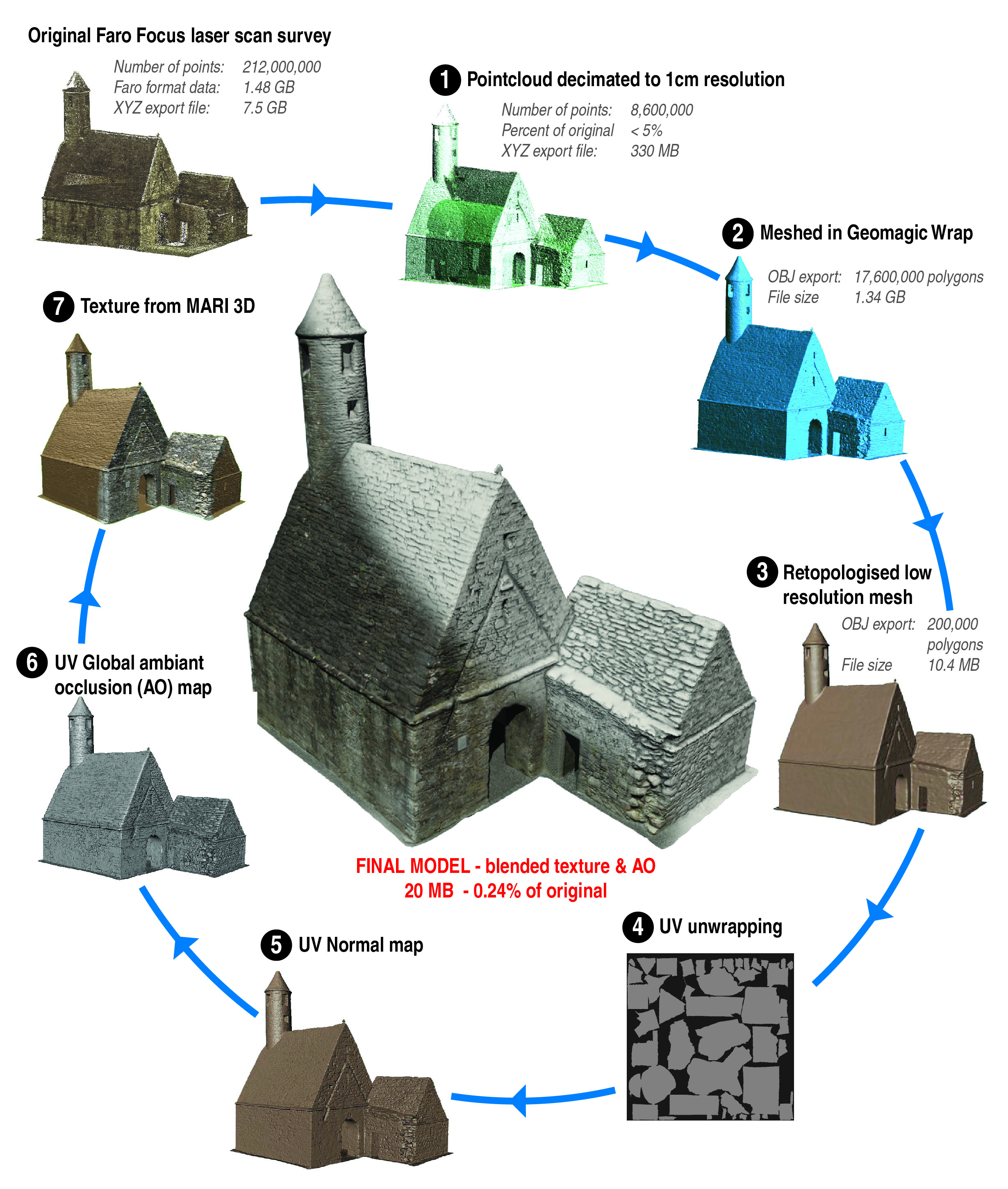
3D scanning workflow developed by the 3D-Icons project to create a lightweight 3D model based on high quality survey data. Click image to enlarge. Source: Corns, A. et al. 2017 3D-ICONS Ireland – fulfilling the potential of a rich 3D resource, Internet Archaeology 43. https://doi.org/10.11141/ia.43.12 |
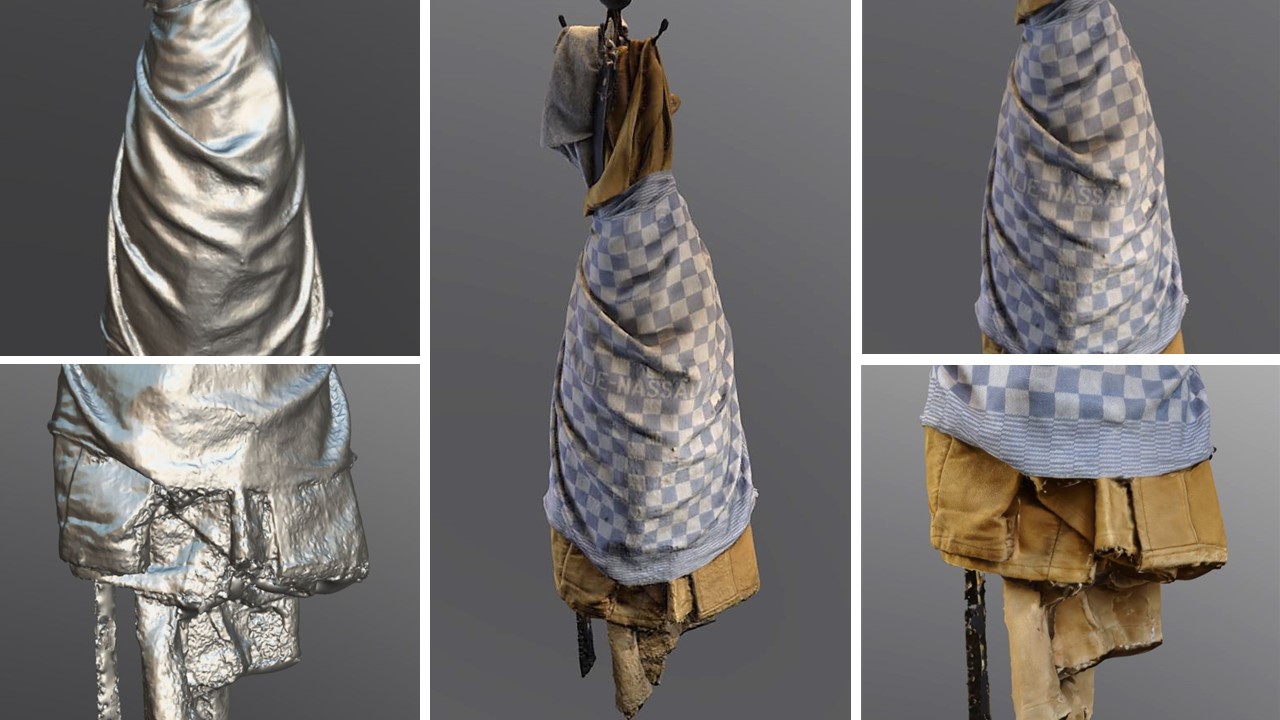
It should also not be underestimated that 3D scanners do not work well for very reflective or black surfaces (this is because the emitted laser bounces off these surfaces in angles that do not allow the device to accurately estimate the object's position). Lastly, as 3D scanners are mostly designed to capture accurate geometric detail, they often do not include a system (i.e. a camera) to capture colour information in high resolution. Therefore, the texture of the 3D models is typically of lower quality than the geometric detail that scanners can capture. In many cases, a digital camera can be used to capture images of higher quality, which then can be wrapped on the object by using a post-processing software. It should be noted, however, that image wrapping can be deceiving in terms of the quality of the model. For example, in the image on the right, where a 3D model of a clothes hanger from the Mijnmuseum in Heerlen (Netherlands) is shown, the image wrapping covers the geometry problems (noise and less detail). Therefore, 3D models should always be inspected not only for their texturing but also for their geometric detail.
 |
|
Comparison between the geometric detail and the texture of a 3D model of a clothes hanger from the mijnmuseum, Heerlen in The Netherlands. (Click to enlarge the figure) |
 Exercise: Find the Words in the grid that describe the powers and limitations of 3D laser scanning
References
- Abbott, M. (2012). Visualising Stonehenge: A virtual archaeology. In Arnold, D., Kaminski, J., Niccolucci, F. and Stork, A. (eds), International Symposium on Virtual Reality, Archaeology and Intelligent Cultural Heritage. The Eurographics Association. http://dx.doi.org/10.2312/PE/VAST/VAST12S/001-004
- Corns, A. et al. (2017). 3D-ICONS Ireland – fulfilling the potential of a rich 3D resource, Internet Archaeology 43. https://doi.org/10.11141/ia.43.12
- Hartigan Shea, R. (2019). Historian uses lasers to unlock mysteries of Gothic cathedrals. National Geographic, 16th April 2019. https://www.nationalgeographic.com/news/2015/06/150622-andrew-tallon-notre-dame-cathedral-laser-scan-art-history-medieval-gothic/
- Shaw, R. (2018). Twenty-five years of Technology Change: Surveying and Visualising in 3D in the Discovery Programme. In Discovery Programme Reports 9, A Research Miscellany, pp. 129-146. The Discovery Programme. https://www.researchgate.net/publication/326776460_Twenty-five_years_of_technology_change_surveying_and_visualising_in_3D_in_the_Discovery_Programme
- Tolksdorf, JF, Elburg, R., Reuter, T. (2017). Can 3D scanning of countermarks on Roman coins help to reconstruct the movement of Varus and his legion. Journal of Archaeological Science Reports 11, 400–410. https://doi.org/10.1016/j.jasrep.2016.12.005