

3.2 Understanding How Cameras Work
3.2.1 From the World to the Sensor
 |
 |
|
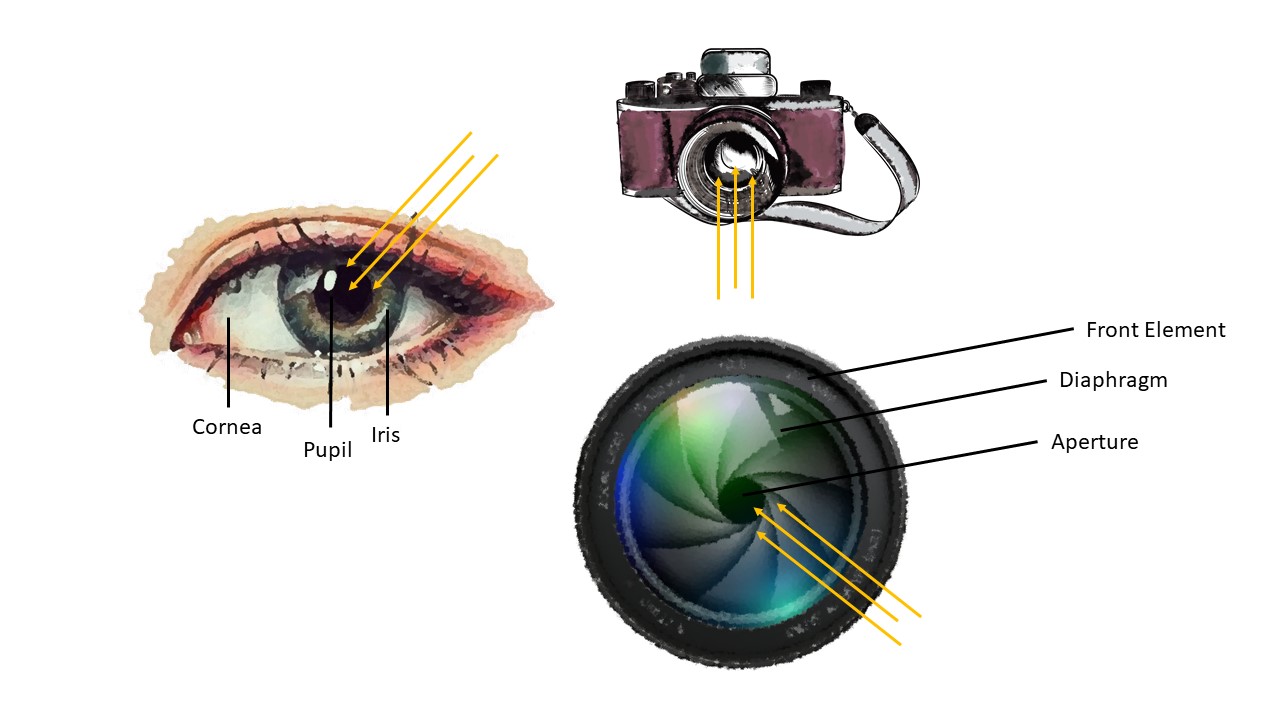
A comparison between a camera and the human eye |
To understand how cameras work, it is worth looking at the human eye. Although we will look at more technical parameters in the following pages, here we will only explore some very basic mechanisms of the cameras. The easier way to start is by comparing a camera with the human eye.
Our cornea directs light to the Pupil. Our Iris shrinks or expands to control the size of the Pupil, and as a result, the amount of light that will enter through the eye. A large Pupil means that more light will go through contrary to a smaller pupil that limits the amount of light that reaches our inner eye. Cameras are designed in a similar way. The Front Element of the lens directs light to the centre. Similarly to the Pupil, cameras control the amount of light through the so-called Aperture, which becomes larger or smaller depending on the Diaphragm, similarly to how our Iris determines the size of our Pupil. Therefore, the diaphragm blocks the light, which can only enter through the aperture; the larger the aperture, the more light enters the camera.
Once light enters our eyes, the initial processing of light patterns starts at the Retina, a light-sensitive tissue at the back of the eye, which is layered with neurons. The photoreceptor cells, which are divided into two main categories, i.e. rod cells and cone cells, are the neurons responsible for converting photons into electrical signals that stimulate a series of biological processes in the brain. Cone shells function in bright light and are responsible for colour vision, since they contain photopigments that are sensitive to red, green and blue colour respectively. Rod cells on the other hand, respond to dim light, while they contain only one type of photopigment, and as a result, they do not mediate colour vision. A similar process is followed once light has entered the camera.
 |
|
A comparison between a camera and the human eye (click to enlarge the figure) |
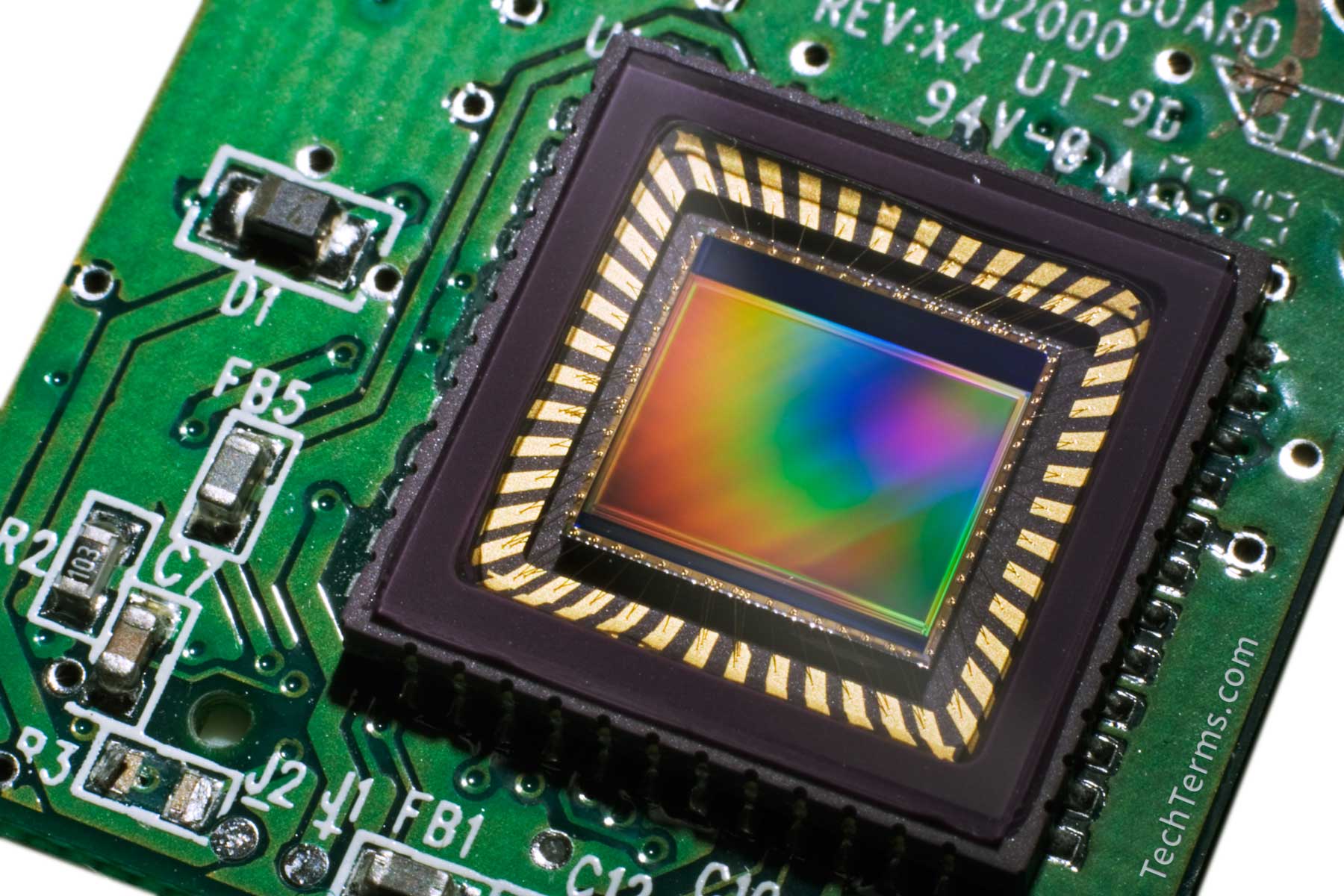
After the shutter of the camera has been pressed, each of these cells start collecting photons. Once the exposure has been completed, each cell measures the amount of photons that were collected and turns them into a digital value, the so-called bit depth, that quantifies how many unique colors are available in an image. However, each pixel can only capture one of the three colours to which the human eye is sensitive, Red (R), Green (G), Blue (B). Most CMOS sensors employ a grid of coloured filters, called the Bayer Filter, thus having each pixel admit only one of the three colours. A Bayer filter has more green than red and blue filters since the human eye is more sensitive to green light. These filters are positioned on the sensor using a mathematical formula that the camera can then use to translate the information from each pixel into the final image. This process is called demosaicing.
 |
|
Bayer Filter (Wikipedia) |
Further Readings/Additional Resources
- VisionDirect 2019. An Interactive Guide about how the human eye works. https://www.visiondirect.co.uk/the-human-eye
- How do digital cameras work? | James May Q&A | Head Squeeze: https://youtu.be/Ic0czeUJrGE